12 Best Upsell Apps for Shopify to Boost AOV in 2025
Discover the top 12 upsell and cross-sell apps for Shopify that can help maximize your average order value. This comprehensive guide compares features, pricing, pros and cons, with practical tips to boost your revenue in 2025.
By The SaaS Hub Team · 2025-11-06
12 Best Upsell Apps for Shopify to Boost AOV in 2025
Driving traffic to your Shopify store is only half the battle. Once customers arrive, the real work begins: maximizing the value of every single order. A successful ecommerce strategy isn't just about attracting new buyers; it’s about increasing the average order value (AOV) of the customers you already have. This is where strategic upselling and cross-selling become critical revenue levers. Implementing the right upsell offer at the right moment can transform a standard purchase into a significantly more profitable one, turning a one-item shopper into a brand enthusiast.
But with hundreds of options on the Shopify App Store, choosing the right tool can be overwhelming. Do you need pre-purchase offers, in-cart recommendations, or post-purchase one-click upsells? Each serves a different strategic purpose, from bundling complementary items to recovering abandoned carts with a compelling last-minute deal. A poorly implemented app can slow down your site, disrupt the checkout experience, and ultimately cost you sales. Finding the best upsell apps for Shopify requires a clear understanding of your specific goals, whether it's boosting AOV, improving conversion rates, or increasing customer lifetime value.
This guide cuts through the noise. We’ve curated and analyzed the top 12 upsell and cross-sell apps, providing a comprehensive resource to help you make an informed decision. For each app, you’ll find:
- A concise summary of its core function.
- Key features and practical use-case examples.
- An honest look at its pros and cons.
- Transparent pricing information and plan limitations.
- Direct links and screenshots to see the app in action.
Our goal is simple: to equip you with the detailed insights needed to select the perfect upsell app that aligns with your store’s unique needs and helps you unlock significant new revenue streams.
1. Shopify App Store — Upsell & Cross-sell Category
While not a single app, the official Shopify App Store’s Upsell & Cross-sell category is the essential starting point for any merchant. It aggregates hundreds of verified solutions, providing the safest and most comprehensive directory for finding the best upsell apps for Shopify. Think of it as the foundational research tool before committing to a specific platform. Its direct integration with the Shopify admin ensures that reviews are from real users and install counts are accurate, offering a layer of trust you won't find elsewhere.
This platform stands out by allowing merchants to filter and compare apps based on critical criteria. You can quickly narrow your search by pricing models (free, paid, usage-based), specific funnel stages like in-cart or post-purchase, and even curated collections like "Built for Shopify" staff picks. This granular control turns a potentially overwhelming search into a manageable shortlisting process.
Practical Tips for Effective Use
A smart strategy is to use the comparison feature for your top three or four contenders. This side-by-side view highlights differences in pricing tiers, key features, and recent review trends. For real insight, don’t just look at the overall rating; read the most recent negative reviews to understand potential pain points or recent bugs. For example, you might discover one app recently pushed an update that conflicts with a popular theme, saving you hours of troubleshooting. For a more expansive view of available software beyond just this category, you can explore detailed comparisons of various Shopify apps on external platforms.
Pros & Cons
- Pros:
- Safest Source: Direct integration with Shopify ensures app legitimacy and security.
- Powerful Filters: Easily narrow down hundreds of options by price, features, and funnel stage.
- Verified Reviews: Ratings and reviews are from actual store owners.
- Cons:
- Information Overload: The sheer volume of apps can be overwhelming without a clear strategy.
- Brief Descriptions: App descriptions are often marketing-focused; deeper investigation is always required.
2. Zipify OneClickUpsell (OCU)
Developed by the ecommerce experts behind the popular Zipify Pages, OneClickUpsell (OCU) is a comprehensive funnel-building tool designed to maximize average order value at every customer touchpoint. It goes beyond simple popups, offering a suite of integrated upsell opportunities that work together seamlessly. Its main strength lies in its powerful post-purchase, one-click offer engine, allowing customers to add items to their order after they've already paid, without re-entering payment details.
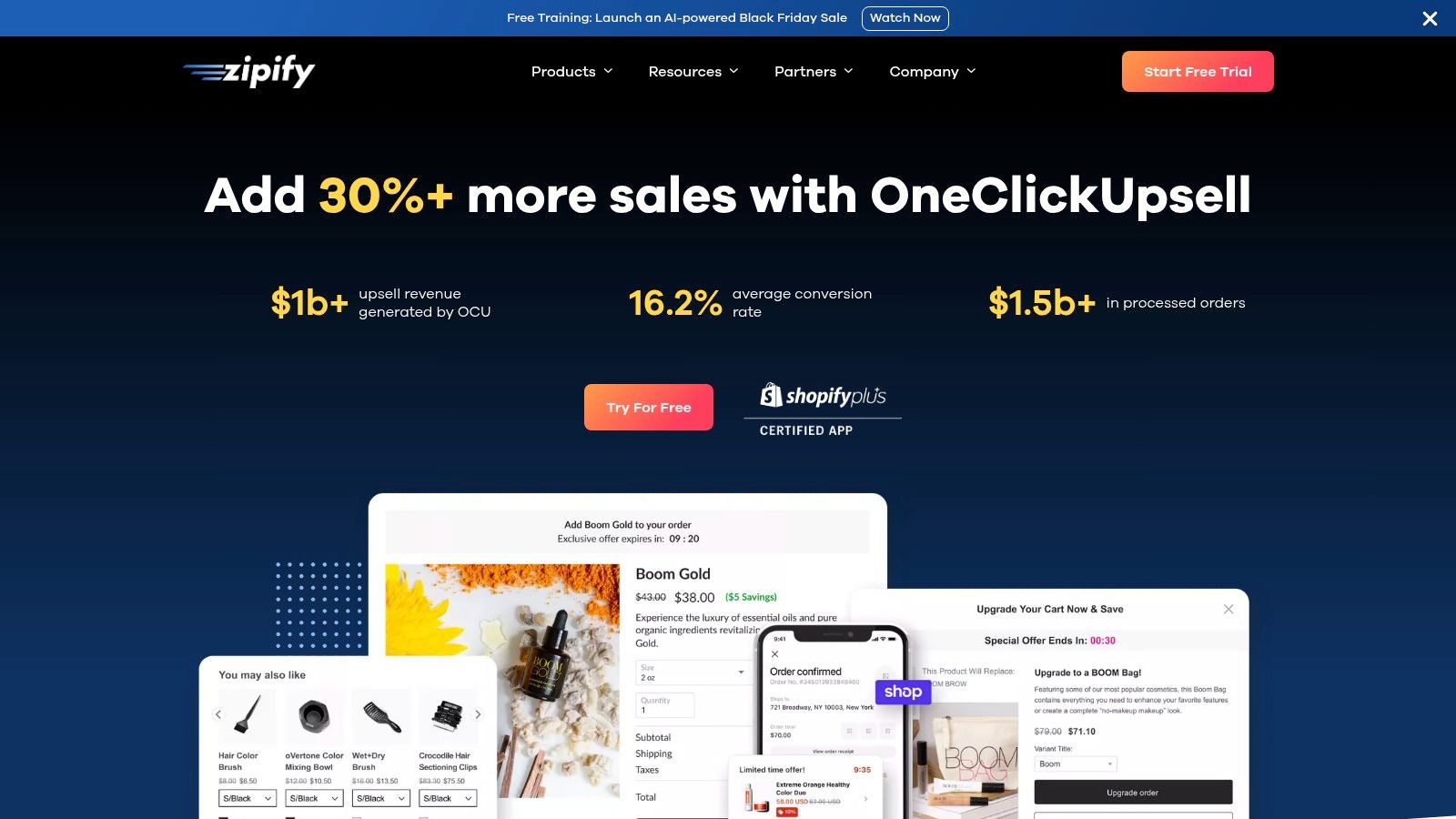
What makes OCU one of the best upsell apps for Shopify is its full-funnel approach. You can engage customers with pre-purchase upsells, show complementary items in the cart drawer, and then present a high-converting post-purchase sequence. For Shopify Plus merchants, OCU offers native in-checkout upsells, creating a frictionless experience right on the checkout page. The platform also includes robust A/B testing, allowing you to optimize offers for maximum revenue lift.
Practical Tips for Effective Use
Start by focusing on your post-purchase funnel, as it's OCU's strongest feature. A great real-world strategy is to create a tiered offer sequence: a primary upsell, followed by a downsell if the first is declined, and then a final "thank you page" offer. For example, if a customer buys a coffee maker, your first post-purchase upsell could be a premium coffee bean subscription (high-value). If they decline, the downsell could be a more affordable milk frother (lower price point, still relevant), ensuring you still capture additional revenue. This sequence maximizes the opportunity from a single transaction.
Pros & Cons
- Pros:
- Full-Funnel Solution: Covers pre-purchase, in-cart, and post-purchase upsells in a single app.
- Powerful Post-Purchase Engine: Frictionless one-click offers significantly boost AOV.
- Built-in A/B Testing: Data-driven tools to optimize your funnels for better performance.
- Cons:
- Shopify Plus Requirement: In-checkout upsells, a key feature, are exclusive to Shopify Plus stores.
- Can Be Complex: The extensive feature set may have a steeper learning curve for beginners.
3. ReConvert (Upsell.com)
ReConvert offers a comprehensive suite of tools designed to create end-to-end upsell funnels that engage customers at every crucial touchpoint. It excels in delivering a cohesive experience from the product page through the cart, checkout, and most notably, the post-purchase thank-you page. This full-funnel approach allows merchants to consistently maximize average order value without disrupting the initial purchase flow.
This app stands out by integrating AI-powered product recommendations with robust A/B testing and customer segmentation. This means you can automatically display the most relevant offers to specific customer groups and test which funnels convert best. With deep integrations into Shopify Checkout, Flow, and popular review apps, ReConvert becomes a central hub for conversion optimization, making it one of the best upsell apps for Shopify merchants focused on data-driven growth.
Practical Tips for Effective Use
Start by focusing on the post-purchase thank-you page, as this is ReConvert's core strength and a low-risk place to add one-click offers. A practical example is to use the drag-and-drop editor to add a time-sensitive offer for a complementary product (e.g., shoe cleaner for a new pair of sneakers) alongside a request for a product review. Once that's optimized, expand into checkout upsells, but be sure to A/B test a version with and without the offer to ensure it doesn't negatively impact your primary conversion rate. To broaden your understanding of this space, you can explore various marketing and conversion tools for more insights.
Pros & Cons
- Pros:
- Low Entry Cost: The initial pricing tier is very accessible for new and small stores.
- Full-Funnel Coverage: Manages upsells from product pages to post-purchase thank-you pages.
- Strong Integrations: Works seamlessly with Shopify Checkout, Flow, and other essential apps.
- Cons:
- Scalable Costs: Fees can increase significantly as your order volume or upsell revenue grows.
- Checkout Customization Limits: Advanced checkout modifications may require a Shopify Plus plan.
4. AfterSell
AfterSell specializes in maximizing profit from every completed transaction by focusing heavily on the post-purchase experience. It allows merchants to present one-click upsell and downsell offers immediately after a customer checks out but before they reach the thank-you page. This timing is critical, as it captures buyers when their purchase intent is highest, without adding friction to the initial checkout process.
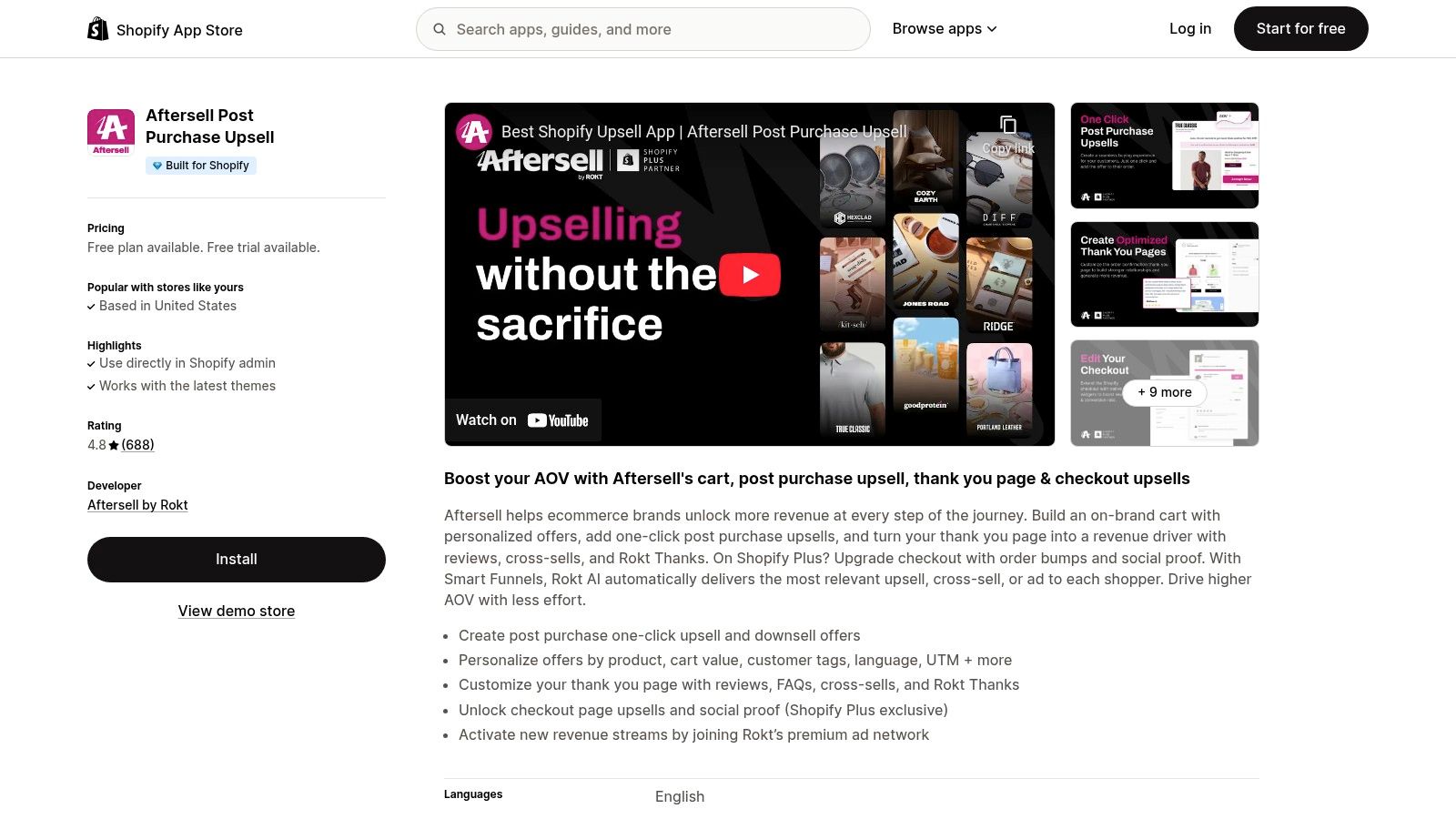
The platform stands out with its powerful "Smart Funnels" feature, which uses AI to analyze customer behavior and automatically display the most relevant upsell offer. This data-driven approach removes the guesswork from offer creation. Additionally, AfterSell allows for extensive customization of the thank-you page, turning what is often a dead end into another opportunity for sales, surveys, or customer engagement. For Shopify Plus merchants, AfterSell extends its functionality to include native in-checkout upsells.
Practical Tips for Effective Use
Start by using AfterSell’s A/B testing on your post-purchase funnels. Pit a static offer (like your most popular accessory) against a Smart Funnel to see which performs better. For example, if you sell coffee, you could test an offer for a specific mug against an AI-driven offer that might suggest a different coffee blend based on the customer's purchase. Also, a key insight is to use the thank-you page editor to add a time-sensitive discount code for a future purchase. This not only encourages repeat business but also helps measure the long-term value of your upsell strategy.
Pros & Cons
- Pros:
- Post-Purchase Focus: Captures high-intent buyers without disrupting the original checkout flow.
- AI-Powered Funnels: Smart Funnels automatically optimize offers to increase conversion rates.
- Clean and Simple Pricing: The pricing model is transparent and based on your store's order volume.
- Cons:
- Shopify Plus Dependency: Native in-checkout offers are only available for Shopify Plus stores.
- Scaled Pricing: Costs increase as your monthly order volume grows, which may affect smaller margins.
5. Rebuy Personalization Engine
Rebuy elevates upselling from a simple tactic to a comprehensive, AI-driven personalization strategy. It moves beyond basic "if-then" rules by analyzing customer behavior to deliver hyper-relevant product recommendations across the entire buying journey, from the cart and checkout to post-purchase thank you pages. This positions it as one of the best upsell apps for Shopify for stores ready to scale with data-backed intelligence.
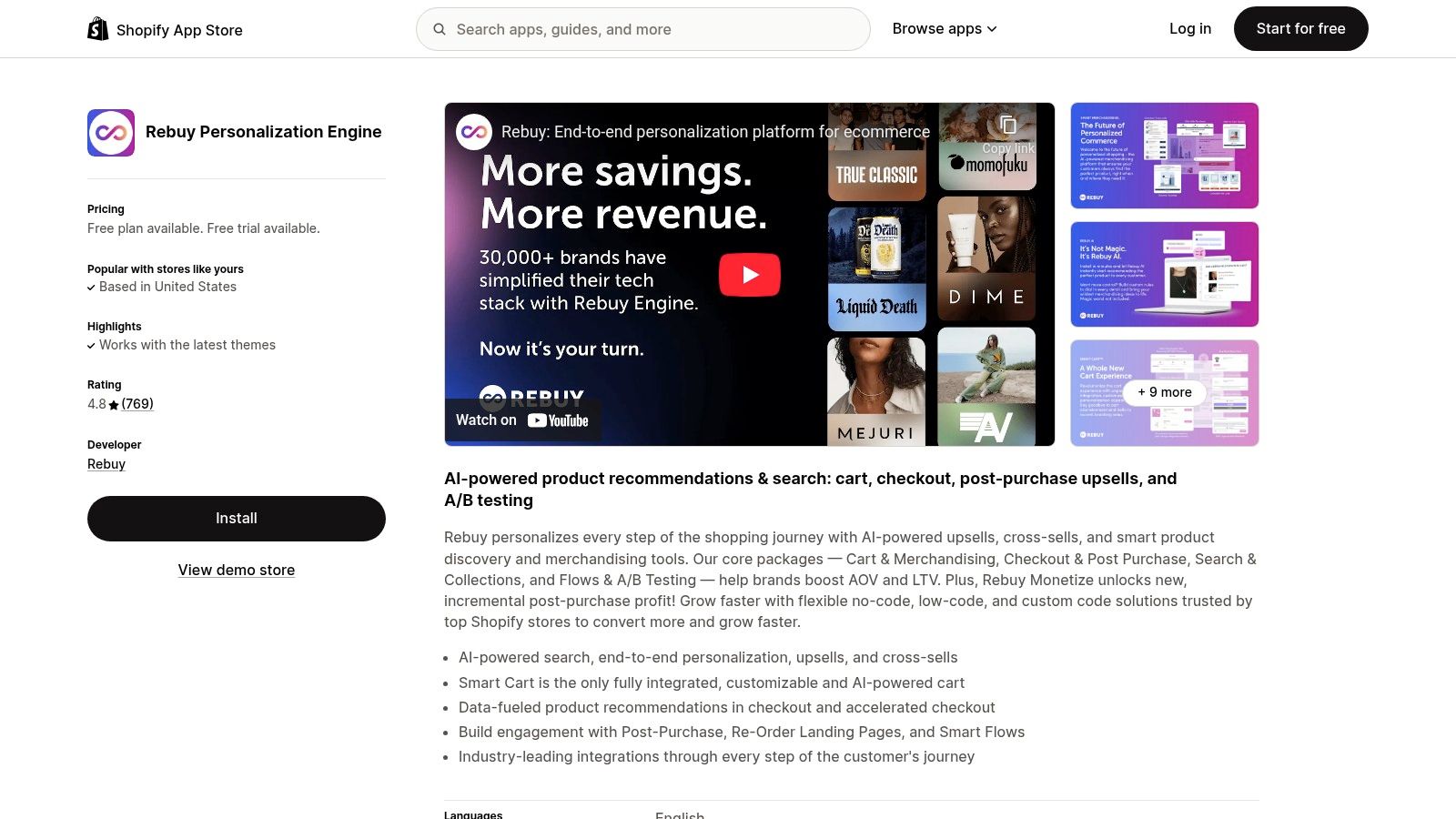
The platform’s strength lies in its modular, à-la-carte packaging. Merchants can choose specific tools like Smart Cart, Checkout & Post-Purchase, or even an A/B testing suite, allowing them to invest only in the functionality they need. Its powerful AI engine can dynamically adjust offers based on cart contents, order history, and site-wide trends, creating a truly one-to-one shopping experience that drives higher average order values.
Practical Tips for Effective Use
Start by implementing Rebuy's Smart Cart to replace your standard cart drawer. A powerful practical example is for a skincare brand: if a customer adds a facial cleanser, the Smart Cart can instantly recommend the matching toner and moisturizer, creating a full-routine bundle with a single click. The real insight here is to apply a small "bundle and save" discount that only appears when all three items are added, creating a powerful psychological incentive to complete the set. For a deeper dive into how such tools impact repeat business, you can explore strategies for improving customer retention.
Pros & Cons
- Pros:
- Powerful Personalization: AI-driven recommendations across the entire customer journey.
- Enterprise-Friendly: Modular pricing and robust features cater to high-growth brands.
- A/B Testing: Built-in capabilities to test and optimize upsell strategies.
- Cons:
- Potential High Cost: Pricing scales with order volume and can become expensive.
- Complex Configuration: More involved to set up than single-purpose upsell apps.
6. Honeycomb Upsell & Cross-Sell (Conversion Bear)
Developed by Conversion Bear, Honeycomb Upsell & Cross-Sell focuses on creating a comprehensive funnel experience that engages customers at multiple touchpoints. The app allows merchants to deploy upsell and cross-sell offers on product pages, within the cart, and, most importantly, on the post-purchase and thank-you pages. This full-funnel approach makes it one of the best upsell apps for Shopify if you want a single tool to manage offers across the entire buying journey.
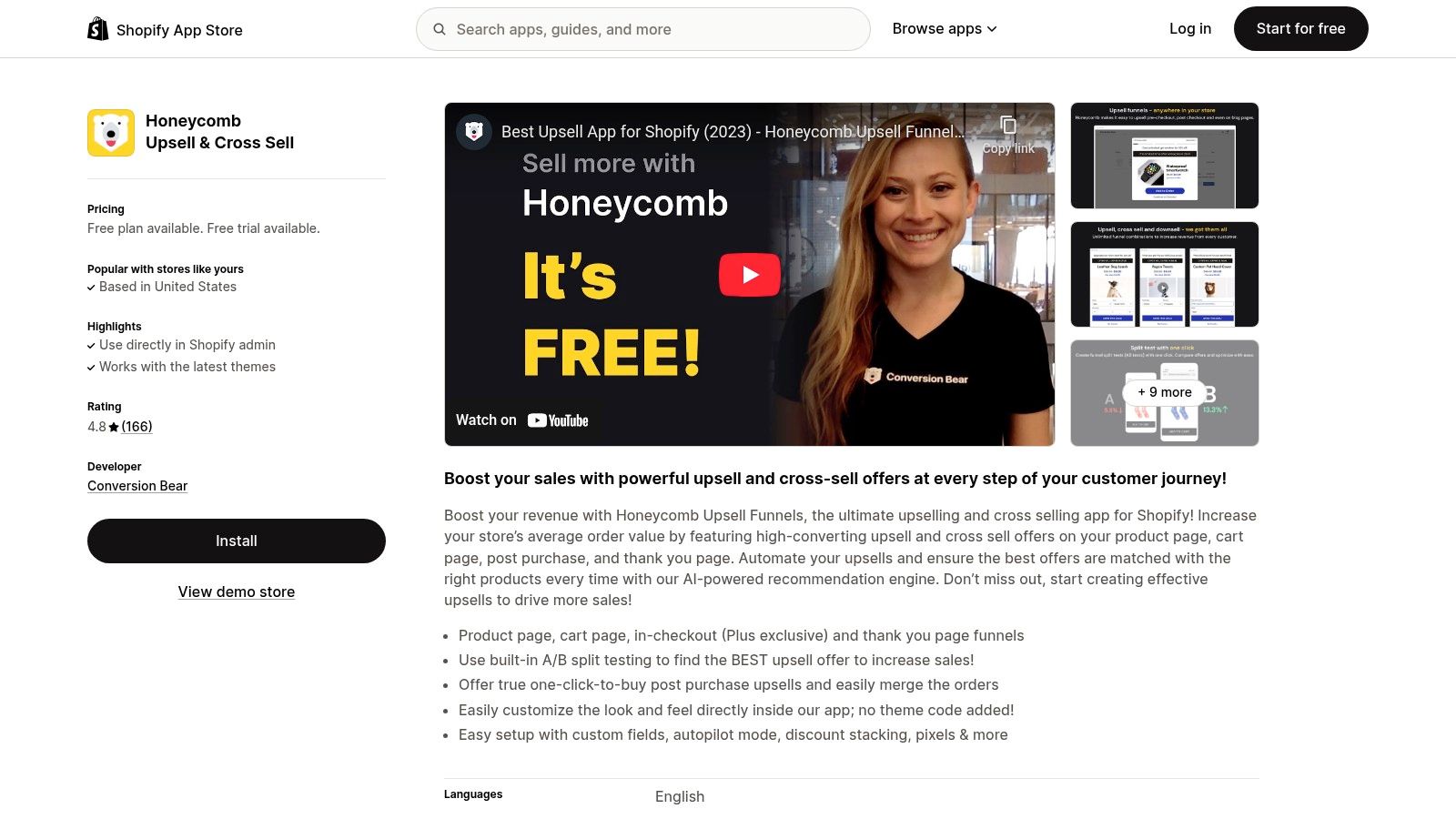
What makes Honeycomb stand out is its blend of user-friendly funnel building with powerful optimization features like AI-powered product recommendations and A/B testing. This allows even novice users to test different offers and let the app's algorithm automatically prioritize the highest-converting options. Its one-click post-purchase upsells are particularly effective, as they don't require customers to re-enter payment information, dramatically reducing friction and boosting average order value.
Practical Tips for Effective Use
Start by A/B testing two distinct post-purchase offers for your best-selling product. For a real-world example, a store selling phone cases could test offering a screen protector (complementary product) against offering a second, different-colored case at a 50% discount (volume offer). Let the test run until it reaches statistical significance to gain a clear insight into your customers' buying psychology. Then, roll out the winning offer type across similar products. Use the thank-you page upsell as a final, lower-cost offer to capture any remaining buyer intent.
Pros & Cons
- Pros:
- Full-Funnel Coverage: Manages offers on product, cart, post-purchase, and thank-you pages in one app.
- Built-in Optimization: Includes A/B split testing and AI recommendations to improve performance.
- Responsive Support: Known for its US-based developer presence and helpful customer service.
- Cons:
- View-Based Pricing: Costs are tied to the number of funnel views, which can become expensive for high-traffic stores.
- Short Trial Period: The 7-day free trial is shorter than many competitors, offering less time for evaluation.
7. In Cart Upsell & Cross-Sell
In Cart Upsell & Cross-Sell by Identified Technologies focuses on maximizing order value at critical conversion points: the product page and the shopping cart. It excels at presenting targeted, non-intrusive offers directly within the user’s shopping flow, preventing the disruptions that can lead to cart abandonment. This app is a strong contender for merchants who need robust in-cart and post-purchase solutions backed by intelligent automation.
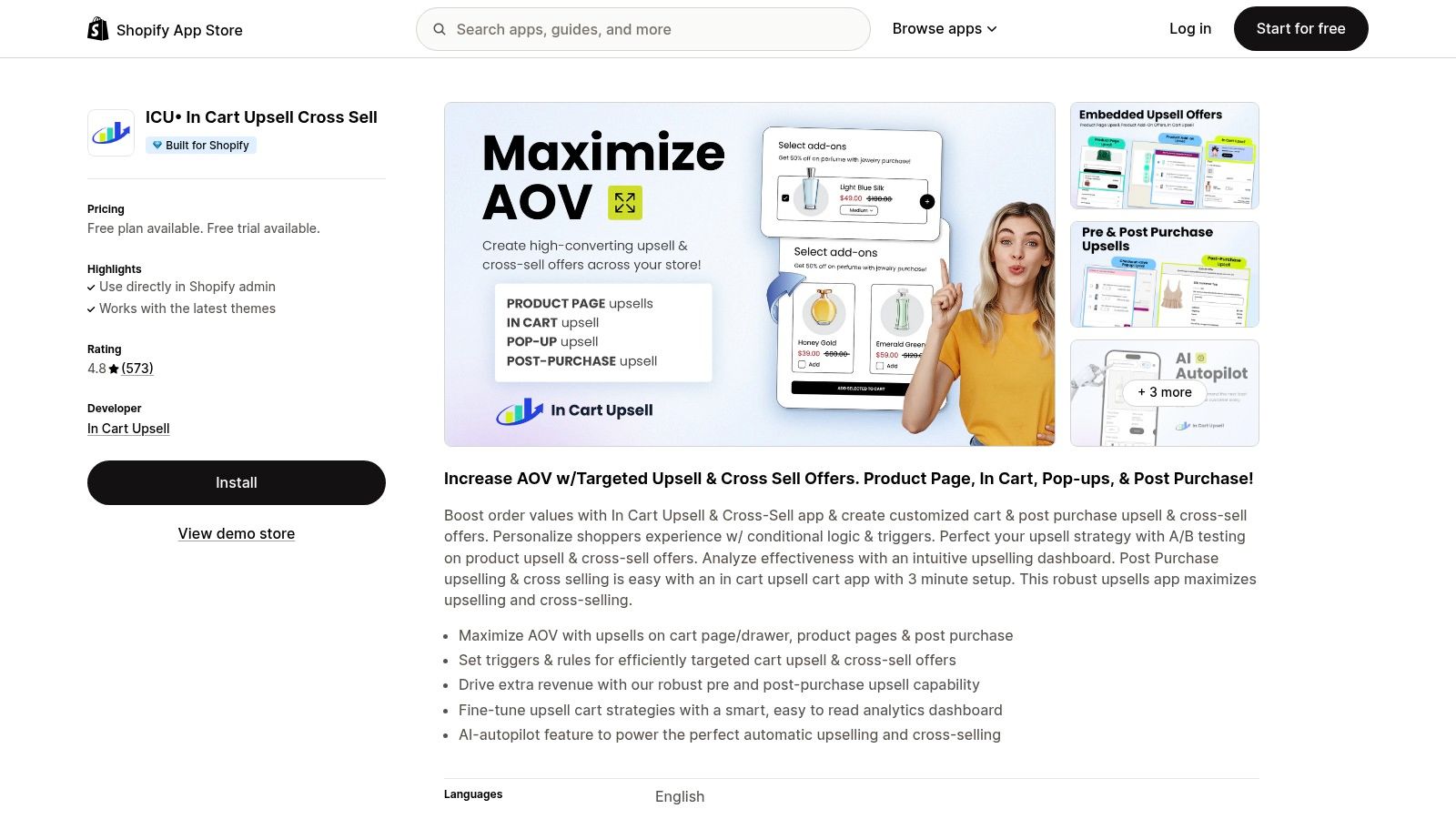
The platform stands out with its AI-powered "Autopilot" feature, which automatically selects the most relevant products to upsell based on user behavior, simplifying campaign management. It also offers advanced targeting and A/B testing, allowing store owners to scientifically optimize their offers. For instance, you can test a "buy one, get one 50% off" offer against a simple product recommendation to see which drives a higher conversion rate for specific customer segments.
Practical Tips for Effective Use
Take full advantage of the concierge onboarding service offered on paid plans. This team can help you set up your initial campaigns based on your store's specific data and goals, ensuring you start on the right foot. For a practical insight, use the conditional logic to create hyper-targeted campaigns. For example, you can display a specific cross-sell (like a premium travel case) only when the cart value exceeds $75 and contains a product from the "Electronics" collection. This level of targeting feels helpful to the customer, not just promotional.
Pros & Cons
- Pros:
- Unlimited Offers: All paid plans allow for unlimited offers and orders, providing excellent scalability.
- Concierge Onboarding: Personalized setup assistance helps accelerate ROI.
- AI Autopilot: Simplifies the process of selecting the most effective upsell products.
- Cons:
- Branding on Free Plan: The free tier is limited to one upsell and includes app branding.
- Plan-Based Feature Gaps: Access to advanced features like post-purchase upsells is tied to higher-tier Shopify plans.
8. UFE Cross Sell & Upsell Bundle (Helixo)
UFE (Upsell Funnel Engine) by Helixo is a performance-focused app designed for creating effective pre-purchase upsells and cross-sells. It specializes in lightweight, fast-loading widgets like "Frequently Bought Together" bundles and quantity breaks directly on product and cart pages. Its primary strength lies in its simplicity and generous free plan, making it an excellent starting point for new stores or those with lower order volumes looking to increase their average order value without initial investment.
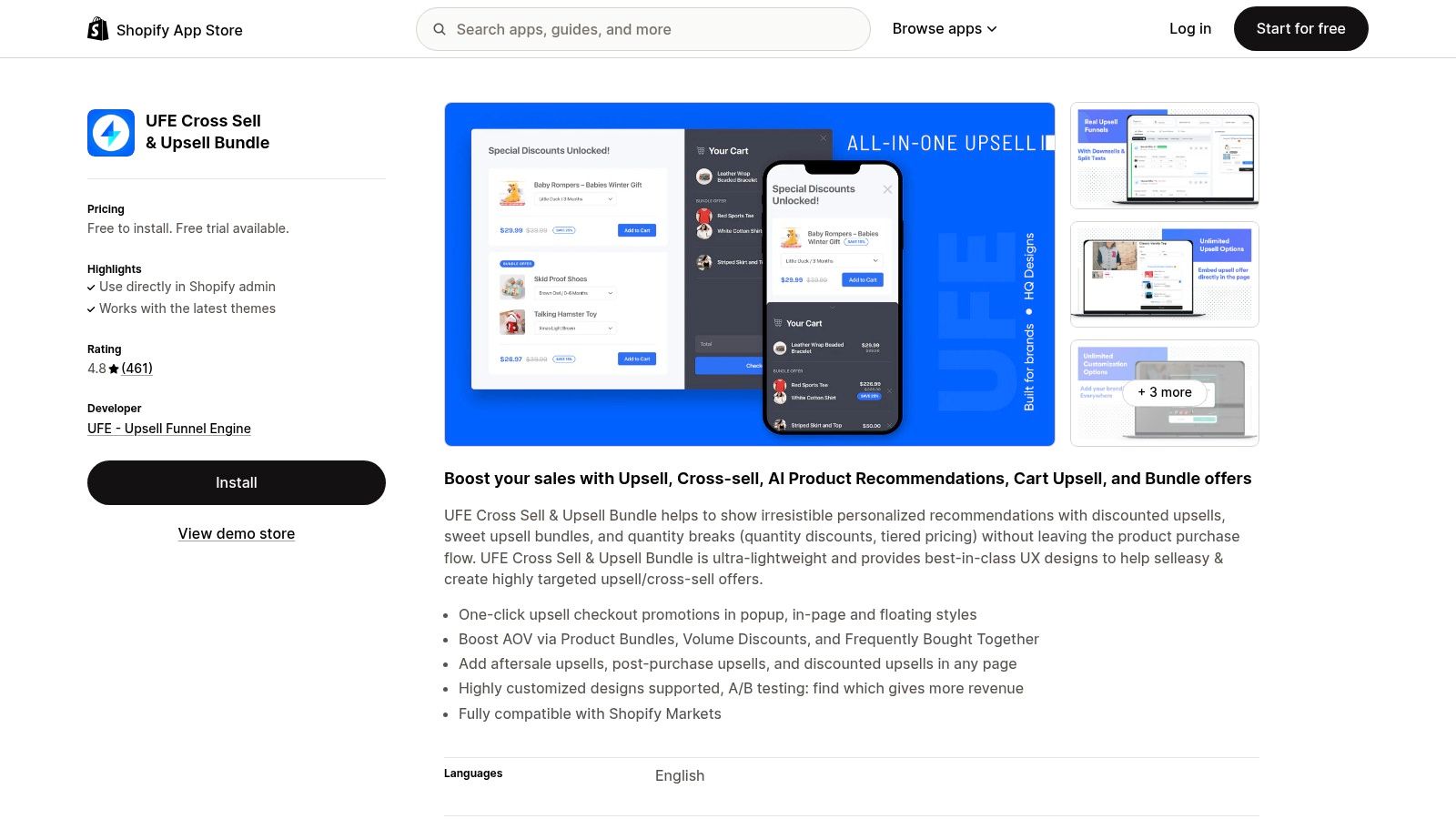
The platform stands out by taking a no-commission approach across all its plans, including the free tier which supports up to 50 orders per month. This means all revenue generated from your upsells is entirely yours. As you scale, paid tiers unlock advanced features like AI-powered recommendations, offer scheduling with countdown timers, and A/B testing to optimize conversion rates, providing a clear growth path within the same ecosystem.
Practical Tips for Effective Use
Start by implementing the "Frequently Bought Together" widget on your top-selling products. Use your own order data to manually curate the initial bundles for maximum relevance. For example, if you sell coffee beans, bundle them with paper filters and a popular branded mug. The real insight is to check your Shopify analytics for products that are *actually* purchased together often—this data-driven approach is far more effective than just guessing. As you upgrade, leverage the AI recommendations feature but continue to monitor its performance against your manually curated bundles.
Pros & Cons
- Pros:
- Generous Free Plan: Free for up to 50 orders per month with no commission fees.
- Performance-Focused: Designed to be lightweight and fast, minimizing impact on site speed.
- Simple Setup: The user interface is intuitive, allowing for quick creation of upsell widgets.
- Cons:
- Limited Post-Purchase: The app's core strength is pre-purchase; it lacks robust one-click post-purchase upsell functionality.
- Order-Based Pricing: The cost can increase quickly as your store's order volume grows.
9. Frequently Bought Together (Code Black Belt)
Inspired by Amazon's iconic product bundling feature, Frequently Bought Together by Code Black Belt brings that same powerful, conversion-focused experience directly to your Shopify store. This app specializes in one thing and does it exceptionally well: creating AI-driven or manually curated product bundles on the product page. It allows customers to add a logical group of items to their cart with a single click, instantly boosting the average order value with a proven, intuitive interface.
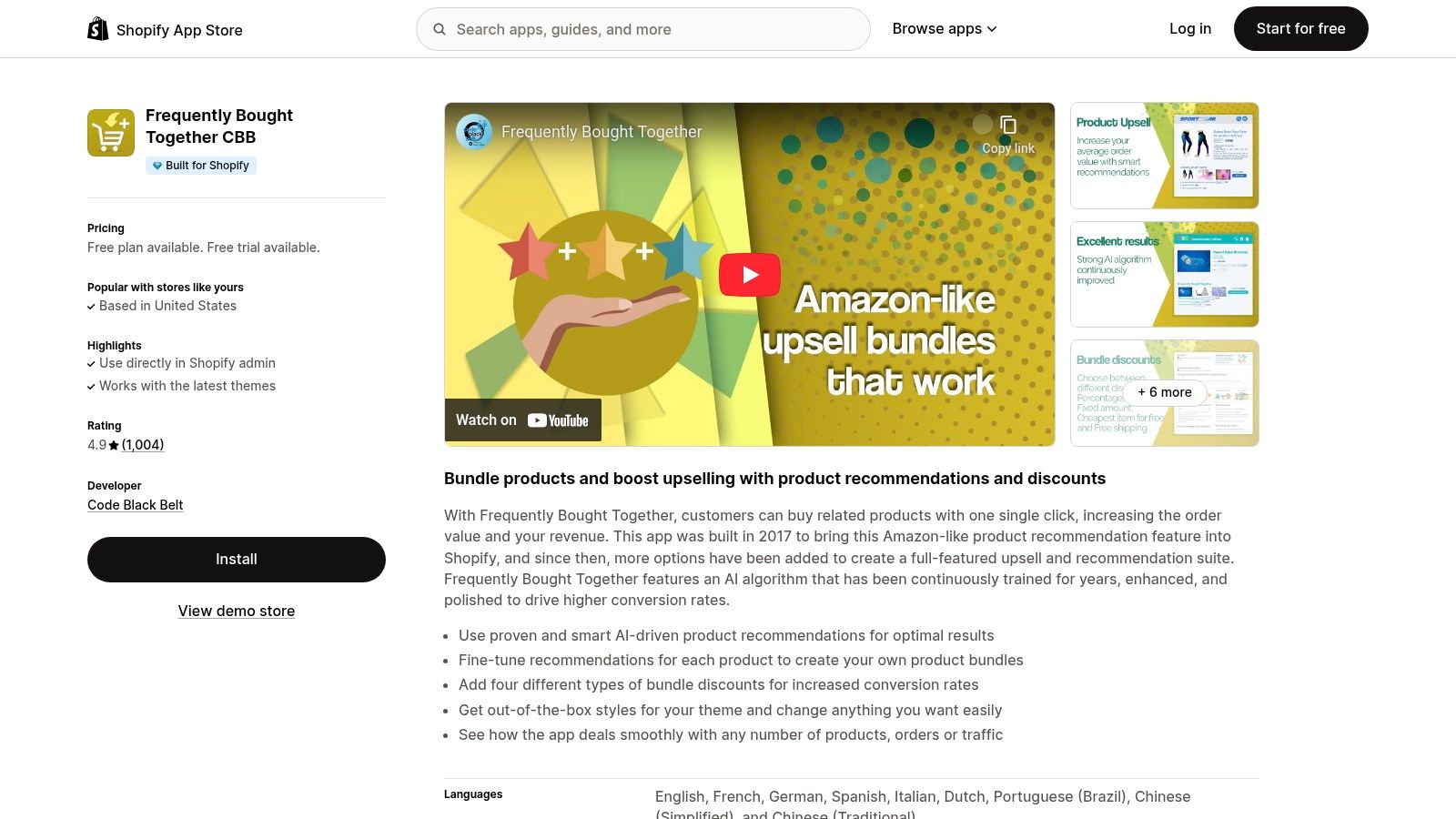
What makes this one of the best upsell apps for Shopify is its simplicity and focus. Unlike complex funnel builders, its setup is straightforward and its impact is immediate. The app’s AI analyzes past purchase data to automatically recommend relevant products to bundle, but merchants retain full control to override these suggestions and create custom bundles. This flexibility is perfect for promoting new arrivals, clearing out specific inventory, or creating kits like a "Beginner's Skincare Set" or a "Complete Grilling Kit".
Practical Tips for Effective Use
For new stores without historical sales data, start by manually creating logical bundles. Pair a coffee maker with a specific brand of filters and a popular bag of beans, then apply a small percentage discount to incentivize the purchase. A key insight is to name your bundle to sell the outcome, for example: "The Perfect Morning Coffee Kit." As your store grows, switch to the AI recommendations but periodically review their performance. The app integrates with major review platforms, so ensure your bundled products all have strong social proof displayed to maximize trust and conversion rates.
Pros & Cons
- Pros:
- Simple & Effective: Replicates a familiar, high-converting feature with minimal setup.
- Predictable Pricing: Offers a flat monthly fee, making it easy to budget for.
- AI-Powered: Smart recommendations save time and leverage sales data for better accuracy.
- Cons:
- Limited Scope: Primarily focuses on product page bundles, lacking post-purchase or checkout upsell features.
- Basic Analytics: Lacks the in-depth A/B testing and analytics of more comprehensive suite apps.
10. Bold AI Upsell & Cross-Sell
Bold AI Upsell & Cross-Sell is a mature and powerful solution known for its AI-driven personalization across the entire customer journey. It offers a comprehensive suite of tools, including product page, cart, post-purchase, and even subscription upsells, making it a versatile choice for established brands. Its long-standing reputation in the ecosystem provides enterprise-level credibility and a feature set that has been refined over many years.
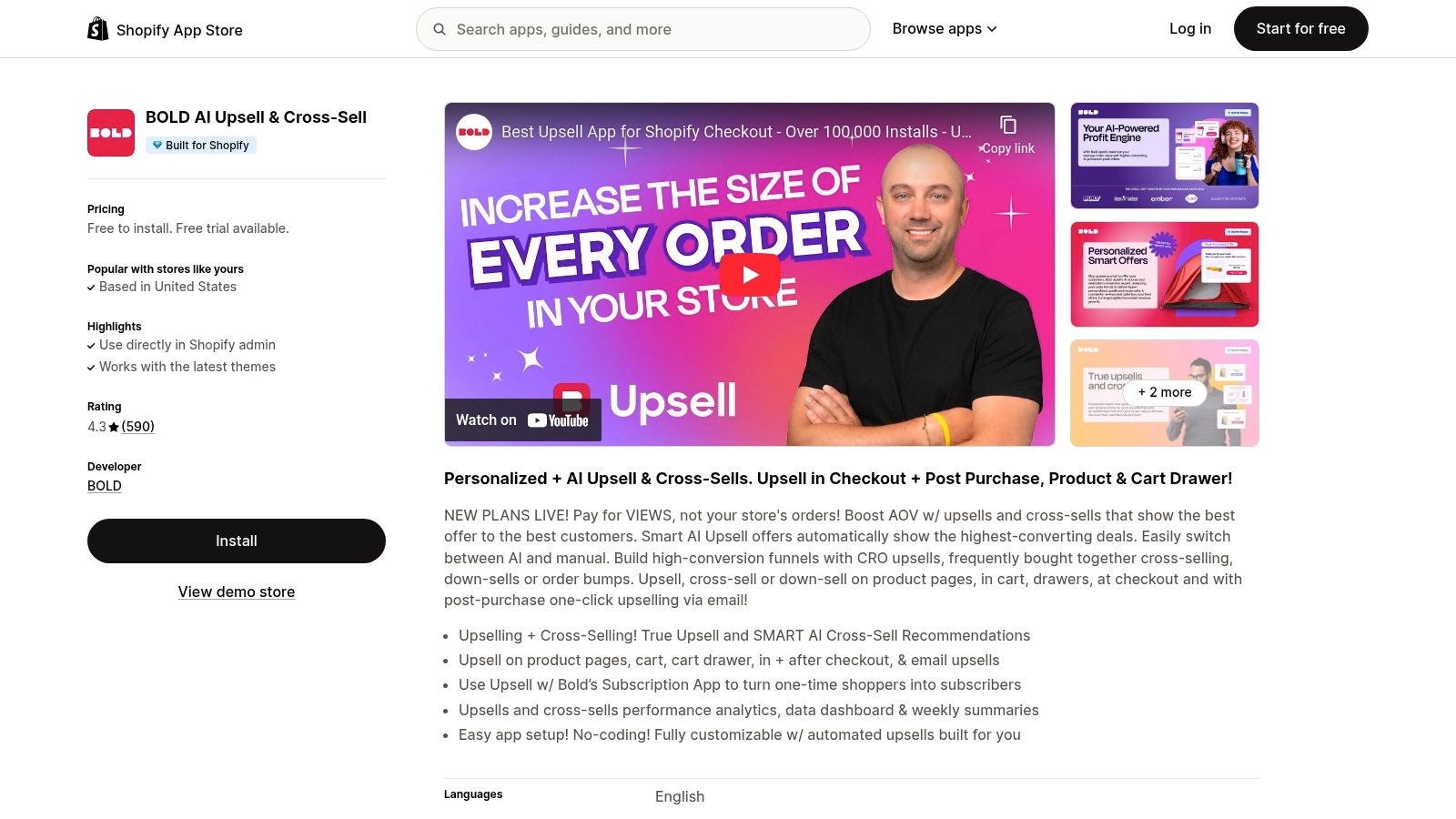
The platform’s key differentiator is its AI engine, which analyzes customer behavior to recommend the most relevant products, moving beyond simple rule-based logic. This makes it one of the best upsell apps for Shopify stores aiming to automate and optimize their offer strategy. For Shopify Plus merchants, Bold offers exclusive in-checkout upsells, providing a final, high-converting opportunity to increase order value before payment. The unique "SmartFlex" pricing is based on offer views, which can be beneficial for stores with lower traffic.
Practical Tips for Effective Use
To maximize Bold's AI, start by letting it run for a period to gather data before making manual adjustments. Use the A/B testing feature to compare the AI's recommendations against your own curated "if-then" upsell rules. For example, you could test an AI-powered "Frequently Bought Together" bundle on a product page against a hand-picked cross-sell you believe is a perfect match. This allows you to see if the machine learning algorithm outperforms your own merchandising instincts—a crucial insight for scaling your strategy without manual effort.
Pros & Cons
- Pros:
- Mature Feature Set: Comprehensive tools with enterprise credibility and advanced reporting.
- Powerful AI: Automates personalized recommendations across multiple funnel stages.
- Flexible Pricing: The view-based model can be very cost-effective for stores with low but high-converting traffic.
- Cons:
- View-Based Pricing Risk: Costs can escalate quickly if your store experiences a sudden traffic spike, even if conversions don't follow.
- Potential Complexity: The extensive feature set may have a steeper learning curve for new merchants.
11. CartHook Upsells
CartHook Upsells is a specialized tool that focuses exclusively on maximizing average order value through post-purchase, one-click offers. By presenting upsells on the thank you page after the initial transaction is complete, it eliminates friction, as customers don't need to re-enter payment details. This single-minded focus makes it one of the most effective and easily implemented solutions for boosting revenue from existing sales.
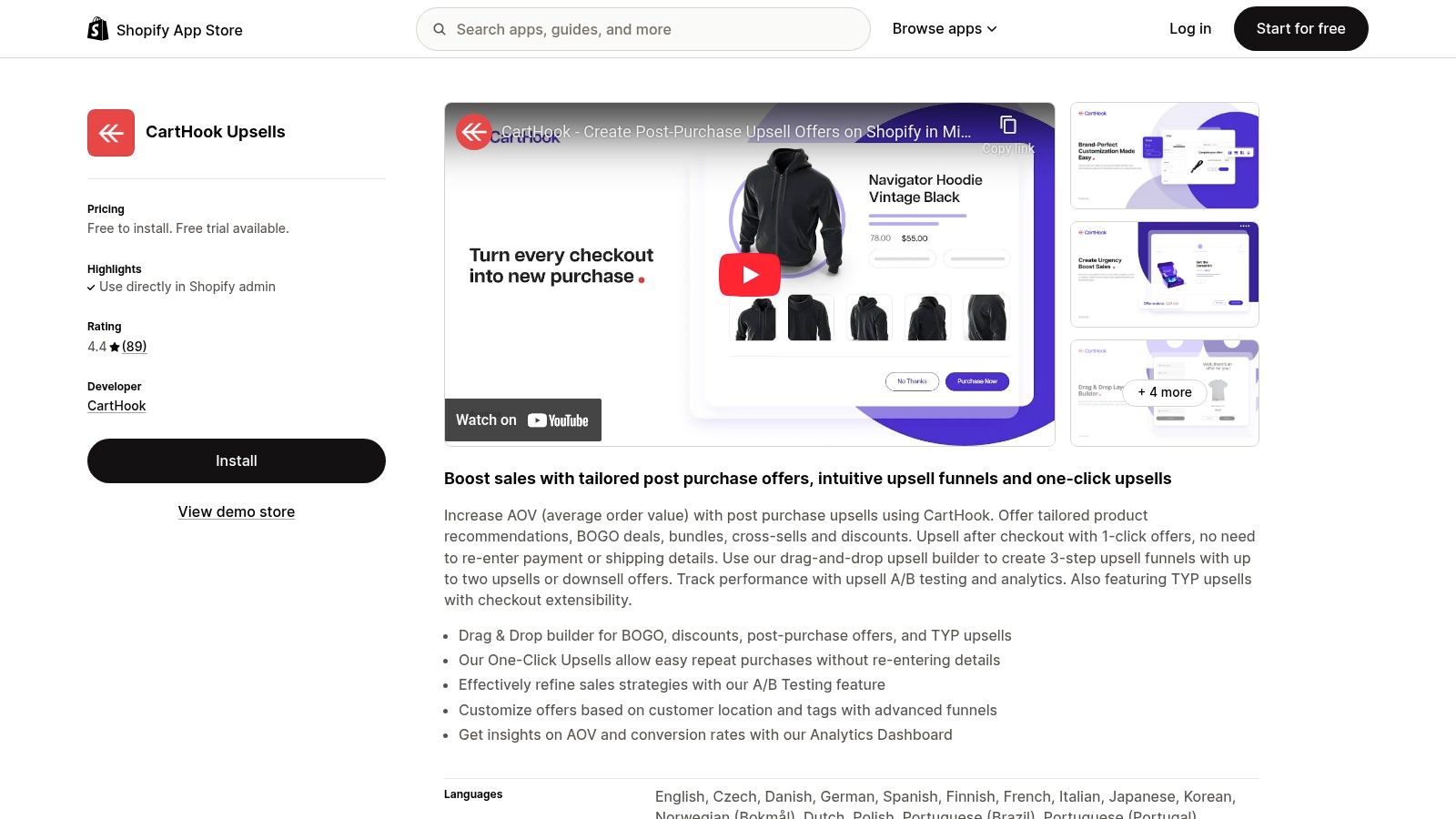
The platform stands out with its intuitive drag-and-drop funnel builder, allowing merchants to quickly construct a sequence of up to two offers (upsells or downsells). This simplicity, combined with robust A/B testing and analytics, provides clear insights into which offers resonate most with customers. Features like geo-targeting and customer-tag targeting also enable highly personalized post-purchase flows, further increasing conversion rates.
Practical Tips for Effective Use
A powerful strategy with CartHook is to create a funnel that offers a complementary product as the first upsell. For example, if a customer buys a coffee maker, offer a bag of premium coffee beans. If they decline, use the downsell slot to offer a less expensive but still relevant item, like a set of coffee filters. This ensures you capture additional revenue without being overly aggressive. A key insight is to use A/B testing to compare a product upsell versus a subscription upsell (e.g., offering one bag of coffee vs. a monthly coffee subscription at a discount) to see which drives higher lifetime value.
Pros & Cons
- Pros:
- Proven AOV Lift: Its post-purchase focus is a highly effective, low-friction method for increasing revenue.
- Simple Funnel Builder: The drag-and-drop editor and A/B testing make optimization straightforward.
- One-Click Acceptance: No need for customers to re-enter payment information, leading to higher conversion rates.
- Cons:
- Revenue-Share Fees: Lower-tier plans include revenue-sharing fees that can add up as your upsell revenue grows.
- Post-Purchase Only: Lacks pre-purchase or in-cart upsell features found in more comprehensive suites.
12. UpCart — Cart Drawer & Cart Upsell
UpCart specializes in optimizing one of the most critical yet often overlooked stages of the customer journey: the cart. Instead of a standard cart page, it replaces it with an interactive, customizable slide-out cart drawer. This tool is designed to increase Average Order Value (AOV) by presenting targeted upsells, add-ons, and rewards directly within the cart, capturing a customer’s attention before they even think about checking out.
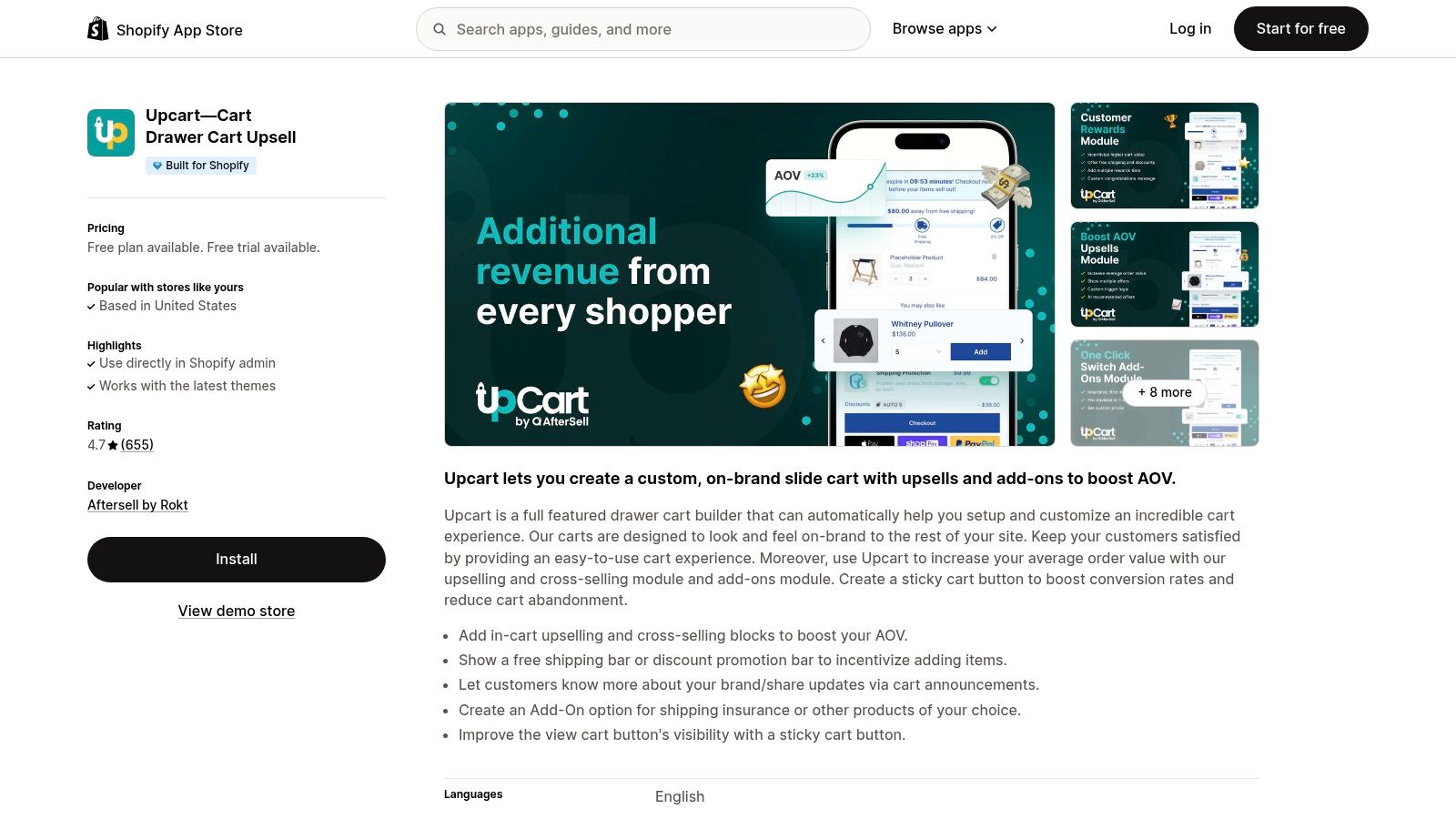
This app stands out by focusing exclusively on cart-stage monetization without adding friction to the checkout process itself. Its features, like a free shipping progress bar or time-sensitive announcements, create a sense of urgency and reward. For merchants with development skills, the ability to add custom HTML/CSS allows for perfect brand alignment, making the cart feel like a native part of the theme rather than a third-party add-on. Its transparent, order-volume-based pricing also makes it an accessible choice for stores of all sizes.
Practical Tips for Effective Use
A powerful strategy is to pair product-specific upsells with a rewards-based progress bar. For example, if a customer adds a leather handbag, configure UpCart to recommend a matching wallet in the slide-out drawer. Simultaneously, use the progress bar to show them they are only "$15 away from free shipping." This combination of a relevant add-on and a tangible reward creates a compelling incentive to increase their cart value on the spot. Test different reward thresholds (e.g., $75 vs. $100) to find the sweet spot that maximizes AOV without deterring conversions.
Pros & Cons
- Pros:
- Strong Cart-Stage Monetization: Excellent for increasing AOV before checkout without adding complex steps.
- Highly Customizable: Custom HTML/CSS controls allow for deep brand integration.
- Clear Pricing: Simple, order-tiered pricing and a free plan for development stores.
- Cons:
- Not a Post-Purchase Solution: Focuses solely on the in-cart experience, requiring another app for post-purchase upsells.
- Limited Targeting Rules: Advanced targeting is less extensive than what is found in larger, more expensive upsell suites.
Top 12 Shopify Upsell Apps — Quick Comparison

Choosing Your Upsell App: A Quick Decision Guide
Selecting the right Shopify upsell app from a crowded field can feel overwhelming, but it's a pivotal decision that directly impacts your store's profitability and customer experience. As we've explored, the "best" app isn't a one-size-fits-all solution; it’s the one that aligns perfectly with your specific business goals, technical comfort level, and budget. The key takeaway is to move beyond a simple feature checklist and instead adopt a strategic, goal-oriented approach.
An app like Zipify OCU or AfterSell excels at post-purchase upsells, which is ideal if your primary goal is to maximize average order value without adding friction to the initial checkout. These tools capitalize on a customer's peak buying intent, offering one-click additions after their payment is already secured. Conversely, if you want to influence the customer *before* they hit the checkout button, an in-cart solution like In Cart Upsell & Cross-Sell or UpCart provides a non-intrusive way to suggest add-ons directly within a cart drawer or on the cart page itself.
Matching Your Goal to the Right Tool
To simplify your decision, let's break it down by your primary objective. This quick-reference guide will help you narrow down the best upsell apps for your Shopify store based on your immediate needs.
- If your main goal is to maximize AOV with post-purchase offers: Your top contenders are ReConvert, Zipify OCU, and AfterSell. They are purpose-built to create frictionless, high-converting funnels after the initial transaction, making them perfect for capturing additional revenue from committed buyers.
- If you want to focus on product discovery and bundling: Look no further than Rebuy Personalization Engine, Frequently Bought Together, or UFE Cross Sell & Upsell Bundle. These apps are masters at contextual recommendations, using AI or simple logic to show customers relevant products they might not have found otherwise. A practical example is a store selling cameras that uses these tools to bundle a camera body with a lens, memory card, and bag, presenting a "Complete Photography Starter Kit" that solves a customer's entire need at once.
- If you need a simple, low-cost solution to get started: Honeycomb Upsell & Cross-Sell is an excellent entry point. It offers a generous free plan and straightforward setup, allowing you to test basic upsell and cross-sell strategies on your product pages and cart without a significant financial commitment.
- If your priority is a highly customizable, in-cart experience: In Cart Upsell & Cross-Sell and UpCart are your best bets. They allow you to create targeted offers that appear directly in the slide-out cart, which is perfect for suggesting low-cost items, warranties, or accessories just before the final checkout step.
Final Considerations Before You Commit
Before you install any app, remember two crucial factors. First, site speed. While modern apps are highly optimized, every script adds some load. Use a tool like GTmetrix or Google PageSpeed Insights to test your site before and after installation to ensure the app doesn't negatively impact your user experience.
Second, strategy over software. Even the most powerful tool on this list will fail without a thoughtful strategy behind it. Don't just offer random products. Analyze your sales data. What items are frequently purchased together? What low-cost accessory perfectly complements your bestseller? A real insight is that a relevant, valuable offer will always outperform a random, high-margin one. Start small, test one type of offer (e.g., a post-purchase upsell on your top-selling product), analyze the results, and expand from there.
Ultimately, the best upsell apps for Shopify empower you to serve your customers better by anticipating their needs and presenting relevant solutions. By choosing an app that matches your goals and implementing it with a customer-centric strategy, you're not just increasing your AOV; you're building a smarter, more profitable, and more satisfying shopping experience.
---
Finding the perfect tech stack to scale your Shopify store can be a challenge. If you're looking for verified reviews, unbiased comparisons, and exclusive deals on the best SaaS tools beyond just upsell apps, check out TheSaasHub. We provide a comprehensive directory to help you discover and choose the right software for every part of your ecommerce operation. Explore top-rated tools and make smarter decisions for your business at TheSaasHub.
Frequently Asked Questions
1. What is the difference between an upsell and a cross-sell?
An upsell encourages customers to purchase a higher-end version of the same product, while a cross-sell suggests complementary items that enhance the original purchase. Both strategies aim to increase average order value by improving relevance and customer experience.
2. What is a "Post-Purchase Upsell" and why is it effective?
A post-purchase upsell appears immediately after checkout, offering customers a one-click add-on before they reach the thank-you page. It is highly effective because it removes payment friction and encourages impulse upgrades without requiring re-entry of payment details.
3. How do AI-powered recommendation engines boost sales?
AI recommendation engines analyze customer behavior and purchase patterns to suggest highly relevant products in real time. This personalization increases conversion rates by showing items that customers are statistically more likely to buy together.
4. Can I add upsell offers directly into the slide-out cart?
Yes, many modern Shopify apps allow in-cart upsells using progress bars, product add-ons, and “frequently bought together” suggestions directly inside the cart drawer, helping increase order value without disrupting checkout flow.
5. Will adding upsell apps affect my store's mobile experience?
Well-built upsell apps are mobile-optimized and use responsive design to ensure smooth user experience on smaller screens. Embedded upsells are preferred to avoid clutter and maintain fast, clean mobile navigation.