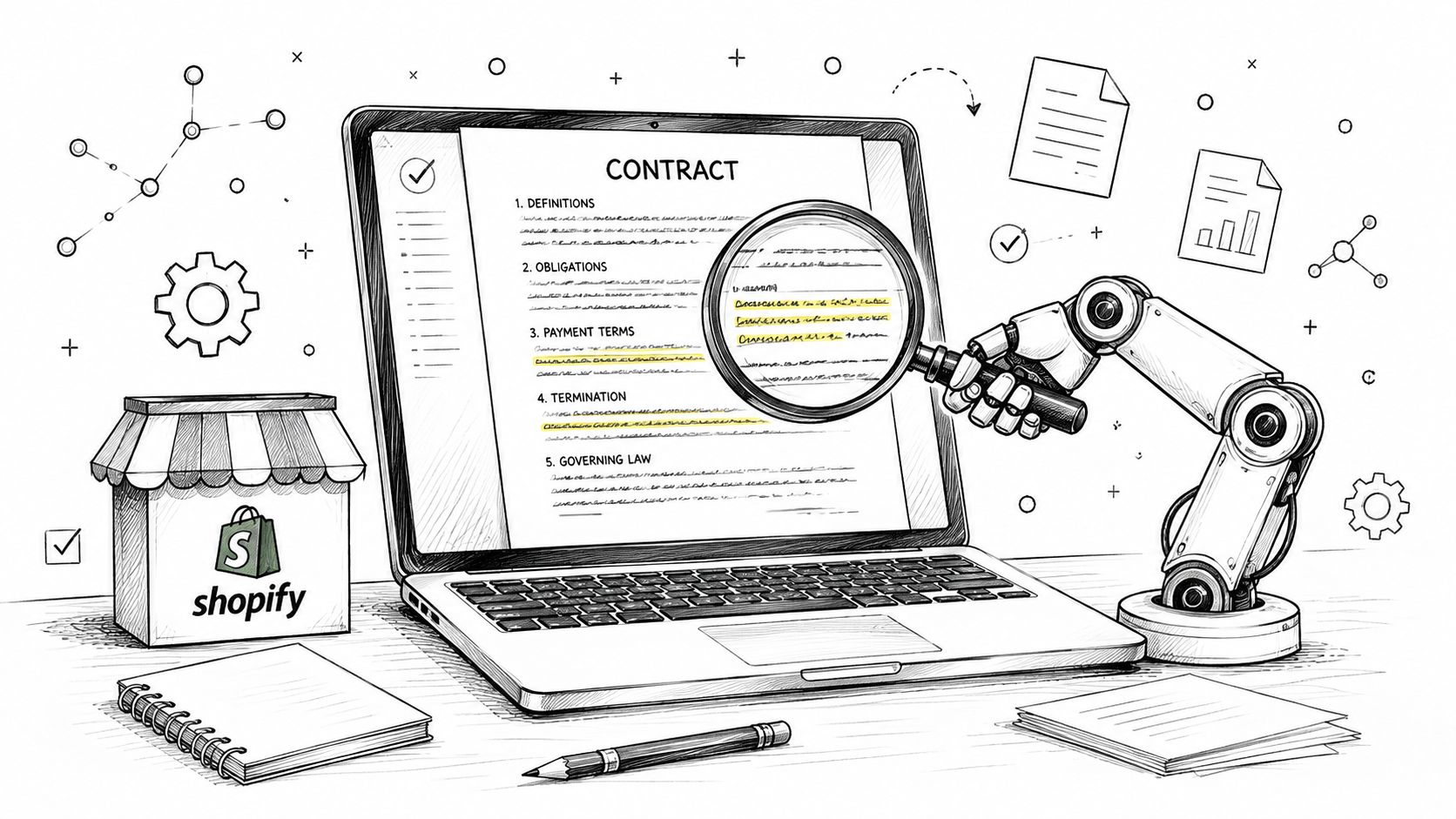
AI Contract Review for Shopify Merchants and Founders
Learn how AI contract review works, where it fits in Shopify app stack decisions, and how merchants and app founders can use it to speed up vendor, partner
By Yuvraj Kewate · 2026-09-05
You're probably staring at the same mess right now. A new app terms update lands in your inbox, the 3PL sends over an MSA with a renewal clause you don't love, and a partner deal wants your team to sign before the campaign goes live. If you run a Shopify brand or build for one, contract review isn't a legal side quest. It's a margin-control job.
AI contract review is software that reads contracts, breaks them into clauses, compares them against your standards, and flags what's off. It's not a chatbot guessing at answers. It's a clause-level workflow that surfaces liability caps, data terms, renewal traps, SLA gaps, and oddball carve-outs fast enough for ops teams to act before the signature hits.
The important shift is this. AI contract review now sits inside the everyday workflow for legal teams, and that matters for merchants too. A 2025 benchmarking study summarized by LawNext found that 38% of surveyed corporate legal teams were already using AI tools, 50% were actively exploring implementation, and among current AI users, 64% used those tools for contract drafting, review, and analysis. That made contract work the leading use case, ahead of legal research at 49% and document translation at 38%. The same data said 88% of departments were already using or seriously evaluating AI, which is the clearest sign yet that contract review has become a mainstream automation layer, not a toy for early adopters. LawNext summary via Onit
For Shopify operators, the value is simpler. AI can take the first pass, compress the review queue, and catch the kind of clause that drains cash later. It won't replace a lawyer on a high-stakes deal, and you shouldn't pretend it will. But it can stop a five-page vendor PDF from sitting in your inbox for three days while your launch clock keeps running.
Table of Contents
- What AI Contract Review Means for Shopify Operators
- How AI Contract Review Actually Works
- Practical Use Cases and Where AI Falls Short
- How LegesGPT Can Help
- Implementation Checklist for Merchants and Founders
- Choosing an AI Contract Review Vendor for Your Stack
- Sample Prompts and Workflows You Can Copy
- Proving Value and Governing AI Inside Your Contracts
What AI Contract Review Means for Shopify Operators
A founder at midnight doesn't need a theory of legal automation. They need to know whether a paid app agreement sneaks in auto-renewal, whether a partner deal lets data move somewhere messy, and whether a 3PL contract leaves them holding the bag if service fails. That's where AI contract review earns its keep. It's the digital version of having a sharp ops hire read every clause first and mark the dangerous ones in red.
The plain-English version
AI contract review ingests the document, classifies the language, and compares it against your playbook. The output is structured, so you get a summary of what changed, what's missing, and what needs human sign-off. That's very different from dropping a contract into a general-purpose chat tool and hoping for a decent answer.
Practical rule: use AI to triage, not to bless. If the clause could change cash flow, data handling, or liability exposure, a human still owns the call.
For Shopify merchants, that distinction matters because your contracts are usually high-volume and low-margin. You don't need a heavyweight legal process for every SaaS renewal, but you do need consistency across app subscriptions, fulfillment addenda, affiliate agreements, and vendor paper. AI gives you that consistency by applying the same standards every time.
Where this guide points next
The useful question isn't “can AI read contracts?” It's “how does it do that, where does it fail, and how do I make it fit a merchant stack without adding another messy tool?” The rest of this article follows that order. You'll see the mechanics, the Shopify use cases, the rollout checklist, the vendor filter, copy-ready prompts, and the governance rules that keep you out of trouble when AI itself starts showing up in contracts.
How AI Contract Review Actually Works
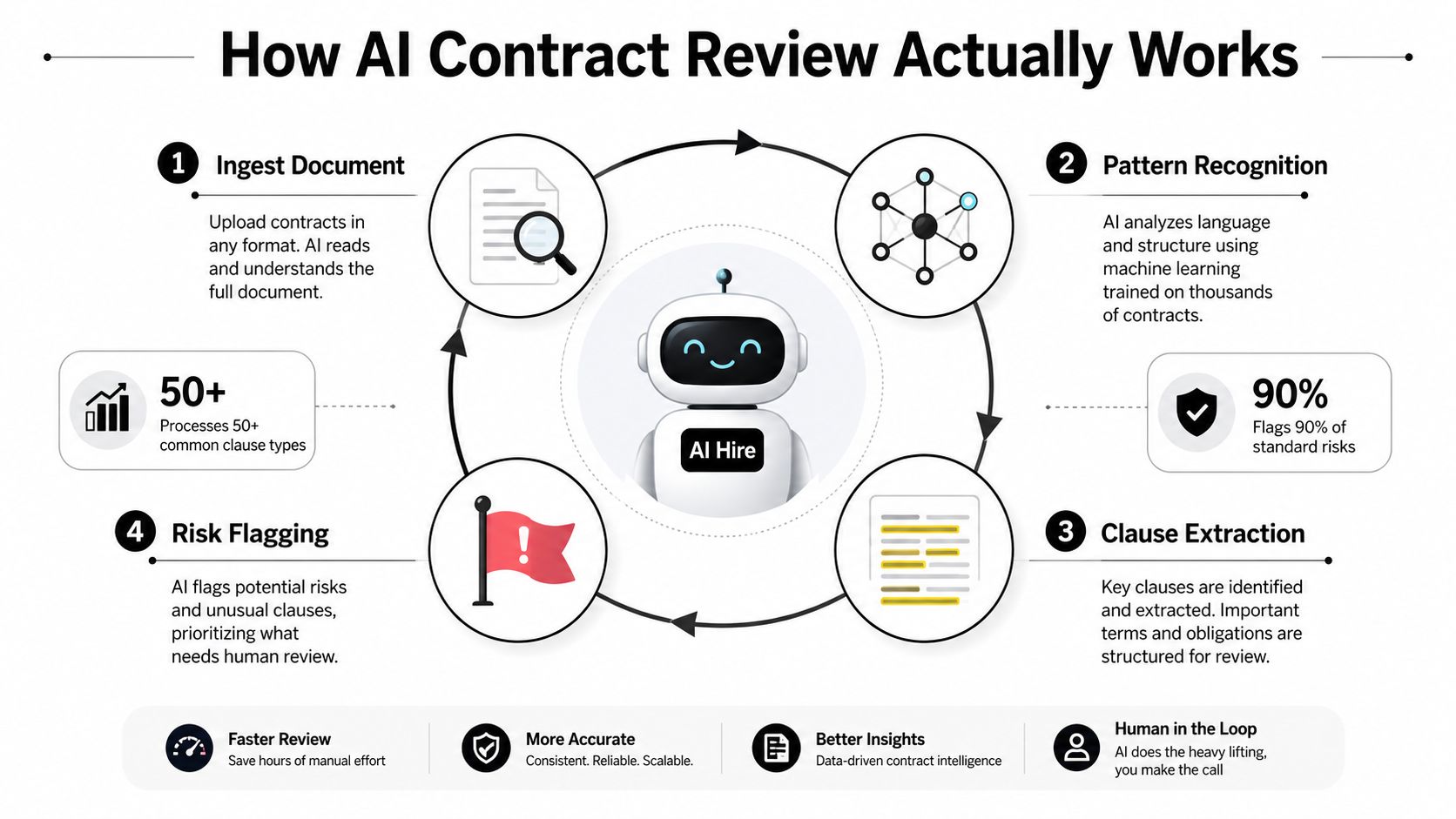
Think of the model like a new operations hire who has read every app agreement, vendor MSA, and partner addendum you've ever seen. It doesn't get bored, and it doesn't skip the boilerplate. It scans for patterns, then tells you where the paper drifts from your house standard.
The workflow is usually three layers. First, natural language processing parses the file and splits it into clauses. Second, a classification layer labels each clause, things like liability cap, SLA, termination, indemnity, data processing, and renewal. Third, a comparison engine checks those labels against your playbook and fallback positions, then flags deviations for review. That's the core reason purpose-built systems beat generic AI. They're not just reading words, they're matching legal structure against your policy.
The speed gap is real. In one benchmark of clause-level legal extraction, GPT-4 finished a real-world procurement review in about 4.7 minutes, while junior lawyers took about 56 minutes and LPOs about 201 minutes. The same benchmark also tracked model correctness using legal evaluation metrics and showed that proprietary models generally outperformed open-source ones on clause extraction quality. arXiv benchmark
That doesn't mean the machine owns the deal. It means cycle time collapses, while edge cases still need judgment. Novel terms, weird commercial structures, and negotiation context still trip models up. If a clause only makes sense when you understand the merchant's margin model, channel mix, or launch timing, the AI should flag it, not decide it.
Why trained systems beat generic chat
A purpose-built review tool usually performs better because it has legal context baked in. Legal corpora, clause libraries, and playbooks make a model better at identifying the exact issue you care about. For a Shopify operator, that's the difference between “this sounds risky” and “this indemnity is wider than your standard and should be redlined before renewal.”
The tool should point to the clause, name the issue, and tell you what changed. If it can't do that cleanly, it's not a review system, it's just another chatbot.
Practical Use Cases and Where AI Falls Short
The clearest wins show up where your team keeps seeing the same paper over and over. A merchant comparing three app subscriptions can use AI to extract pricing, overages, auto-renewal windows, and termination notice periods from each agreement. A founder signing a vendor MSA can have the system flag escalation language, weak fallback wording, or an unusually broad liability carve-out before finance approves the spend. An agency or affiliate manager can run batches of partner agreements through the same playbook instead of reading each one line by line.
Where it helps most
| Scenario | AI Strength | Human Required For |
|---|---|---|
| App subscription comparison | Extracts commercial terms and highlights differences fast | Final subscription choice tied to budget and roadmap |
| Vendor MSA review | Flags auto-renewal, pricing drift, and liability language | Negotiating business trade-offs and exception requests |
| Data processing clauses | Spots broad data-sharing terms and missing restrictions | Confirming what your stack actually stores and transmits |
| SLA redlines | Surfaces weak uptime credits and vague service remedies | Deciding what service risk you can tolerate |
| Affiliate or influencer deals | Reviews repeated terms at scale | Handling brand risk, channel strategy, and exceptions |
Where humans still have to lead
AI falls down when the clause is novel, the commercial structure is unusual, or the meaning depends on context. Equity-linked arrangements, international 3PL structures, and multi-party deals often need a person who understands the business outcome, not just the text. If the deal turns on whether the vendor can meet your fulfillment timeline or whether a clause affects a launch sequence, human review is mandatory.
The same applies when intent matters more than syntax. AI can spot a vague indemnity, but it can't tell whether the counterparty is bluffing, negotiating in good faith, or compensating for something buried in another attachment. That's where your team earns its keep. For operators who want to benchmark how stack decisions affect retention and customer economics, this Shopify retention and LTV guide is a useful adjacent read.
Bottom line: use AI for volume, pattern detection, and triage. Use people for strategy, exceptions, and the deals that can break the stack if they go wrong.
How LegesGPT Can Help
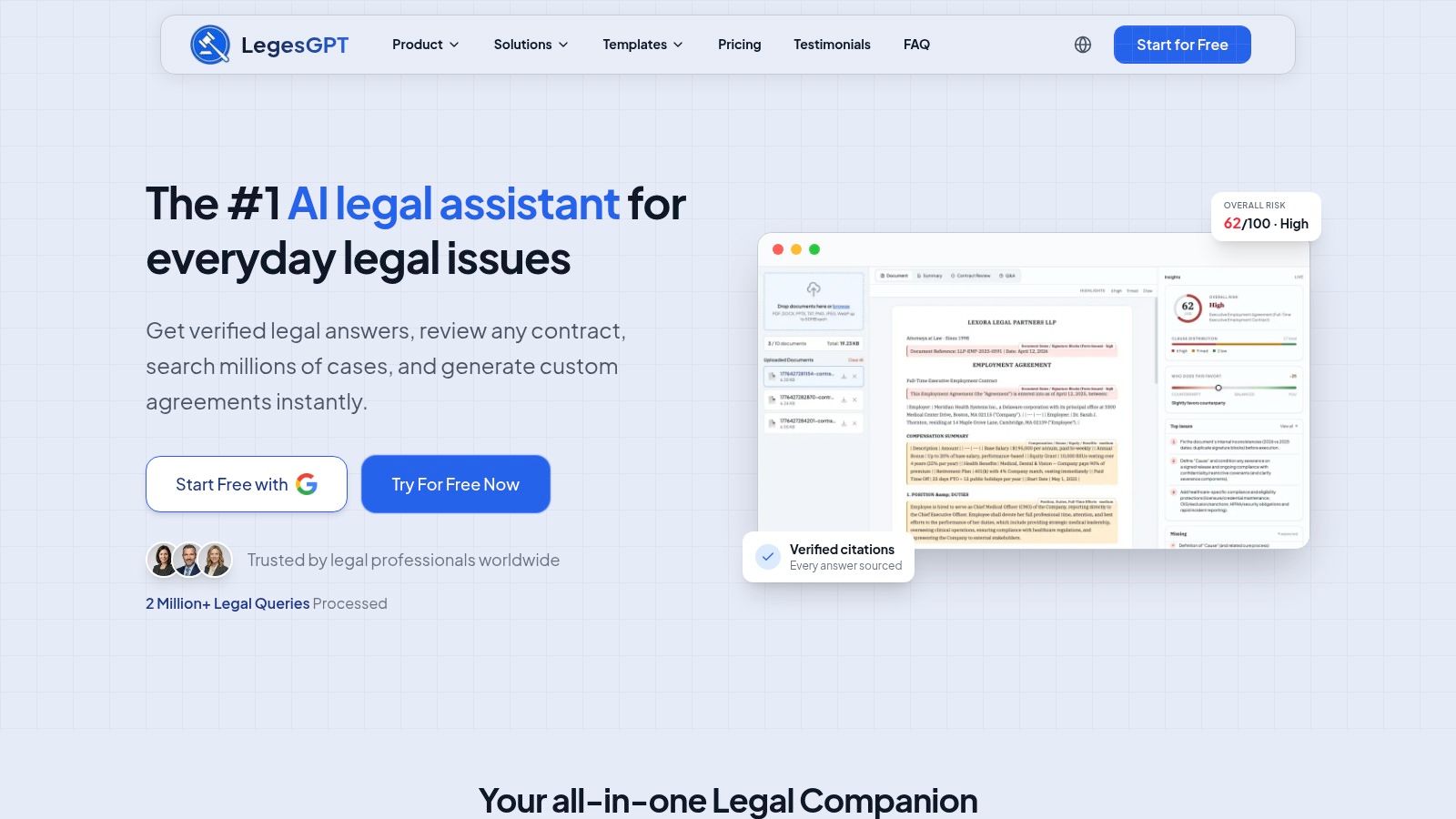
If you want a legal assistant that's built for practical review work, LegesGPT's AI contract review is worth a look. It's a chat-first legal assistant for contract work, legal research, and everyday legal questions, with answers grounded in statutes and regulations across U.S. federal law, 44 U.S. states, the UK, Canada, and the UAE.
That matters because generic AI tools love to hallucinate citations or answer confidently without a real legal source behind them. LegesGPT is built to do the opposite. It uses statute-grounded retrieval, gives cited answers, and says it can't find something instead of inventing a reference. For merchants and founders who need to sanity-check contract language against actual law, that's a better default than a flashy chatbot.
Where it fits in a merchant workflow
The strongest use case here is upload-and-chat review. You can upload contracts, ask for key term extraction, get plain-language summaries, and flag risks without turning your team into prompt engineers. It also helps when you need drafting support for NDAs or standard agreements, or when you're dealing with contract questions that cross jurisdictions.
When it's the right choice
Pick a tool like this when your team wants a single place for review, drafting, and legal Q&A, especially if you're dealing with more than one jurisdiction or you need cited answers, not generic summaries. It's also a sensible fit if you want a subscription model that stays accessible for founders and operators instead of pushing you into enterprise procurement.
If your stack needs one assistant for the messy middle, contracts, questions, and quick legal research, LegesGPT is a practical option. If you only need a narrow contract scanner inside a broader CLM, then a lighter review-only tool might be enough.
Implementation Checklist for Merchants and Founders
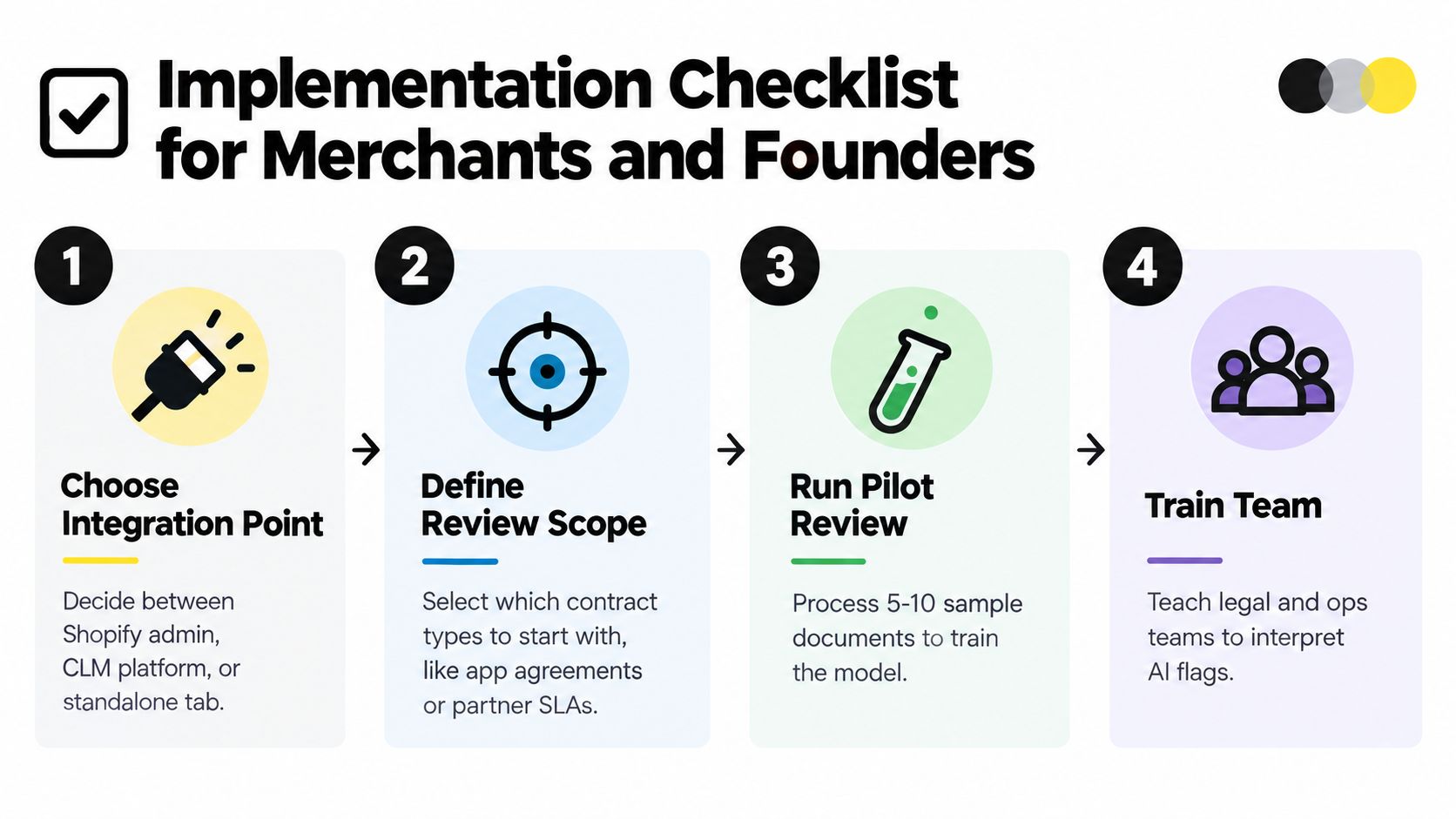
Start with where the tool lives. If the review happens in a separate tab nobody opens, adoption dies fast. If it lives in your CLM, your ops workflow, or a place legal and finance already trust, it gets used. For a Shopify team, the key question is whether the tool fits the handoff path between ops, legal, and whoever signs vendor paper.
Put security in front of convenience
Before you upload a single contract, confirm the platform's data handling. Ask whether it has SOC 2 Type II, encryption at rest and in transit, region controls, a DPA, and a clear answer on whether your data trains shared models. If a vendor can't answer those questions cleanly, skip it.
Then build a merchant-specific playbook. Standard clauses for app agreements, vendor SLAs, partner MSAs, and NDAs should be captured in writing so the AI flags deviations from your standard, not just generic “risk.” That's the difference between useful output and noise.
Run the pilot like an operator
Don't test on one shiny contract. Run a parallel review on a small historical set, compare the AI output to human review, and note where it missed nuance or over-flagged harmless language. That gives you a realistic baseline before the tool touches live deals.
- Integration point first: decide whether the tool belongs in Shopify-adjacent ops, a CLM, or a standalone review space.
- Security second: verify data isolation, encryption, and training policy before upload.
- Playbook third: encode your standard positions before asking the model to flag deviations.
- Pilot fourth: compare AI output against real historical contracts.
- Escalation last: define exactly which clause types require human sign-off.
Defensible rule: if you can't explain the tool's placement, security posture, and escalation path in a leadership meeting, you're not ready to deploy it.
Choosing an AI Contract Review Vendor for Your Stack
A merchant should not shortlist vendors the same way a corporate legal team does. You don't need a procurement matrix that ignores app-store terms, partner addenda, and low-margin deal flow. You need a tool that can read the paper you sign, keep data isolated, and fit your review rhythm without creating admin work.
What to compare
| Vendor | Shopify Fit | Security & Data Isolation | Review Depth | Best For | Skip If |
|---|---|---|---|---|---|
| LegesGPT | Good for contract Q&A and review support across common merchant contracts | Strong emphasis on grounded legal sources and controlled document handling | Solid for review, drafting, and legal research | Founders and operators who want one assistant for contracts and legal questions | You want a deeply embedded CLM workflow first |
| Purpose-built contract review platform | Best when it handles clause playbooks cleanly | Should offer SOC 2, encryption, and no-training assurances | Strong on clause classification and deviation flags | Teams with repeat vendor and app agreements | You need legal research and drafting in the same place |
| CLM-first platform | Best if contracts touch several internal teams | Usually strongest when paired with enterprise security controls | Good when review sits inside the workflow layer | Bigger stacks with procurement and legal coordination | You only need fast first-pass review |
If you want a broader view of stack-fit decisions across your Shopify environment, this guide to choosing the perfect Shopify app stack is a useful complement.
The decision rule I'd use
Pick a platform-first vendor if contracts move across several departments and you need workflow, storage, and review in one place. Pick a lightweight review tool if you sign fewer than 20 contracts a quarter and mostly need fast triage. Anything else is likely overkill for a merchant stack that has to stay lean.
Sample Prompts and Workflows You Can Copy
The fastest way to get value is to give the model a narrow job. Don't ask it to “review this contract.” Ask it to extract the terms you care about, flag the clauses that matter to your business, and compare the draft to your own standards. That keeps the output useful and reduces junk.
Prompt templates for merchant contracts
- Commercial terms extraction: “Extract all pricing, usage caps, overage rates, renewal triggers, and termination notice windows into a structured summary. Quote the exact clause text next to each item.”
- Shopify risk scan: “Flag any clause that creates Shopify-specific risk, including data residency outside approved regions, sub-processor sharing without consent, IP assignment that extends to merchant data, or indemnity caps below the standard in my playbook.”
- Deviation table: “Compare this draft against my uploaded playbook and return a table grouped by must-have, negotiate, and accept as-is.”
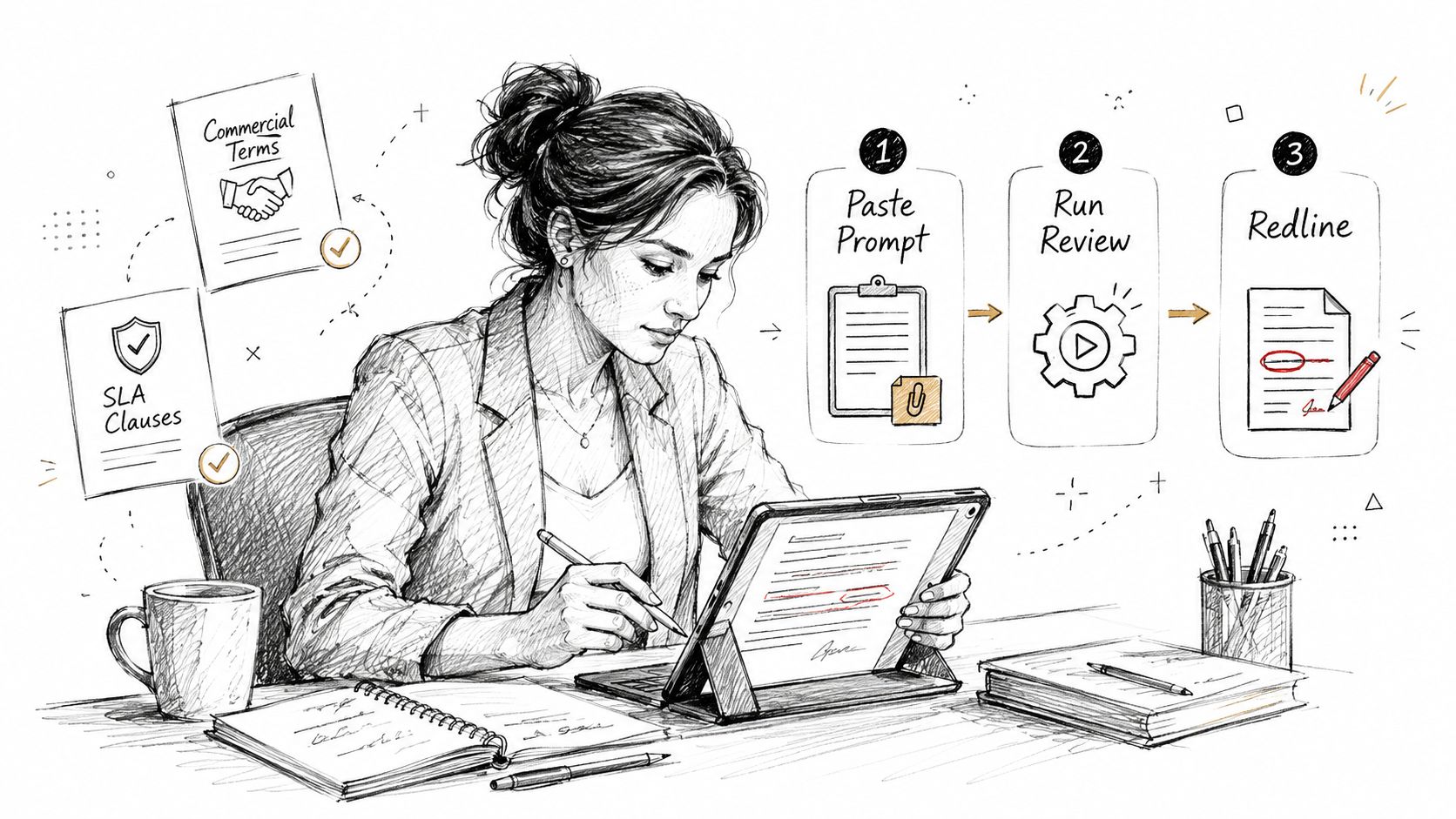
The useful workflow is simple. Upload the agreement, extract the key terms, flag the risks, suggest the redline, then send only the disputed items to a human reviewer. That saves time without pretending the model should close the deal on its own.
If you're building around AI in a broader legal stack, the contract itself should start reflecting that reality. AI use, confidentiality, output ownership, and whether tools can retain or learn from inputs now belong in the paper, not in a side conversation.
Don't let the review tool become the policy gap. If AI touches your contracts, your contracts should say what AI is allowed to touch.
Proving Value and Governing AI Inside Your Contracts
A contract review tool only earns its seat if it changes throughput, cycle time, and deviation control. Track how many contracts you can move, how long first-pass review takes, and how often the tool catches deviations your team would otherwise miss. Those are the numbers a CFO, COO, or founder can defend.
What to measure and what to add
| Dimension | What to Measure or Add | Owner |
|---|---|---|
| Throughput | Number of contracts reviewed per period | Ops or legal |
| Cycle time | Time from upload to first-pass output | Legal ops |
| Deviation rate | How often the AI flags clauses outside your playbook | Legal |
| AI use policy | Rules on allowed tools, approved data, and retention | Legal and security |
| Output ownership | Who owns model-generated language and edits | Legal |
| Sub-processors | Whether AI vendors can retain, learn from, or share data | Procurement and legal |
For merchants, the move is straightforward. Audit a few active vendor or app contracts for liability and data terms, then write down your standard positions so the system knows what to flag. For app founders, add AI-specific sub-processor language and output-warranty terms to your standard MSA so buyers know where the boundaries are.
If you're handling GDPR-heavy workflows or consent-sensitive data, this Pandectes GDPR compliance resource is a useful companion reference for the privacy side of the stack.
The bigger point is that AI contract review compounds. Every playbook you refine improves the next round of review. Every redline you accept or reject becomes part of the standard. That's why this shouldn't be treated as a one-time software deployment. It should be treated as a contract intelligence layer that gets sharper every month.
If you run Shopify operations, start with one vendor agreement and one partner deal this week. Compare AI output against your own judgment, tighten the playbook, and only then roll it into the rest of the stack. If you want a Shopify-first place to keep building that operating system, use The SaaS Hub to shortlist the adjacent tools and processes that help you review faster without taking on avoidable risk.