The Best Shopify Apps for Dropshipping
If you're launching a Shopify dropshipping store, think of it as designing an automated factory. You're the architect, but you're not the one on the assembly line. Your job is to create a seamless sys...
By The SaaS Hub Team · 2025-11-06
The Best Shopify Apps for Dropshipping
If you're launching a Shopify dropshipping store, think of it as designing an automated factory. You're the architect, but you're not the one on the assembly line. Your job is to create a seamless system, and your Shopify apps are the high-tech robotic arms that do all the heavy lifting for you.
They are the engine of your store, working 24/7 to find products, talk to suppliers, and get orders out the door.
Without the right app toolkit, you’d be drowning in manual tasks. Imagine you get 10 orders overnight. Manually, you'd have to copy and paste each customer's address into your supplier's portal, hunt down product photos from their website, and email order details one by one. It’s not just slow—it's a surefire recipe for burnout and costly shipping mistakes. The best dropshipping apps eliminate that friction, creating a smooth workflow that lets you focus on what actually grows the business: marketing and customer service.
The Core Functions You Absolutely Must Automate
Every single successful dropshipping operation hinges on automating three critical areas. Get these right, and you've built a solid foundation.
- Product Sourcing & Importing: This is how you find what to sell. Sourcing apps plug your Shopify store directly into massive supplier marketplaces. You can pull in products, descriptions, and images with just a click, saving you hundreds of hours. For example, instead of manually saving 10 photos for a product, you can import them all in five seconds.
- Order Fulfillment: This is the magic that happens when a customer hits "buy." Instead of you manually forwarding the order, a fulfillment app instantly sends all the details to your supplier, who then ships the product directly to your customer. You never have to touch a box.
- Marketing & Customer Engagement: This is how you find customers and earn their trust. Marketing apps are your tools for running email campaigns, collecting genuine product reviews, and offering solid customer support—all crucial for building a brand people come back to.
> The real power of a dropshipping business isn't just selling products you don't own; it's building an automated system that operates efficiently, whether you receive one order or one thousand. Your app stack is the blueprint for that system.
To give you an idea of the landscape, the Shopify App Store is massive and continues to explode in size. As of January 2025, there are over 12,200 apps available—that's more than triple the number from just a few years ago.
This growth is a double-edged sword. You have incredible choices, with over 3,100 apps just for marketing and conversion alone. However, it also makes finding the gems a real challenge. Thankfully, Shopify has also been cracking down on quality, removing underperforming apps to ensure merchants have reliable options. You can find more data on the Shopify ecosystem's growth at meetanshi.com.
Ultimately, picking the right combination of tools is your first major step toward building a scalable, profitable, and automated online store.
Finding Winning Products with Sourcing Apps
Let's be blunt: the products you sell are the absolute lifeblood of your dropshipping business. You can have the slickest marketing in the world, but if your products don't solve a problem or spark genuine interest, you're just burning cash. This is where sourcing apps come in. Think of them as the critical bridge connecting your Shopify store to a massive, global warehouse packed with millions of potential best-sellers.

This shot of the DSers app listing shows just how deep these connections run—as an official AliExpress partner, it's built to sync flawlessly with one of the planet's biggest product marketplaces.
These apps are basically supercharged search engines built specifically for e-commerce. Forget spending hours manually trawling supplier sites, saving low-res images, and copy-pasting descriptions. With a sourcing app, you can pull everything—professional photos, detailed specs, and current pricing—into your store with just a couple of clicks. What used to be a mind-numbing, multi-hour chore becomes a streamlined process that you can knock out in minutes.
Global Marketplaces vs. Curated Supplier Networks
Sourcing apps aren't all the same. They generally fall into two camps, and knowing the difference is key to picking the right tool for your brand.
- Massive Marketplaces (like DSers for AliExpress): These apps plug you directly into behemoths like AliExpress, unlocking an almost endless catalog of products at rock-bottom prices. This is the perfect playground for testing out different niches, hunting for viral trends, and getting started on a lean budget. A real insight here is that you're trading speed for variety; shipping may take longer, but you can test ten different product ideas for a minimal investment.
- Curated Networks (like Spocket or DropCommerce): These platforms take a different approach. They focus on pre-vetted suppliers, often based in the US or Europe. The product selection might be smaller, but what you gain is huge: faster shipping, higher product quality, and far more reliable partners. This is the way to go if your brand's unique selling proposition is a premium customer experience and speedy delivery.
The numbers don't lie—global sourcing is a dominant force. In fact, DSers is the single most popular dropshipping app on Shopify, with over 131,000 stores relying on it as of January 2025. This proves just how central marketplaces like AliExpress are to the entire dropshipping model, which is fueling a market expected to smash $301 billion in 2024.
A Practical Walkthrough: Finding a Product
Let's make this real. Imagine you want to sell a cool pet gadget—say, an automated puzzle feeder that dispenses treats. Finding a great supplier manually would be a nightmare of endless searching and guesswork.
With a sourcing app, the whole game changes.
1. Search and Filter: You'd start by typing "automatic pet feeder" into the app. Right away, you can start slicing and dicing the results. You could filter for suppliers with a 4.5-star rating or higher, those who ship from the US to slash delivery times, and those who have a proven track record with a high number of orders. 2. Vet the Supplier: When you spot a promising product, you can dig into the supplier’s profile. Check their overall rating, read actual customer reviews, and look at their average response time. A solid supplier will have a history of positive feedback. For example, look for reviews that say "fast shipping" or "good communication." 3. Check Shipping Details: The app will lay out the estimated shipping times and costs to different countries. This is non-negotiable information for setting your retail price and managing customer expectations. No surprises. For a US customer, you might see options for 7-day shipping for $5 or 20-day shipping for $2. 4. Import to Your Store: Found a winner? One click and the app beams the product right into your Shopify dashboard. From there, you can tweak the title from "Pet Dog Feeder Toy Puzzle" to something more brand-friendly like "The Pawsitive Puzzle Feeder," rewrite the description to inject your brand's personality, and set your final price.
> This process isn't just about saving time; it's about making data-driven decisions. Sourcing apps provide the supplier ratings, order history, and shipping data you need to partner with reliable businesses, minimizing risks like poor product quality or shipping delays.
By using one of the best Shopify apps for dropshipping, you take the guesswork out of product selection. You get to explore a world of options and pinpoint the perfect items to build your brand around.
To go even deeper, check out our complete guide on finding products and sourcing options for dropshipping.
Automating Your Fulfillment and Order management
That *cha-ching* sound of a new sale is exhilarating. But once a customer clicks 'buy,' the real work begins. Sourcing a great product is one thing; getting it to your customer’s doorstep quickly and accurately is what builds a brand people trust. This is where fulfillment and order management apps come in—they’re the automated backbone of your entire dropshipping operation.
Think of these apps as your store's dedicated operations manager, working tirelessly behind the scenes. The moment an order hits your Shopify store, the app grabs all the critical details—what was ordered, how many, and where it's going—and sends it straight to your supplier.
From Manual Chaos to Automated Clarity
Imagine you run a killer ad campaign and wake up to 50 new orders. Fantastic, right? Well, manually, that's a nightmare. You’d be facing hours of mind-numbing data entry, copying and pasting each customer's info into your supplier’s portal. One typo in a zip code could send a package to the wrong state, leading to angry customers and lost money. It’s a recipe for disaster.
Now, picture this with an automation app like AutoDS or DSers. That entire process is done in minutes. The app pulls the order data from Shopify, routes it to the right supplier, and even lets you pay for all 50 orders in one single, bulk transaction. The time you get back isn't just a convenience; it's a competitive edge that lets you focus on what actually grows your business.
> The real magic of automation is that it frees you from the weeds of logistics. It lets you build a system that works *for you*, instead of getting trapped in a job working *in* your business.
This automation doesn't stop at placing the order. Once the supplier ships the item, the app grabs the tracking number and syncs it right back to your Shopify dashboard. This automatically triggers Shopify’s shipping confirmation email to your customer, keeping them in the loop and cutting down on those dreaded "Where is my order?" support tickets.
Crucial Features for Seamless Operations
Not all fulfillment apps are built the same. When you're looking for the best Shopify apps for dropshipping, the top contenders in this category all share a few non-negotiable features.
- Real-Time Inventory Syncing: This is absolutely critical. Imagine you sell a trendy phone case. The app constantly checks your supplier's stock. If the supplier sells their last blue case, the app automatically marks it as "out of stock" on your store. This simple feature prevents the massive headache of selling products you can't actually deliver.
- Automated Price Updates: Your supplier's costs can change overnight. A good app monitors these price shifts and adjusts your store's prices based on rules you define. For example, you can set a rule to always maintain a 60% profit margin, so if a supplier's cost goes from $10 to $11, your price automatically adjusts to keep your profit intact.
- Bulk Order Processing: As we talked about, the power to process hundreds of orders with just a few clicks is what makes scaling possible. This is a must-have, not a nice-to-have.
- Supplier Mapping: Sourcing a popular product from multiple suppliers is a smart move. Supplier mapping lets you set a primary supplier and a few backups. If your main source for that phone case runs out of stock, the app automatically reroutes the order to the next one in line, so you never miss a sale.
Ultimately, these tools give you control and make your business reliable. For more complex logistics with multiple shipping carriers and huge order volumes, you can centralize everything. You can learn more about how tools like ShipStation help streamline order fulfillment by pulling in orders from various channels and managing them all in one place. This level of organization is what keeps the customer experience smooth, even when your business is growing like crazy.
How to Choose the Right Apps for Your Business
Staring at the Shopify App Store and its 12,000+ options can feel overwhelming. It’s a classic case of paralysis by analysis. The fear is real: you could end up with a clunky, expensive app stack that actually hurts your business more than it helps.
The secret isn’t just picking the most popular apps. It's about creating a repeatable evaluation process to find the tools that perfectly match your business goals, your products, and your budget. A great app for a high-volume store might be a total dud for a beginner. Let's break down a framework that helps you build a tech stack that’s reliable, affordable, and ready to grow with you.
Evaluate Supplier Location and Quality First
Before you even glance at an app's feature list, you need to go straight to the source: its supplier network. An app is only as good as the suppliers it gives you access to. In dropshipping, faster shipping times and higher-quality products are your biggest competitive advantages, so supplier location is filter number one.
- Order Product Samples: This is completely non-negotiable. Before you commit to selling *anything*, order it for yourself. Does the "premium leather" wallet actually feel premium, or is it flimsy plastic? Is the print on the t-shirt crisp, or does it look like it will peel off after one wash? This simple, firsthand test is the single best way to vet a supplier.
- Analyze Shipping Times: Be honest with yourself. If an app mainly connects you with overseas suppliers, can you realistically manage customer expectations for 15-30 day delivery times? Or does your brand promise demand speed? If so, you should immediately prioritize apps like Spocket that focus on US or EU-based suppliers and can deliver in 5-7 days.
Decode Pricing Models to Protect Your Margins
App pricing isn't a simple one-size-fits-all deal. You've got to understand the two main models to protect your profit margins, especially when you're just starting out.
A flat monthly fee gives you predictability. You pay the same fixed cost whether you process 10 orders or 1,000. For instance, a $29/month plan. This model is usually a better fit for established stores processing hundreds of orders, where a per-order fee would quickly spiral out of control.
On the flip side, a per-order commission or a free plan with a limited number of orders is perfect for beginners. It keeps your upfront costs rock-bottom, letting you pay only as you actually make money. Always do the math. If an app charges a 2% transaction fee and your average order is $50, you'll pay $1 per order. At 30 orders per month, you'd break even with the $29 plan.
This flow chart shows the simple, automated journey an order takes when the right apps are in place.
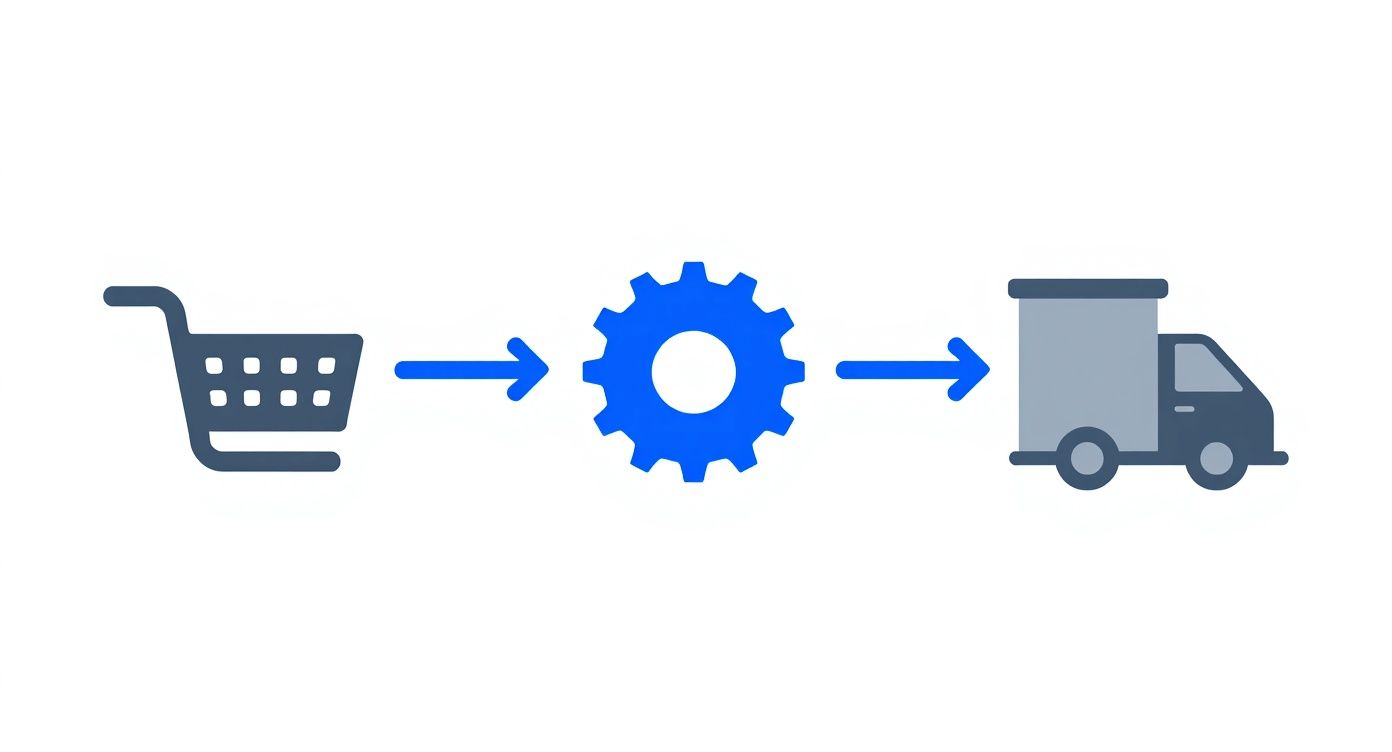
This process highlights just how much manual work you can eliminate by choosing apps with strong, reliable automation.
Prioritize Automation Capabilities and Authentic Reviews
Let’s be real—the whole point of using dropshipping apps is to build an automated, hands-off system. When you're comparing options, focus intently on the features that take manual work off your plate. Does it offer automatic inventory syncing? Bulk order processing? Dynamic price updates? These are the functions that free up your time to focus on marketing and actually growing the business.
Finally, you need social proof. The Shopify App Store reviews are a goldmine of unfiltered feedback. With 87% of Shopify merchants using apps, the user base is massive and they aren't shy about sharing their experiences. Dive into the reviews, but learn to read between the lines.
> Don't just look at the star rating. Look for patterns. Are dozens of users praising the customer support team for being incredibly responsive? Are there repeated complaints about the same bug or a clunky interface? One person complaining about a sync error might be a fluke; twenty people mentioning the same error is a major red flag. These trends tell a much more accurate story than the overall rating ever could.
A systematic approach—vetting suppliers, analyzing pricing, demanding automation, and reading reviews intelligently—is how you move past the noise. It empowers you to confidently select the best Shopify apps for dropshipping that will become the solid foundation your business needs to scale.
To make this process even easier, use this checklist as a scorecard when comparing your top app candidates. It helps you stay objective and focus on the criteria that truly matter for long-term success.
App Evaluation Checklist
Evaluation CriteriaWhat to Look ForRed Flags to AvoidSupplier NetworkAccess to suppliers in your target shipping regions (e.g., US, EU). High-quality product samples.Primarily overseas suppliers with long shipping times. Poor quality or inaccurate product samples.Pricing ModelClear, transparent pricing. A structure that aligns with your sales volume (e.g., low-cost plan for beginners).Hidden fees, confusing tiers, or models that punish growth with excessive commissions.Automation FeaturesAutomatic inventory syncing, one-click order fulfillment, and automated tracking number updates.Requiring manual data entry for orders, inventory, or pricing. Lack of key integrations.Integration QualitySeamless, officially supported integration with Shopify. Positive reviews mentioning reliability.App conflicts mentioned in reviews. Frequent syncing errors or required workarounds.User ReviewsConsistent positive feedback on core features and customer support. Recent, detailed reviews.A high ratio of negative reviews. Repeated complaints about the same bug or poor support.Customer SupportMultiple support channels (live chat, email, phone). Fast response times mentioned in reviews.Slow or non-existent support. A pattern of unresolved issues in user reviews.ScalabilityHigher-tier plans that can support growing order volume without breaking the bank.Plans that become prohibitively expensive as you scale. Lack of features for larger businesses.
By systematically running each potential app through this checklist, you can move beyond marketing hype and make a data-driven decision. This ensures the tools you choose will support your business not just today, but as you grow in the months and years to come.
Crafting Your Perfect Dropshipping App Stack
Think of individual apps as tools in a toolbox. A single screwdriver is useful, but its real power comes when you pair it with a hammer, a drill, and a level. The same goes for your dropshipping store. Building a smart "app stack" is like assembling a specialized pit crew—each app has a specific job, but they all work in sync to win the race.
This is where we move from theory to action. Instead of just grabbing a few popular apps, you need a strategy. The goal is a seamless workflow where data moves effortlessly from product sourcing all the way to customer support, cutting out manual work and making every step of the customer journey better.
https://www.youtube.com/embed/AYwY93IaMzM
Let's break down three distinct, field-tested app stacks you can steal and adapt for your own store.
The Budget-Conscious Starter Stack
This stack is for the entrepreneur who's testing the waters and wants to keep upfront costs near zero. The entire focus is on free and low-cost apps that tap into massive global marketplaces, giving you a huge product selection without denting your wallet.
- Sourcing and Fulfillment: The undisputed champion here is DSers-AliExpress Dropshipping. Its free plan is a powerhouse, letting you import products from AliExpress, process hundreds of orders with a few clicks, and automatically sync tracking info. It’s the engine of a lean startup.
- Marketing and Reviews: Start with Judge.me Product Reviews. Their free plan is incredibly generous, letting you collect and display unlimited text and photo reviews. This is non-negotiable for building trust when customers can't see the product in person.
- Customer Support: Keep it simple. A basic contact form linked directly to your email is all you need. You're not managing a complex helpdesk yet; you just need a reliable way for customers to get in touch.
> The core idea behind the starter stack is validation. You're using free tools to find product-market fit and generate your first sales before you even think about committing to paid software. This stack lets you test if your "Cat-Themed Yoga Mats" store has an audience without spending more than your Shopify subscription.
The Fast Shipping and Quality Stack
Once you've proven your concept, it's time to compete on customer experience. This stack is built around suppliers in the US or EU, which means faster shipping and higher-quality products. This is how you build a brand people trust for its reliability.
- Sourcing and Fulfillment: Spocket is a top contender here. It gives you access to a curated network of pre-vetted suppliers in North America and Europe, with many offering shipping times of just 3-7 days. Yes, the product costs are higher, but that's easily offset by happier customers and fewer "where's my order?" emails.
- Marketing and Reviews: Loox - Photo Reviews is perfect for this model. Visual proof is incredibly powerful, and Loox makes it dead simple to collect and beautifully display customer photos, justifying your premium prices. For example, showing a real customer using your high-end coffee maker is more persuasive than any stock photo.
- Support and Retention: It's time to upgrade your support game with an app like Gorgias or Tidio. Faster shipping creates higher expectations. Responsive live chat becomes critical for answering pre-sale questions and instantly solving any issues that pop up.
The Brand Builder Stack
This stack is for the visionary—the entrepreneur building a unique brand from the ground up. The focus shifts to print-on-demand (POD) and custom branding, creating products you simply can't find on AliExpress.
- Sourcing and Customization: Your go-to platforms are Printful or Printify. They let you put your own designs on a massive catalog of products, from t-shirts and hoodies to mugs and posters. They handle all the printing and shipping, giving you a custom product line with zero inventory.
- Packaging and Branding: An app like Arka lets you order custom-branded packaging, like boxes, mailers, and tissue paper. This completely transforms the unboxing experience. Instead of a generic mailer, your customer receives a box with your logo, making your brand feel established and professional from the moment the package arrives.
- Marketing and Community: Now you need a sophisticated email marketing tool like Klaviyo. Use it to tell the story behind your designs and your brand's mission. This is how you nurture your audience and turn one-time buyers into loyal fans who are invested in your vision.
Apps for Marketing and Customer Retention
Getting your product sourcing and fulfillment automated is a huge step, but it’s really only half the battle. If you talk to any successful dropshipper, they'll tell you the real, sustainable profit comes from finding customers and turning them into raving fans. This is where your marketing and customer retention apps come in—they’re the tools that transform a simple storefront into a genuine brand.
Think of these apps as the engine for your entire customer experience. They're not just optional add-ons; they handle everything from building your email list and sending out killer promotions to showcasing social proof and delivering five-star support. Without a solid game plan here, you're just stuck on a hamster wheel, constantly paying for new traffic instead of building a business that lasts.
Driving Sales with Email and SMS Marketing
Email and SMS are the absolute bedrock of customer retention. These channels give you a direct line to your customers, letting you build actual relationships, drive repeat sales, and manage expectations—something that’s incredibly important when you're dealing with the longer shipping times common in dropshipping.
> One of the classic dropshipping mistakes is going silent after a customer makes a purchase. A simple, automated email flow that keeps customers updated on their order status can slash the number of "where is my order?" tickets and build a ton of trust.
Practical Example: The Post-Purchase Flow
Let's walk through it. A customer places an order. Instead of radio silence, an app like Omnisend or Klaviyo kicks off an automated sequence:
1. Order Confirmation: Right away, a sharp, branded email lands in their inbox confirming the purchase. 2. Shipping Update: A few days later, a second email pops up with a tracking number and a friendly reminder about estimated delivery times. This email can say, "Your order is on its way! Remember, our eco-friendly shipping takes 10-15 days." 3. "Out for Delivery" Notification: An SMS alert lets them know their package is on the truck and arriving soon. 4. Delivery Confirmation: A final email confirms the package has been delivered and asks for a review.
This hands-off, automated flow turns what could be an anxious waiting game into a positive and reassuring experience. You can dive deeper into these strategies and see how powerful email and SMS marketing with Klaviyo can be in our dedicated guide.
Building Trust with Social Proof and Reviews
When you don't physically hold the inventory, building trust is everything. Your most powerful weapon here is social proof, especially genuine customer reviews. It's the ultimate confirmation for potential buyers that real people have bought your stuff and are happy with it.
Apps like Loox, Judge.me, or Ali Reviews are fantastic for automating the whole process of gathering and displaying these testimonials.
Practical Example: Using Photo Reviews
Imagine a store that sells unique home decor. They use Judge.me to automatically email customers two weeks after their order arrives. The email asks for a review and offers a sweet 10% discount on their next purchase if they include a photo.
These user-submitted photos then get showcased in a beautiful gallery right on the product page. This kind of visual proof is infinitely more convincing than any product description you could write. It directly answers the biggest question in a shopper's mind: "Yeah, but what does it *actually* look like in a real home?"
Delivering Excellent Customer Support
Finally, your customer support is your last line of defense—and a massive opportunity to create brand advocates. Dropshipping businesses inevitably run into hiccups they can't control, like a shipping delay or a supplier mistake. A great support app helps you manage these conversations without breaking a sweat.
Tools like Gorgias or Tidio pull all your customer messages—email, live chat, social media DMs—into one clean dashboard. This setup lets you respond quickly and keep track of every conversation. For example, if a customer asks "Where's my order?" via live chat, you can instantly see their order details from Shopify right next to the chat window and give them a precise update in seconds. This turns a potentially bad situation into a win and earns you repeat business, even when things don't go perfectly.
Got Questions About Dropshipping Apps? We’ve Got Answers.
As you start piecing together your dropshipping store, questions are bound to pop up about the tools you're using. That's perfectly normal. Getting straight, practical answers is what helps you move forward with confidence. Here’s a breakdown of the most common questions we see from new entrepreneurs about the best Shopify apps for dropshipping.
How Many Apps Do I *Really* Need to Start?
You can get a fully functional store off the ground with just three essential apps. Seriously.
Start with a solid product sourcing and fulfillment app like DSers, toss in a review app like Loox to build trust, and round it out with an email marketing tool like Omnisend. The whole point is to launch with a lean, mean, effective stack.
> Starting lean is a huge advantage. It keeps your monthly bills low and, just as importantly, your website fast. Only add a new app when you run into a real, repeating problem that automation could fix—think manually sending abandoned cart emails or managing a flood of support tickets.
Whatever you do, avoid "app bloat." Every app you install adds more code to your store, which can drag down your page load times and frustrate potential customers.
Can I Switch My Supplier App Later On?
Yes, you absolutely can switch your main supplier app, but it’s a move that requires a bit of planning to avoid messing up your business operations. A common pivot is moving from an AliExpress-based app like DSers to a US-supplier network like Spocket once you're ready to offer faster shipping.
The key thing to remember is that the new app can't fulfill orders for products you imported with the old one.
Here’s how to handle the switch smoothly: 1. Find new suppliers for your best-selling products within the new app. 2. Order samples to make sure the quality is what your customers expect. 3. Delist the old products from your storefront. 4. Import the new versions of those products through your new supplier app.
It’s always a good idea to manage this kind of transition during a slower sales period to keep any potential hiccups to a minimum.
Are the Free Dropshipping Apps Actually Good Enough?
For anyone just starting out, free dropshipping apps aren’t just "good enough"—they're the perfect place to begin.
The free plans offered by top-tier apps like DSers or CJdropshipping are incredibly capable. They let you import products, process your orders, and sync tracking details without spending a dime upfront.
As your store grows and your order volume picks up, you'll eventually bump up against the limits of those free plans. For example, DSers' free plan might limit you to 3 stores and 3,000 products. That’s when upgrading becomes a necessity to unlock features you’ll need for scaling, like bulk order processing, smarter automation, and priority support. Think of the free plans as your launchpad—they’re designed to help you get profitable *before* you need to invest more.
--- Ready to build the perfect app stack without all the trial and error? TheSaasHub is a curated marketplace of vetted Shopify apps, all hand-picked by e-commerce experts. Find top-rated tools and build a store that’s designed to convert.
Frequently Asked Questions
1. Which apps are best for sourcing high-quality products?
DSers is widely used for AliExpress sourcing due to its bulk ordering features, but many modern dropshippers prefer Spocket or Zendrop because they connect to vetted US and EU suppliers, improving product quality and reducing shipping times.
2. How can I reduce long shipping times for my customers?
The best way to reduce delivery delays is to work with local suppliers through apps like Spocket or use print-on-demand services such as Printful or Printify, which fulfill orders from nearby warehouses for faster shipping.
3. What is the best way to automate the fulfillment process?
Automation tools like DSers and AutoDS help sync orders directly with suppliers and automatically update tracking numbers, allowing store owners to process large volumes of orders without manual effort.
4. How do I handle product price changes from my suppliers?
Many dropshipping apps offer real-time inventory and pricing sync. If suppliers change prices or run out of stock, these tools automatically update your Shopify store to protect margins and prevent overselling.
5. Can I still build a unique brand while dropshipping?
Yes, modern dropshipping tools support branding through private labeling, custom packaging, and print-on-demand customization. Using tools like PageFly also helps create a unique storefront that avoids a generic dropshipping look.