Beyond Building Shopify Apps: The Rise of the App Founder Operating Stack
Building a Shopify app is only the beginning. Explore the emerging app founder operating stack, with Meridian as a case study in connecting infrastructure, monetization, merchant operations and growth.
By Yuvraj Kewate · 2026-10-19
For much of Shopify's history, the central challenge for an app founder was easy to describe. Build something merchants want, connect it to Shopify, publish it in the App Store, and find a way to acquire customers.
That model hasn't gone away, but it has stopped being the whole job.
Building the application is still the fundamental work, but it is increasingly only the starting point. Once merchants begin installing an app, the company behind it has to run an entire system around the product: hosting, deployments, databases, billing, subscriptions, usage tracking, merchant data, analytics, customer communication, automation, security, App Store performance and growth. None of those functions is the application itself. All of them can determine whether the application becomes a sustainable business.
This is creating a new layer in the Shopify ecosystem: an operating stack for app founders.
Meridian is one of the clearest examples of what that stack can look like. The company positions Meridian as the operating platform for Shopify app developers, bringing together infrastructure, monetization, merchant operations, analytics, automation, email, affiliate management, App Store intelligence and developer tooling around the needs of Shopify app companies.
The more interesting story isn't Meridian on its own. It's the problem Meridian is responding to. Shopify made it easier to build software for commerce. The next challenge is making it easier to operate the business around that software.
Editorial note: Meridian capabilities discussed here reflect the platform's public descriptions, not independent product testing. Lifecycle workflows are illustrative examples; founders should confirm available triggers, integrations and plan limits with Meridian before adopting the platform.
Building the App Was Only the Beginning
Shopify's developer ecosystem has always been built on leverage. An app founder doesn't need to build a commerce platform, payment infrastructure, checkout system or merchant administration layer from scratch. Shopify provides the underlying ecosystem, and developers build specialized software on top of it.
That model dramatically lowers the amount of infrastructure required to bring a commerce product to market. It doesn't eliminate the operational work required to turn an application into a business.
A founder builds the first version of an app and gets it running, and then the questions start multiplying. Where should it run? How should deployments be managed? Where do production secrets live? How are logs collected? Does it need a database or Redis? How should subscriptions and free trials work? How is usage measured? How does the team know which merchants are actually active? What happens when a customer approaches a usage limit? How should trial users be contacted? What happens when someone cancels? How does the company measure retention? How does it manage affiliates or understand where it sits in the App Store?
The technical application is only one component of the system. The rest is the operating machinery around it, and that distinction matters more for smaller Shopify app companies than for large ones. A large software organization can spread these responsibilities across engineering, DevOps, product, customer success, lifecycle marketing, analytics and growth teams. A small app company may have only a handful of people responsible for all of them.
That creates a problem that's easy to underestimate. Operational complexity grows even when the application itself stays relatively simple. A useful app might do one narrow job extremely well, but running a SaaS business around that job can require dozens of supporting systems. That's the gap the app founder operating stack is starting to address.
The Hidden Stack Behind a Shopify App
The conventional way to solve this problem is to assemble specialized software. A founder picks one provider for hosting, another for the database, another for email, another for analytics, another for CRM, another for automation, and another for affiliate management. Billing sits somewhere else, while App Store performance and market intelligence live somewhere else again.
There's nothing wrong with this approach on its own. Specialized tools can be genuinely excellent at what they do. The problem is that the app company becomes responsible for connecting all of them.
The merchant exists in the application, but also needs to exist in the CRM. Their subscription needs to stay in sync with billing. Their product activity needs to reach analytics. Their usage may need to influence billing. A lifecycle event may need to trigger an email. That email may depend on a customer segment. A cancellation may need to trigger a retention workflow. Every one of these systems needs to agree about who the merchant is and what state they're in.
The result is an architecture where the app founder isn't just building software; they're building the connective tissue between software systems. That connective tissue has a real cost: engineering time to build integrations, ongoing maintenance to keep them working, and the less visible cost of context switching, moving between multiple dashboards just to answer one question about one merchant.
As the app grows, this fragmentation can become more consequential. The company usually isn't suffering because any individual tool is bad. It's suffering because there are too many tools that all need to work together. That's the underlying case for an operating layer.
Defining the App Founder Operating Stack
The phrase "app founder operating stack" describes something broader than the technical stack used to build an application. It's the collection of systems required to take a Shopify app through its entire commercial lifecycle, from development and deployment through monetization, merchant management, retention and growth.
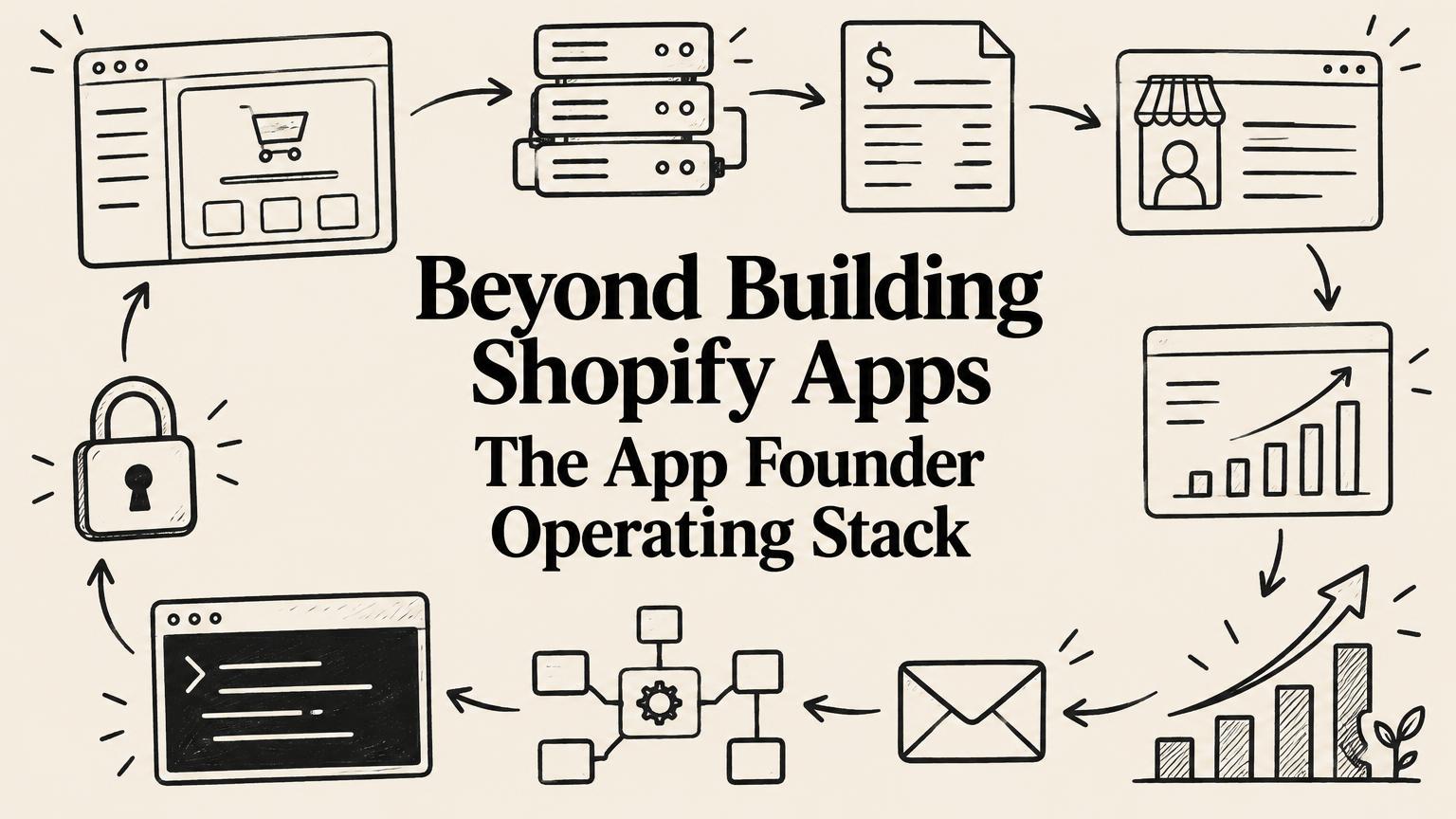
One useful way to picture it is as a loop: Build → Deploy → Monetize → Understand → Operate → Grow.
Build covers the application and the developer environment around it. Deploy covers the infrastructure that keeps it running. Monetize covers plans, subscriptions, trials, billing and usage. Understand covers merchant data, segmentation, product usage and business analytics. Operate covers communication, automation and lifecycle management. Grow covers affiliates, App Store intelligence, keywords and reviews.
These aren't isolated activities; they form a loop. A merchant installs an app. The installation creates a customer record. The customer picks a plan. The merchant generates usage. Usage informs analytics and potentially billing. Their behavior can trigger an automation, which can send an email. Their activity contributes to retention data. Their experience eventually shows up in reviews and in the growth of the application. The more mature the app becomes, the more interconnected these systems get.
That suggests the next generation of Shopify app infrastructure may be defined by something broader than hosting or developer tooling: how well the entire app lifecycle can operate as one system.
Why This Stack Matters More in the AI Era
The timing of this shift is important because AI-assisted development is changing the economics of software creation. If developers can produce working software faster, the relative importance of everything surrounding that software can increase rather than decrease.
The limiting factor can move from writing the first version of the application to getting that application into production, setting up billing that works, understanding customer behavior, building lifecycle systems, and operating the product at scale. AI can reduce the cost of creating the application without necessarily reducing the cost of running the company around it.
That creates a different kind of bottleneck. A founder who can build a prototype in a fraction of the traditional time still has to answer the same questions once merchants show up. The application needs infrastructure. Customers need to be managed. Usage needs to be measured. Revenue needs to be understood. Retention needs to be watched. Communications still need to happen.
For Shopify app founders, that means the question is increasingly not just how quickly an application can be built, but how quickly the company can move from software creation to software operation.
Why Meridian Is an Interesting Case Study
Meridian's product architecture reflects this shift directly. Its publicly described product surface covers organization and account management, app management, billing and subscriptions, usage, stores and merchants, analytics, automations, email, affiliates, hosting and infrastructure, product configuration, market intelligence, permissions and security.
At first glance, those categories look unrelated. Hosting belongs to engineering. Billing belongs to monetization. CRM belongs to customer operations. Email belongs to marketing. Affiliates belong to growth. App Store intelligence belongs to market research. But they have one thing in common: they all exist because a company is running a Shopify app.
Instead of treating each operational function as a separate product, Meridian is built around the app company itself as the customer. Meridian isn't a merchant-facing Shopify application designed to add functionality to a store; it sits on the other side of the ecosystem, helping the developers and companies that build those applications manage the systems around them.
That makes Meridian interesting less as a list of features than as a case study in a broader category: the possibility that the operational layer around a Shopify app can become a platform in its own right.
What Meridian Is Not
It's worth being precise about the category before getting into the individual capabilities. Meridian isn't a Shopify merchant-facing app, a Shopify App Store replacement, a generic cloud hosting provider, or simply a billing system, CRM, analytics tool, email platform, affiliate platform, App Store optimization tool or deployment platform.
It combines those types of functions around one specific customer: the company building and running a Shopify app. Shopify remains the underlying commerce platform and ecosystem. Meridian operates at the developer layer, providing systems that sit around the Shopify application itself.
That distinction is important because it explains why such a broad set of features can exist inside the same product without necessarily being unrelated. The common denominator isn't the technology. It's the app company.
Infrastructure Is the Foundation, Not the Whole Product
Meridian starts with the infrastructure required to build and run an application. Its publicly described capabilities include hosting, deployment, GitHub integration, environments, secrets, logs, database, Redis, scheduler, storage, autoscaling, always-on server capacity, bandwidth, domains and Pub/Sub, alongside vulnerability scanning.
This is the most recognizable part of the proposition, since every production application needs infrastructure. The more interesting question is what happens above that infrastructure. A Shopify app isn't deployed just to sit on a server; it needs to interact with merchants, subscriptions, product events and Shopify's APIs. The infrastructure becomes the foundation the rest of the operating stack is built on.
This matters because infrastructure decisions made early in an app's life can be hard to unwind later. A founder may initially optimize for getting an MVP live, only to discover that the architecture needs to support increasingly complex billing, usage tracking, background jobs, customer data and lifecycle workflows. A platform that brings those capabilities together from the start is making a different proposition: don't just deploy the application, but build the operational environment around it at the same time.
Monetization Becomes Part of the Operating System
One of Meridian's most important layers is billing. Its advertised product includes pricing plans, merchant subscriptions, free trials and usage billing. Founders should confirm billing intervals, one-time charges, capped amounts and usage-threshold support for their intended setup.
The important idea here is that monetization isn't treated as an isolated checkout function. For a SaaS application, a subscription is a state, not simply a transaction. A merchant can start a trial, subscribe, change plans, generate usage, approach a limit, freeze a subscription or cancel, and each of those events changes the commercial relationship between the app and the merchant.
That means billing data can also become operational data. A merchant approaching a usage threshold might need an email. A newly activated subscription might kick off onboarding. A cancellation might trigger a retention workflow. A plan change might alter the merchant's segment or unlock different functionality. Meridian advertises managed pricing and Shopify usage billing alongside automation and merchant-management capabilities.
For an app founder, the value of an integrated billing layer is therefore not simply that it makes charging merchants easier. It's that commercial events can become product and customer events without every system needing to be connected by hand.
The Merchant Becomes the Center of the System
The next major shift is from infrastructure toward merchant operations. Meridian publicly describes CRM and segmentation capabilities alongside merchant and operational data.
That reflects an important change in how an app company thinks about its customers. An installation is a technical event. A merchant is a relationship. That distinction becomes more important as an application grows. Knowing how many stores have installed an app tells a founder something about distribution. Knowing which of those merchants are actively using the product, what plan they're on, how much they use, which features they touch and where they sit in their lifecycle tells the founder something about the actual business.
Merchant data becomes the connective tissue between the different parts of the operating stack. The merchant has a subscription. The merchant generates usage. The merchant receives communications. The merchant belongs to a segment. The merchant can trigger an automation. The merchant contributes to retention and revenue metrics. The merchant can even become an affiliate or referral source. Once the merchant becomes the central object in the system, the rest of the platform starts to make more sense.
Usage Is More Than an Analytics Metric
Usage tracking is another capability that becomes more powerful once it's connected to the rest of the stack. Meridian advertises usage-based billing; teams should confirm which activity views, events and thresholds are available for their app.
For an app using usage-based pricing, this has an obvious financial role. It's also a product and customer signal. A merchant whose usage is climbing quickly could be a sign of successful adoption, or a sign they're about to hit a pricing threshold. The same underlying event can be relevant to product analytics, billing, customer communication and retention at the same time. Declining usage, on the other hand, can be an early warning that a merchant is losing engagement before churn shows up elsewhere.
This is where a unified operating layer becomes more than a convenience. The value isn't just that the founder can see the number; it's that the number can participate in the rest of the system.
Analytics Moves From Dashboards to Decisions
Meridian advertises reports on revenue, stores and churn. These categories point toward a different type of analytics than basic application monitoring; founders should confirm the depth of trial, retention and discount reporting they require.
Application monitoring asks whether the software is working. Business analytics asks whether the software is becoming a viable business, which is a different question. A founder needs to know how many merchants start trials, how many convert, how long they stay, how revenue changes over time and where churn actually happens. Those answers become more useful once they're connected to the merchant and usage data already flowing through the same platform.
This is another place where fragmented systems create friction. If customer data, subscription data, usage data and analytics data all live in different tools, the founder has to build the connections themselves before they can interpret the business. The operating-stack model flips that priority, treating those pieces as belonging together from the start rather than something to be stitched together after the fact.
Automation Turns Data Into Action
If merchant data and analytics tell the founder what's happening, automation is the mechanism that responds to it. Meridian publicly lists automations, email and segments. The precise conditions, actions, wait steps, templates and event triggers available should be confirmed against the current product documentation.
This opens up the possibility of event-driven lifecycle management. A new installation could kick off onboarding. A subscription activation could trigger a different sequence. A merchant approaching a usage threshold could get a warning before they hit it. A cancellation could update the customer's state and start a retention flow. These are examples of the operating-stack model, not a guarantee that every trigger is currently available in Meridian.
None of these workflows is individually difficult to imagine; most SaaS teams already build something similar. What's different is where the workflow lives. In a fragmented setup, the event originates in the application, travels through an integration platform, updates a CRM, triggers an email system, and eventually the result lands back in another database. In an operating platform, the event and the response can live in the same environment from the start, making lifecycle operations much closer to the product itself.
Email Becomes a Product Capability
Email is another place the operating-stack model shows up clearly. Meridian publicly lists email functionality alongside its broader operating capabilities. Teams should confirm template, API and sending-domain requirements for their setup.
For an app founder, email isn't just a marketing channel; it's part of the application lifecycle. A merchant needs onboarding communication after installation, billing-related communication during their subscription, usage notifications as they approach thresholds, and lifecycle communication when their behavior changes. When those messages are driven by events inside the application, email stops being a separate marketing activity and becomes an operational capability.
That changes the question a founder asks. Instead of "which email tool should we connect?", the more useful question becomes "which events in our application should produce communication, and how should those workflows behave?" That's a more product-oriented way to think about lifecycle messaging, and it works best when email sits alongside the merchant data and automation system rather than behind another separate integration.
Growth Extends Beyond the App
The operating stack also reaches outward from existing customers toward acquisition. Meridian publicly lists affiliates as part of its product. Teams should confirm program, commission and payout functionality for their requirements. Affiliate management traditionally sits well outside the technical application stack, but from the app company's perspective it's simply another part of growth. Having it in the same environment as merchant data and billing can also make it easier to connect referral activity with the customer relationships it produces.
Meridian's advertised market intelligence capabilities extend this further, covering App Store analytics, keywords, reviews and market or competitor analysis. A Shopify app doesn't exist in isolation; it competes for attention in an ecosystem full of other apps targeting similar merchants. Founders need to understand more than their own product: how their listing is positioned, what merchants are searching for, how competing apps appear, and what the broader market looks like.
Bringing those capabilities into the same platform creates an end-to-end ambition: build the product, operate the product, understand the customer, and understand the market around the product. That's a considerably broader ambition than conventional developer infrastructure typically attempts.
The Developer Layer Still Matters
Despite the business-facing breadth of the platform, Meridian remains fundamentally developer-oriented underneath it all. Its publicly described developer surface includes MCP and infrastructure tooling. Teams should verify current SDK, CLI, API, Pub/Sub and Shopify API alert support against their needs.
This matters because an operating platform can't rely entirely on a graphical dashboard. Developers need programmatic access to the systems they operate, and they increasingly expect those systems to work inside modern, AI-assisted development environments rather than as a separate tab they have to context-switch into.
The MCP piece is particularly interesting. Meridian's developer MCP is described as allowing developers to connect AI-assisted tools to the platform and perform Meridian operations from their development environment. Meridian advertises access to pricing configuration, deployments and logs from an AI-assisted workflow. Founders should confirm the tools currently exposed by its MCP server.
That makes MCP more than an abstract "AI integration" bullet point. It points toward a model in which the development environment itself becomes an interface to operational infrastructure. For a founder working in an AI-assisted coding environment, the boundary between writing the application and operating the application can become much thinner.
There's also a smaller, easy-to-miss detail in the developer layer: Shopify API Alerts. This isn't the headline feature, but it reflects a practical reality of building on another platform's API surface. An operating platform has to help developers deal with the changes and issues in Shopify's environment that can affect an application.
The broader principle is that the operating stack needs to be accessible from inside the developer's actual workflow, not sitting beside it as one more tab to check.
Security and Team Operations Become Part of the Same Problem
As an app grows, operational complexity isn't limited to the application itself. The team operating it needs its own infrastructure too. Meridian publicly describes team and security capabilities, including infrastructure vulnerability scanning. Founders should confirm organization, collaborator, role and authentication controls, including passkeys, two-factor authentication and session management, before relying on them.
These aren't the most exciting features in the product, but they reveal something important about the category. An operating platform eventually has to account for people, permissions and risk, not just applications. A solo founder can manage much of this informally. A growing company can't. Once multiple developers, applications and environments are involved, access control and operational security stop being an afterthought and become part of the product architecture itself.
The organization model also matters for teams operating multiple apps. Instead of treating each application as a completely separate operational island, an organization-level structure can give a team a common place to manage apps, collaborators and roles.
The Real Value Is the Connection Between the Layers
The most compelling part of Meridian isn't any single feature. Hosting exists elsewhere. Billing exists elsewhere. Email exists elsewhere. Analytics exists elsewhere. Automation exists elsewhere. The interesting part is what happens when those functions understand the same underlying application and the same merchant.
Walk through a simple lifecycle. A merchant installs an app, which becomes a merchant record. They start a trial, and the subscription becomes part of their commercial state. They begin using the product, and usage gets recorded. Their activity feeds analytics. They approach a threshold, an automation responds, and the merchant gets an email. Their behavior later feeds into retention analysis. If they cancel, another workflow can respond. If the app grows, affiliate and App Store intelligence become part of the acquisition loop that brings the next merchant in.
The point isn't that any one of these workflows is revolutionary. It's that they can be understood as one customer lifecycle rather than as a series of disconnected software categories. The merchant remains the common object as the app moves from installation to subscription, usage, communication, retention and growth.
From App Developer to App Operator
The maturation of the Shopify ecosystem is changing what it means to be an app founder. The old model was relatively simple: find a problem, build an app, publish it. The version many founders are operating today looks more like: find a problem, build, deploy, acquire, onboard, monetize, measure, retain and grow.
That second model looks a lot like a conventional SaaS company, because the founder is now combining two worlds at once. There's the technical world of APIs, infrastructure, databases, deployments and application performance, and there's the business world of subscriptions, customers, retention, revenue, lifecycle communication and growth.
The app founder operating stack sits at the intersection of both. Its purpose is not necessarily to eliminate every specialized tool, but to reduce the amount of operational infrastructure and integration work the app company has to build and maintain itself.
The Case for Consolidation
There's a natural question here: why not simply keep using best-of-breed tools for each piece?
For some companies, that will remain the right answer. Specialized software can offer deeper functionality, more customization or a better fit with an existing enterprise architecture, and a mature app company may already have systems it has no reason to replace.
The argument for consolidation isn't that specialized tools are obsolete. It's that integration itself has become an operating cost. Every additional service is another relationship to maintain. Every integration is another dependency. Every piece of synchronized data is another potential failure point. For a small app company, that can add up disproportionately quickly relative to the size of the team.
The founder usually doesn't care whether an email provider has hundreds of advanced features. They care that an installation event can reliably trigger onboarding without requiring a six-system integration to make it happen. They may not need a generic analytics platform with hundreds of dashboards; they need to know which merchants are churning and why. They may not need a generic CRM built for every industry; they need something that already understands Shopify stores, subscriptions and app usage.
That's where vertical platforms can have a meaningful advantage. The more specific the platform is to the actual business model, the more of the integration problem it can potentially eliminate from the start.
What This Means for Shopify App Founders
The practical takeaway isn't that every app founder should immediately rip out their existing stack and replace it with a single platform. It's that founders should start treating the operating stack as part of the product architecture from the beginning, rather than as an afterthought once the core app is finished.
When planning a new app, infrastructure and billing shouldn't wait until the product is done. Merchant data, usage events, subscription state, lifecycle communication and analytics eventually become part of the product experience whether they were planned for or not.
For an existing app, the more useful exercise is an honest operational audit. How many systems does the team actually depend on? Where does merchant data live? Where does subscription information live? How is usage captured? What happens when a merchant installs, upgrades, approaches a limit or cancels? Which customer events actually trigger communication today, and which ones should but don't? How are retention and churn measured? How much engineering time goes into maintaining integrations versus improving the actual application?
Those questions reveal the true operating cost of the current stack, and they also reveal where consolidation could genuinely help.
It's also worth remembering that the app founder operating stack, as a category, is bigger than any single product, Meridian included. Some founders will keep assembling their own stack from specialized providers. Others will lean on infrastructure platforms, CRM systems, billing services and automation tools kept separate. Larger companies may build meaningful portions of this internally. What's changing across all of those approaches is the growing recognition that the software business around a Shopify app has its own infrastructure requirements, separate from the app's codebase, and those requirements deserve to be planned for rather than discovered under pressure.
The Next Shopify App Stack May Be Defined by Operations
The Shopify ecosystem has already moved through several phases. First came the opportunity to build applications on top of Shopify. Then came a much larger ecosystem of tools, agencies and infrastructure providers supporting those applications. Now another layer is emerging: platforms designed specifically to make operating the app company itself easier.
That shift is a logical one. As the ecosystem matures, the technical challenge moves up a level. It's no longer enough to ask whether an app can be built. Founders have to ask whether it can be operated efficiently: can the team deploy reliably, understand its merchants, monetize different usage patterns, automate lifecycle events, measure retention, communicate with customers, respond when something changes in the Shopify ecosystem, manage its own infrastructure and security, and grow without adding a corresponding collection of operational systems?
Those aren't purely engineering questions anymore. They're questions about the operating model of the company itself.
What Comes After the App
The next generation of Shopify app founders will likely be able to build applications faster than previous generations. AI-assisted development will continue lowering the cost of prototyping and iteration. Shopify will continue providing the underlying commerce ecosystem. Developers will continue finding specialized problems merchants are willing to pay to solve.
But faster software creation raises a new question: what happens after the code works?
The answer increasingly involves an operating system around the application. Infrastructure keeps it running. Billing turns usage into revenue. Merchant data turns installations into relationships. Analytics turns activity into insight. Automation turns insight into action. Email keeps the relationship moving. Affiliates and App Store intelligence feed the growth loop that brings the next merchant in.
The application is still the product. It just isn't the whole company.
Frequently Asked Questions
What is the App Founder Operating Stack?
It's the collection of technical and business systems required to build, deploy, monetize, understand, operate and grow a Shopify application. It can span infrastructure, billing, merchant data, usage tracking, analytics, email, automation, affiliates and App Store intelligence.
Is Meridian a Shopify app for merchants?
No. Meridian is built for Shopify app developers and the companies operating those apps. It sits on the developer side of the ecosystem rather than being installed by merchants from the Shopify App Store.
Who is Meridian designed for?
Meridian is designed around Shopify app developers and app companies, including teams that need infrastructure, billing, merchant operations, analytics, automation and growth capabilities around one or more Shopify applications. Teams should confirm the organization, collaborator and role controls they require.
Does Meridian replace Shopify?
No. Shopify remains the underlying commerce platform and ecosystem. Meridian operates at the developer layer, providing systems that sit around the Shopify application itself.
How does the MCP integration actually work day to day?
Meridian describes its Developer MCP as a way to connect AI-assisted development tools to the platform. Its advertised developer workflow includes pricing configuration, deployments and logs. Founders should consult Meridian's MCP documentation for the currently supported tools and required permissions.
Will every Shopify app need a platform like this?
Not necessarily. Teams with mature existing systems, or specific needs that a vertical platform doesn't cover well, may reasonably keep pieces of their stack separate. The broader trend is that the operational requirements around a Shopify app have become substantial enough to justify purpose-built infrastructure for some founders and teams.
Final Takeaway
The Shopify app ecosystem is entering a phase where building the product and operating the business are becoming two distinct challenges.
For founders, the next competitive advantage may not come only from how quickly they can build an app. It may also come from how efficiently they can move from an idea to a reliable, monetized and continuously improving software business.
That requires an operating stack.
Meridian's approach is to bring much of that stack into a Shopify-specific platform, connecting infrastructure with the commercial and operational systems that surround the application.
The larger category, however, is bigger than Meridian. It is the recognition that behind every Shopify app is another product most merchants never see: the operating system that allows the founder to build, deploy, monetize, understand, operate and grow it.
Shopify gave developers a platform for commerce. The emerging app founder operating stack is about giving the companies building on that platform a more integrated way to run the businesses they create.
The next chapter of the Shopify app economy may not be about building more apps. It may be about building better systems for the people who run them.
Ready to Operate Your Shopify App as a Business?
Building the app is only one part of the job. The next step is having the infrastructure, billing, analytics, merchant operations, automation, and developer tooling to run it as the business it can become.
Try Meridian and see what an operating platform for Shopify app developers can look like.
Build less operational complexity into your stack, and spend more time building the app itself.
Beyond Building Shopify Apps: The Rise of the App Founder Operating Stack