Earnings Call Sentiment Analysis: A Practical Guide
Learn earnings call sentiment analysis step by step, from transcripts and audio to NLP models, bias, evaluation, and deployment for real investor use cases.
By Yuvraj Kewate · 2026-10-13
The earnings release landed before the morning meeting. EPS beat expectations, revenue was in line, and the stock moved anyway. Your team has the transcript open, but the useful signal isn't obvious. The CEO sounds confident, the CFO qualifies several answers, and an analyst keeps returning to the same unresolved issue. A dashboard that reduces the entire call to “positive” won't tell you which part matters.
Earnings call sentiment analysis works better as a probability signal about how qualitative language complements reported numbers. It doesn't produce a buy or sell verdict. A strong system measures tone, uncertainty, speaker credibility, disagreement, and changes from the company's own historical language, then tests whether those features add information around the event.
Table of Contents
- Why Earnings Call Sentiment Analysis Is Harder Than It Looks
- Collecting Transcripts and Audio Without Breaking Your Pipeline
- From Lexicons to Large Language Models
- How Artul.ai Can Help
- Speaker, Section, and Question-Aware Scoring
- Evaluation, Bias, and Common Modeling Pitfalls
- Small-Cap, International, and Cross-Market Generalization
- Deployment, Monitoring, and Real Business Use Cases
Why Earnings Call Sentiment Analysis Is Harder Than It Looks
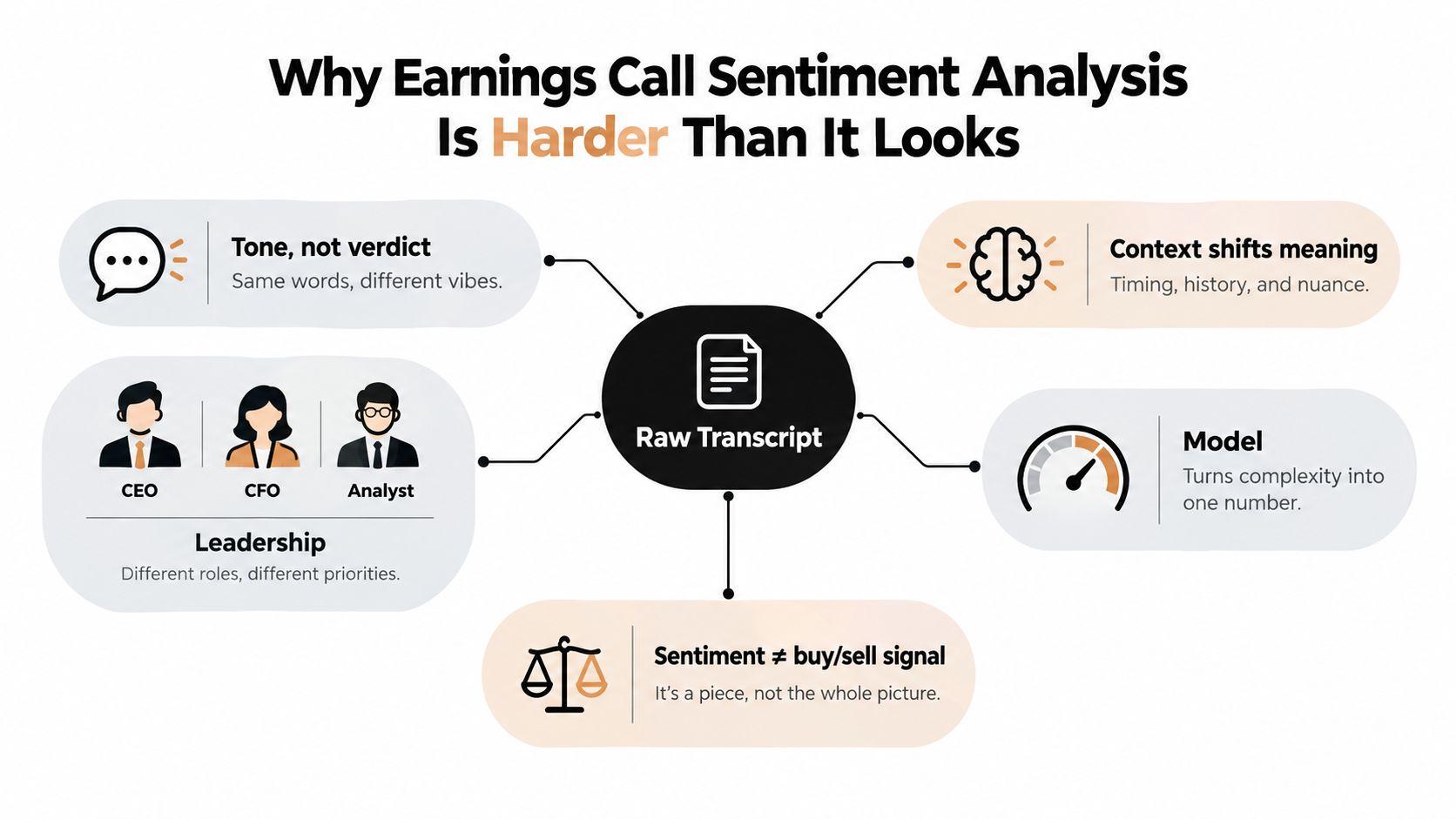
A raw transcript looks like a document, but an earnings call is an interaction. Management delivers prepared remarks, analysts challenge the narrative, executives answer under pressure, and the moderator controls the transitions. Each layer has a different purpose, vocabulary, and level of spontaneity.
A single sentiment score erases those distinctions. It can average a carefully scripted opening statement with a hesitant answer from the CFO and a skeptical analyst question, then label the call “moderately positive.” That label may be technically consistent with the words in the transcript and still be useless for research.
The question comes before the model
Start by defining the decision you need to support.
- Event reaction: Did management's language add information beyond the earnings surprise during the announcement window?
- Forecast revision: Did guidance, uncertainty, or answer quality change expectations about future performance?
- Risk monitoring: Did executives introduce language associated with operational, legal, or financial risk?
- Competitive intelligence: Did the company's confidence or discussion of a market change compared with earlier calls?
- Research triage: Which calls deserve a human review first?
These questions need different labels and validation windows. A model built to detect immediate market reaction shouldn't be judged by its ability to summarize a company's strategy. A system built for competitor monitoring may care more about tone change and topic coverage than polarity.
The historical case for this work is stronger than “positive words are good.” A foundational study reviewed in a 2024 academic review found that both positive and negative earnings-call sentiment were significantly associated with abnormal returns, post-earnings-announcement drift, and abnormal trading volume. The important contribution was that qualitative language contained information not fully captured by EPS or other headline figures, with qualitative call information showing greater explanatory power for subsequent returns over longer horizons than the earnings figures themselves (the academic review of earnings-call sentiment and market outcomes).
Positive language can hide disagreement
Consider a call where the CEO describes demand as durable, while the CFO repeatedly narrows the outlook and avoids committing to a margin target. A call-level average might remain positive because the prepared remarks contain polished growth language. A speaker-aware system would flag executive divergence.
That distinction matters because disagreement can carry more information than the average tone. Recent research defines tone distance as the difference in tone among managers and associates greater divergence with lower event-period returns, higher volatility, greater information uncertainty, and higher operational risk (research on tone distance and executive disagreement).
Practical rule: Treat a headline sentiment score as a starting coordinate, not a conclusion. Always show who created the tone, where it appeared, and how it changed.
The right mental model is therefore conditional. Given the earnings surprise, guidance, historical language, speaker role, and call structure, how much does this language change the probability of a market or business outcome? That framing determines your data pipeline, model choice, evaluation design, and reporting interface.
Collecting Transcripts and Audio Without Breaking Your Pipeline
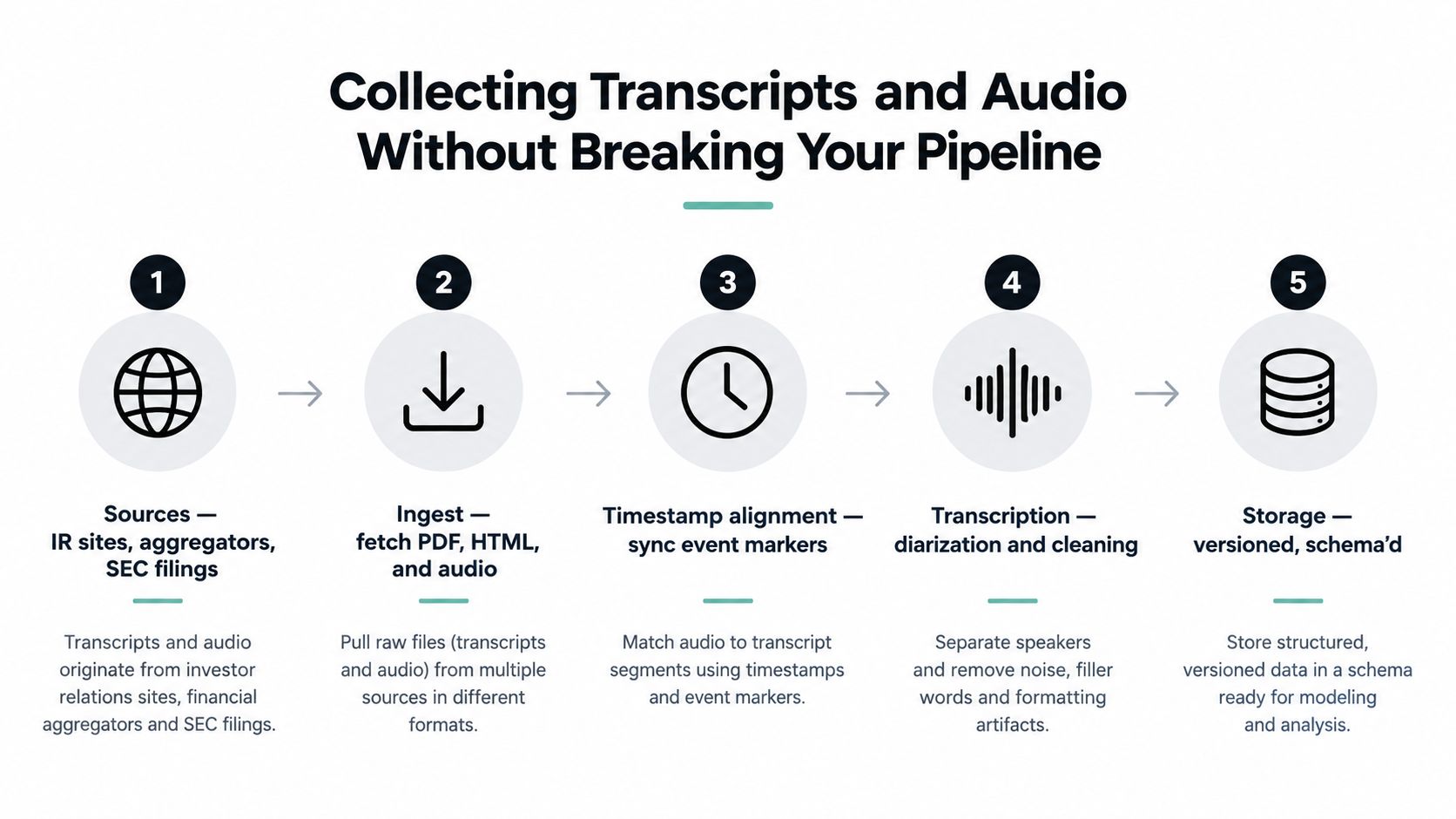
Model quality often fails before modeling begins. Missing timestamps, inconsistent speaker labels, duplicated safe-harbor text, and transcript revisions can distort sentiment more than the choice between two competent classifiers.
Begin with a source hierarchy. Company investor-relations pages can provide official releases, presentations, and audio. Filing databases can anchor formal disclosures. Transcript aggregators may offer cleaner speaker formatting and faster search, but their coverage and licensing terms vary. Store the original file, retrieval time, source identifier, and a content hash so you can distinguish a revised transcript from a new event.
Build the event record first
Every call should receive a durable event record before text enters the model. Include the company identifier, fiscal period, announcement timestamp, call start time, market timezone, document type, and whether the text represents prepared remarks or Q&A.
That timestamp alignment supports clean event studies. A transcript posted after the call isn't automatically the same event as the earnings release. If you use the wrong event marker, the model may appear predictive only because the label window contains information that was already public.
A useful ingestion sequence looks like this:
- Capture the release context. Save the earnings release, guidance materials, transcript, and audio reference together.
- Normalize the document. Convert HTML, PDF, and plain text into a common schema while preserving paragraph boundaries.
- Recover speaker identity. Map names to roles such as CEO, CFO, operator, analyst, or other executive.
- Mark call sections. Separate prepared remarks, Q&A, introductions, disclaimers, and closing comments.
- Version every transformation. Keep raw and processed text so a changed parser doesn't invalidate historical comparisons.
Audio is useful, but not free
Audio earns its place when vocal affect, interruptions, pacing, or answer timing matter. Research has associated vocal affect in Q&A with contemporaneous returns even after controlling for linguistic content and quantitative information, so audio can add a complementary signal (research on credibility, tone, and vocal affect).
It also adds engineering risk. Automatic speech recognition can mishear ticker symbols, product names, figures, accents, and specialized terminology. A Whisper-class system is flexible and economical for internal experimentation, while a commercial financial ASR service may provide stronger support, diarization, confidence scores, and operational guarantees. Neither removes the need for spot checks.
Two-speaker diarization may work for a simple call. Multi-speaker diarization is safer when several executives and analysts participate, but it can confuse overlapping speech and similar voices. Preserve word-level confidence and unresolved speaker labels rather than assigning every segment by default.
Clean language without deleting the signal
Strip moderator boilerplate, repeated connection notices, and generic safe-harbor language when they don't answer the research question. Don't remove every disclaimer automatically, though. A change in the scope or intensity of forward-looking language can itself matter.
Normalize numbers and ticker mentions into consistent representations. Tag forward-looking statements, guidance references, questions, answers, interruptions, and hedging phrases. Keep the original text beside every normalized field so analysts can inspect the evidence.
A practical schema should make it possible to query: what was said, by whom, in which section, in response to which question, at what time, and with what transcription confidence. Without those fields, later modeling becomes guesswork.
From Lexicons to Large Language Models
There isn't one universally best model. The sensible choice depends on whether you need transparent drivers, low latency, domain fit, or flexible interpretation.
What each layer contributes
Finance-specific lexicons remain valuable because they expose interpretable dimensions. The Loughran–McDonald vocabulary supports measures such as uncertainty, litigiousness, constraining language, and sentiment. Lexicons are fast and easy to audit, but they don't understand negation, speaker intent, or context well. A phrase can contain a word associated with risk while describing a risk that has already been resolved.
Classical machine learning improves structure without eliminating that limitation. TF-IDF, n-grams, linear classifiers, and document embeddings can perform well when labels are stable and the vocabulary is controlled. They're easier to retrain and inspect than a large generative model, but they can struggle when a term changes meaning across financial contexts.
Finance-specific transformers are the practical workhorse for polarity and sentence-level classification. A 2023 study using FinBERT measured sentiment across 28,873 earnings conference-call transcripts from 2003 through 2020. In its labeled evaluation sample of 10,000 sentences, 3,577 were positive, 4,586 neutral, and 1,837 negative. FinBERT sentiment aligned more closely with investor market reactions than the other NLP measures tested (the FinBERT earnings-call study).
That result supports domain adaptation, not blind trust. FinBERT can estimate polarity, while a lexicon can separately measure uncertainty or litigiousness. Combining them usually gives a more useful representation than asking one model to explain every dimension.
Prompted large language models are effective for ad-hoc extraction, comparison, and evidence selection. They can answer questions such as “Which guidance topics did the CFO avoid?” or “What changed from the previous call?” They're less attractive as an uncalibrated production score because outputs can vary with prompts, context ordering, model updates, and transcript chunking.
A knowledge base for artificial intelligence can help teams document prompts, labels, and evidence conventions, but documentation doesn't replace out-of-sample validation.
| Approach | Cost | Finance vocabulary fit | Explainability | Best for |
|---|---|---|---|---|
| Finance lexicon | Low | Explicit but limited | High | Uncertainty, risk, and audit trails |
| Classical ML | Low to moderate | Depends on training data | Medium to high | Stable labeled tasks and fast scoring |
| FinBERT-style transformer | Moderate | Strong domain fit | Medium | Polarity and sentence-level sentiment |
| Prompted LLM | Variable | Broad contextual understanding | Variable | Exploration, extraction, and qualitative review |
Evaluate the task, not the fashion
For a live alerting system, start with a finance-specific transformer plus lexicon features. For a strategy team exploring an unfamiliar topic, add an LLM as a research assistant that cites transcript excerpts. For regulated or high-stakes workflows, keep a deterministic baseline and require evidence for every generated conclusion.
Avoid random sentence splits when the same call contributes to both training and testing. Split by time and, where possible, by company. Otherwise the model can memorize recurring management language and appear more reliable than it is.
How Artul.ai Can Help
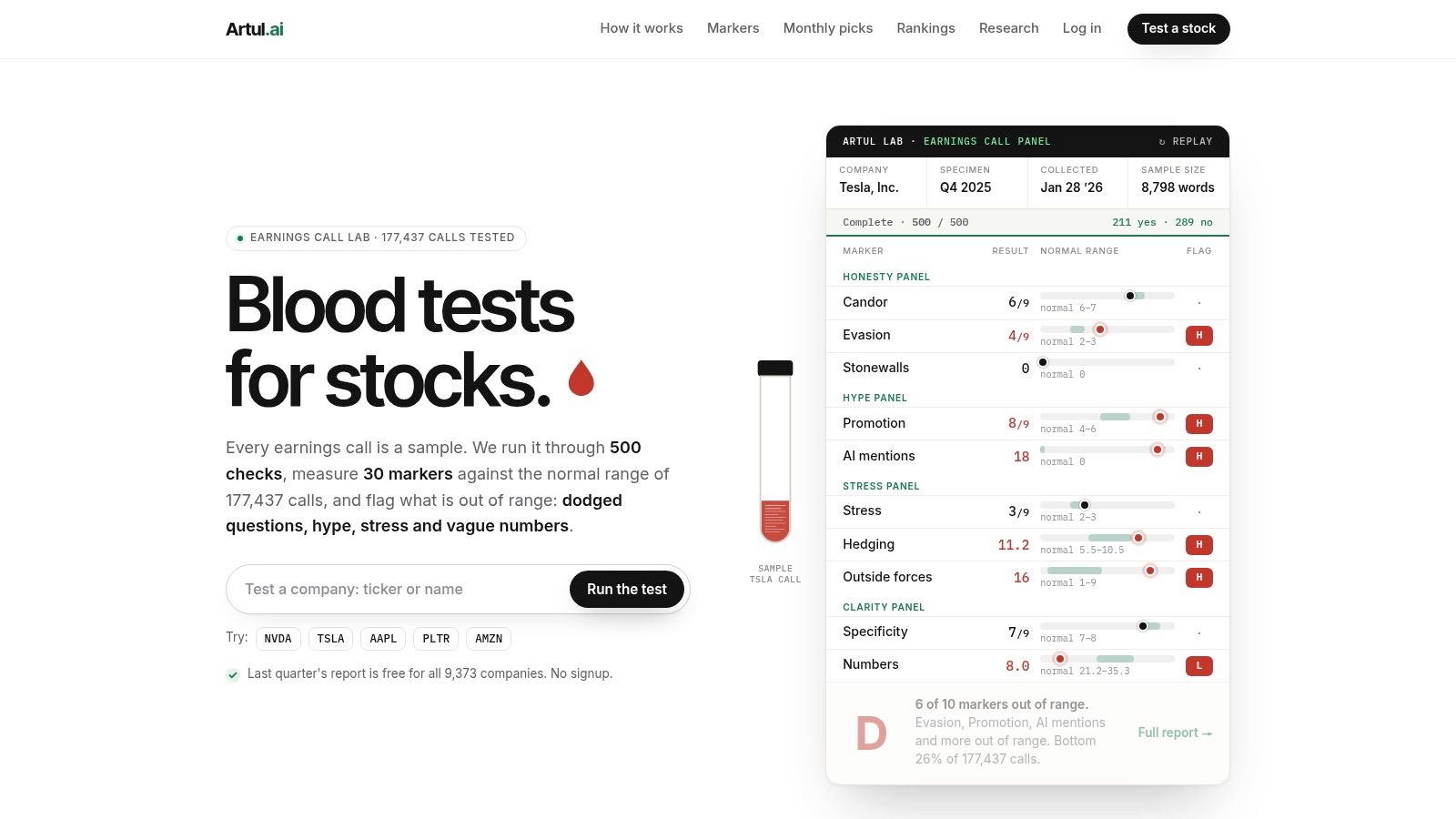
Artul.ai is a subscription web application designed to analyze executive communications and financial filings for publicly traded U.S. companies. It turns plain-English questions about wording, tone, and topics into evidence-backed patterns connected with subsequent market performance, which makes it useful when the bottleneck is hypothesis testing rather than raw model development.
The platform ingests and indexes earnings calls, Q&A, 10-K and 10-Q filings, and related disclosures. Its natural-language interface lets a researcher ask about executive language without building a query language, while the evidence viewer surfaces representative excerpts tied to the detected pattern. It also provides summaries with directionality and confidence indicators, rather than forcing the user to read every document before forming a hypothesis.
Where it fits well
Artul.ai is a sensible choice for investors and research teams that want to investigate executive-language signals across U.S. equities without assembling ingestion, indexing, historical matching, and evidence retrieval themselves. It can accelerate questions such as whether a phrase, behavior, or tone pattern has appeared before and how matched cases performed over configurable horizons.
That makes Artul.ai's earnings call sentiment analysis most useful for rapid discovery, comparative research, and evidence gathering. It isn't a substitute for validating a speaker-aware model on your own universe, and its U.S.-equity focus means international deployment still needs separate testing.
The product's strengths are practical: near-real-time updates, historical financial text and metrics, private user workflows, representative matches, and a discovery library on higher plans. Its subscription structure includes an Explorer plan at $1 per month for one question per month, a Professional plan at $97 per month for 200 questions per month, and Fund plans starting at $500 per month with collaboration and priority support. Those plan details may change, so confirm current terms before purchasing.
Use it when your team needs to test a language hypothesis quickly, review supporting excerpts, or monitor executive wording without maintaining a full data platform. Don't use any tool's directional label as a standalone investment decision. The evidence, controls, market coverage, and assumptions still need human review.
Speaker, Section, and Question-Aware Scoring
A call-level score hides the structure that creates meaning. Separate the transcript before calculating sentiment, then retain both the granular scores and the aggregate view.
Segment by role and section
At minimum, create separate streams for CEO, CFO, other management, analysts, prepared remarks, and Q&A. The CEO often frames the narrative. The CFO may provide more constrained financial detail. Analysts reveal what the market is probing, while management answers reveal whether executives address the question directly.
Prepared remarks are rehearsed and optimized for consistency. Q&A contains interruptions, clarification requests, challenges, and evasive answers. Combining the two can make polished language overpower the less scripted evidence.
For each segment, calculate more than polarity:
- Net tone: Positive language minus negative language, normalized for segment length.
- Uncertainty: Hedging, conditional language, and unresolved statements.
- Constraint: Language that limits commitments or narrows interpretation.
- Question pressure: Topic difficulty, repeated questions, and follow-up requests.
- Answer alignment: Whether the response addresses the question asked.
- Historical change: Difference from the company's prior calls and speaker baseline.
Tone distance then becomes a first-class feature. Measure disagreement between executives, between prepared remarks and Q&A, and between the analyst tone and management response. A positive aggregate score with a large internal gap deserves a different label from a moderately positive call with consistent language.
Aggregate with a reason
A simple mean treats every segment as equally informative. That choice is convenient, not neutral. A recent study of 16,428 S&P 500 calls found that aggregation methodology materially changed predictive performance. A section-weighted approach produced a Spearman information coefficient of 0.119, compared with 0.081 for a simple mean, and analyst sentiment received the greatest weight (research on section-weighted aggregation and analyst sentiment).
Those figures don't prove that one fixed weighting scheme works everywhere. They show why aggregation must be treated as a modeling decision. Learn weights on historical data, constrain them so one unusually long segment can't dominate, and report the underlying components beside the combined score.
Question-aware scoring adds another layer. Pair each analyst question with the relevant answer and assess whether management provides a direct response, changes the subject, repeats prepared language, or introduces new uncertainty. Evasiveness shouldn't be inferred from one phrase. Look for answer length, topic overlap, conditional wording, repeated deflection, and whether a follow-up question was required.
Research-grade output: “Overall tone positive, Q&A tone weaker, CFO uncertainty elevated, executive tone distance widened, confidence moderate.” A single “positive” badge is not enough.
Evaluate the system with event-study windows around the call and separately test longer-horizon drift. Track calibration, not just ranking accuracy. If the model says an event has high confidence, the observed outcomes should justify that confidence across time and subgroups.
For practical workflows involving stored conversations and longitudinal review, AI chatbot conversation archives and insights offer a useful analogy: preserve the interaction context instead of reducing every exchange to one summary field.
Evaluation, Bias, and Common Modeling Pitfalls
The most dangerous error is interpreting optimism as reliable information. Executives can use confident language while disclosing weak evidence, and cautious language can reflect credibility rather than deterioration.
Test timing before performance
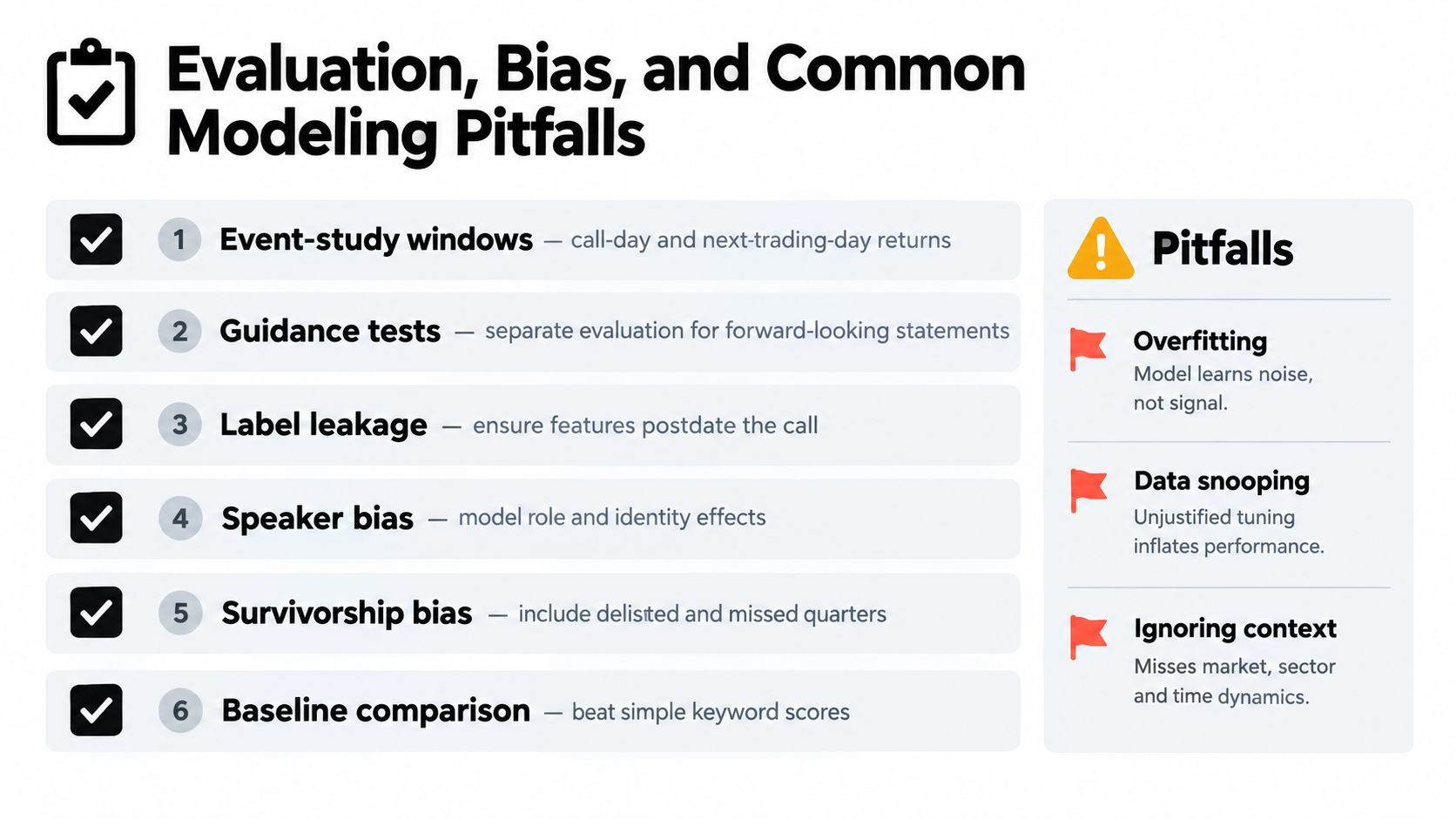
Use the call day and next trading day for immediate market reaction. Then test post-call drift separately. If you combine all horizons, the model may learn when prices react rather than what language means.
Control for earnings surprise, guidance changes, firm size, volatility, industry, and market returns. Compare the full model with simple baselines such as keyword counts, historical tone, and the numerical earnings surprise. A complicated model that doesn't beat those baselines isn't earning its operational cost.
The evaluation split must respect time. Features must be available at the call timestamp. Don't let a later transcript correction, analyst revision, or price movement enter the feature set for an earlier prediction.
Optimism, credibility, and audio
Research on U.S. conference calls found that less optimistic year-end tone is associated with greater future stock-price crash risk, while investor responses vary with speaker and message credibility (evidence on tone, credibility, and crash risk). The relationship isn't a simple “more positive is better” rule.
Add features for hedging, certainty, forward-looking statements, guidance specificity, question difficulty, interruptions, and changes from the company's own language. Audio can complement text through vocal affect in Q&A, but prosody is easy to overfit to speaker identity, microphone quality, and recording conditions. Treat it as an additional feature family, not a replacement for transcript analysis.
Monitor the silent failures
Accuracy can look stable while calibration deteriorates. Track whether confidence levels remain meaningful across sectors, market regimes, management speakers, languages, prepared remarks, and Q&A.
Review these failure modes explicitly:
- Label leakage: A feature includes information released after the call.
- Speaker bias: The model learns identity instead of language.
- Survivorship bias: The universe excludes companies that disappeared or stopped reporting.
- Section imbalance: Long prepared remarks overwhelm shorter but informative answers.
- Convention drift: New disclosure practices change how executives speak.
- Threshold dependence: A fixed alert threshold behaves differently across industries.
A good production report should show calibration curves, subgroup performance, error examples, and the model version that generated each score. If stakeholders can't inspect why a call was flagged, they'll either overtrust it or ignore it.
Small-Cap, International, and Cross-Market Generalization
A model that works on large U.S. companies may not travel cleanly to a small-cap issuer or a non-U.S. market. The research base is concentrated in U.S. large-cap samples, and a recent review explicitly questions generalization to small-cap, international, and emerging-market companies (the review of generalization limits).
A 2025 study of calls from May through November 2024 included 124 calls and found suggestive, but not statistically significant at the 95% level, evidence connecting highly positive sentiment with excess returns. The authors also warned that the restricted window limited generalizability (the study of sentiment and excess returns). Because that URL has already been used for the review, the study should be assessed as part of the same evidence base, not treated as independent confirmation.
Use a transferability checklist
Before deploying outside the training market, validate:
- Country: Refit or recalibrate separately by market.
- Sector: Compare language conventions within the relevant industry.
- Language: Test translation loss, multilingual code-switching, and finance vocabulary.
- Disclosure style: Distinguish cautious guidance from genuine negativity.
- Analyst mix: Check whether question depth and challenge patterns differ.
- Liquidity: Control for trading conditions that affect event returns.
- Time zone: Align call timing with the local and relevant reference market.
- Fundamentals: Include earnings surprise and guidance changes as controls.
Translation is especially risky for hedging and certainty. A phrase that sounds cautious in one language may be conventional investor-relations wording in another. A model can also confuse language difficulty, accent, or transcription quality with negative sentiment.
Communicate the result to non-technical stakeholders as a market-specific probability signal. Say that the model identified language patterns associated with a historical outcome under defined controls. Don't say that management “caused” the return or that the score is portable across every company.
For a small-cap or international rollout, the first useful deliverable isn't a global dashboard. It's a local validation report with confidence intervals, error examples, subgroup results, and a clear statement of where the model has no evidence.
Deployment, Monitoring, and Real Business Use Cases
A production system should ingest new transcripts, preserve versions, rescore historical calls when the model or language conventions change, and alert on tone surprise rather than raw polarity. Tone surprise can be estimated by modeling tone against recent operating performance, historical tone, firm effects, and executive effects, then examining the residual change.
Dashboards should keep management tone, analyst tone, prepared remarks, Q&A, uncertainty, and tone distance visible. Store the supporting excerpts beside every alert. A user who can't move from signal to evidence will treat the system as a black box.
Match the workflow to the team
- Event-driven investors: Add tone surprise and Q&A features to post-earnings research, while controlling for earnings surprise and guidance.
- Long-short teams: Compare historical speaker and section patterns across a defined universe, then validate with rolling time splits.
- Corporate strategy teams: Track competitor language across quarters and flag changes in confidence, risk, and category discussion.
- Product and growth teams: Monitor how public companies describe a category, customer demand, or competitive pressure, then compare that language with internal pipeline observations.
Use rolling backtests, model-version comparisons, and calibration monitoring. Don't let a successful historical pattern become a permanent rule without checking whether the underlying disclosure behavior has changed.
If you're designing an analytics workflow beyond earnings calls, a practical guide to AI analytics for Shopify retention and lifetime value illustrates the same operating principle: define the business question first, connect the model to evidence, and monitor whether the output remains useful.
Your next step depends on your role. An investor should begin with a speaker- and section-aware research template for a defined universe. A finance team should build a versioned transcript pipeline and event-time labels. A strategy team should compare one company's language with its own historical baseline before expanding coverage. In every case, keep sentiment as one evidence layer, never the decision itself.
If you're building or evaluating an earnings-call workflow, start with the transcript fields that matter most: speaker role, call section, question-answer pairing, timestamp, tone, uncertainty, and historical change. Then test whether those features add information beyond the earnings surprise in your market. For practical software research, implementation guidance, and AI tooling comparisons, explore The SaaS Hub and use the findings to choose a workflow your team can validate and maintain.