
How to Sell Data: A Playbook for SaaS Founders
Learn how to sell data as a governed product. Step-by-step guide on pricing, compliance, APIs, and choosing the right monetization model for your data.
By Yuvraj Kewate · 2026-10-13
The most valuable data product is often the one with the fewest usable fields, not the largest database. The U.S. Federal Trade Commission's investigation of nine major data brokers documented approximately $426 million in combined annual revenue from products sold in 2012, but that revenue came from defined commercial applications rather than undifferentiated files. Five brokers generated more than $196 million from marketing products, while four generated approximately $177 million from risk-mitigation products (Federal Trade Commission report).
That distinction still determines whether a SaaS founder can sell data profitably. Buyers don't pay for rows because rows exist. They pay for a better decision, a faster workflow, lower operational risk, or an insight they couldn't reproduce easily. The practical question isn't “How do I export this database?” It's “What governed product can I offer, to whom, for which decision, under what rights?”
Table of Contents
- Understanding the Economics of Data Selling
- How to Prepare and Package Your Data as a Product
- Choosing the Right Delivery Model and Pricing Strategy
- How SourceX Can Help
- Navigating Consumer Trust and Privacy Constraints
- Calculating Willingness to Share and Incentivizing Contributions
- Entering Marketplaces and Closing Direct Enterprise Deals
Understanding the Economics of Data Selling
The unit of value in data sales is not the row. It is the permissioned outcome a buyer can use with confidence.
A raw export usually pushes cost downstream. The buyer still has to interpret the schema, verify provenance, strip or suppress sensitive fields, test quality, build an integration, and decide whether the asset is safe enough and reliable enough for the intended use. That extra work lowers willingness to pay, even if the dataset looks large in a sales deck.
Higher-value products reduce that burden. They are built around a specific commercial job: an audience segment for acquisition, a benchmark for planning, an alert for intervention, a risk score for screening, a governed dataset for model training under clear usage rights. The same FTC segmentation found demand for segmentation, analytics, reports, and risk products, which is the useful lesson for sellers. Buyers pay more readily when the product already fits a workflow and a decision.
Commercial rule: Sell the decision your data improves, not the volume of information your system stores.
Start with the buyer's decision
Start with the operating moment, not the file format. Who uses the product, what decision are they making, and what happens if the signal is late, noisy, or legally unusable?
The answers change the product. A revenue operations lead may want account-prioritization signals inside an existing CRM. A fraud team may need a continuously refreshed indicator with clear thresholds and review paths. A merchandising team may want an aggregated benchmark that is stable enough to support planning. An AI buyer may need rights-cleared operational records, documented exclusions, and contract terms that define permitted use, retention, and downstream sharing.
Those buyers all say they are buying “data.” Their evaluation criteria are different. One team will focus on latency and API reliability. Another will focus on coverage, false positives, and refresh cadence. A third will ask harder questions about provenance, deidentification, auditability, and whether counsel can defend the license if procurement escalates.
That is why a structured research view of Shopify's changing commerce field can be more useful than a generic export from a store system. Buyers usually do not want undifferentiated transaction history. They want a governed view that answers a business question fast enough to affect action.
Measure utility instead of guessing at a record price
Pricing gets distorted when founders start by asking what a record is “worth.” The OECD's economics review cited earlier makes the underlying problem clear: there is no single accepted way to value personal data across contexts. In practice, buyers anchor value to commercial utility, replacement cost, legal risk, and how quickly the asset changes outcomes.
That shifts the work from counting rows to measuring usefulness. Good tests include:
- Revenue per customer or record, where identifiable access is lawful and required for the product.
- Renewal rate, which shows whether the asset keeps producing value after the first sale.
- Usage frequency, especially for APIs, feeds, and dashboards that must stay part of a recurring workflow.
- Conversion lift, where the buyer can compare performance against a credible baseline.
- Reduced fraud losses, when the product improves detection or prevention.
- Time saved, when the dataset replaces manual research, cleanup, or reconciliation.
In real deals, smaller datasets often win. If the data is proprietary, accurate, hard to reproduce, permissioned for the intended use, and delivered inside a recurring workflow, buyers can justify budget. Large datasets with stale values, duplicate records, unclear ownership, or weak documentation may generate interest but struggle in procurement and legal review.
Distinguish data sales from data-enabled services
A one-time export is simple to explain and easy to pilot. It also tends to create a shallow relationship. The buyer inherits implementation work, and your influence in renewals drops once the file has been delivered.
A continuously updated API, benchmark dashboard, alerting system, or recommendation layer changes the economics. You are no longer selling access alone. You are operating refresh pipelines, monitoring quality, handling support, enforcing access controls, and responding when something breaks or a customer asks for evidence about provenance and rights. That costs more to run, but it also supports recurring pricing because the customer keeps receiving ongoing utility instead of a static asset.
Founders who do this well start with the decision, test whether buyers will pay to improve it, and choose the delivery model only after the governance model is clear. Governance and usefulness, more than packaging, create the defensible margin.
How to Prepare and Package Your Data as a Product
Most data-selling failures begin before sales outreach. A founder spots an attractive internal dataset, removes a few obvious identifiers, and sends a sample to prospects. That approach creates two problems at once: the legal basis may be unclear, and the buyer still can't determine whether the asset is reliable enough to use.
Treat preparation as product development. You need a documented chain from collection to delivery, a defined commercial use, and controls that continue after the contract is signed.
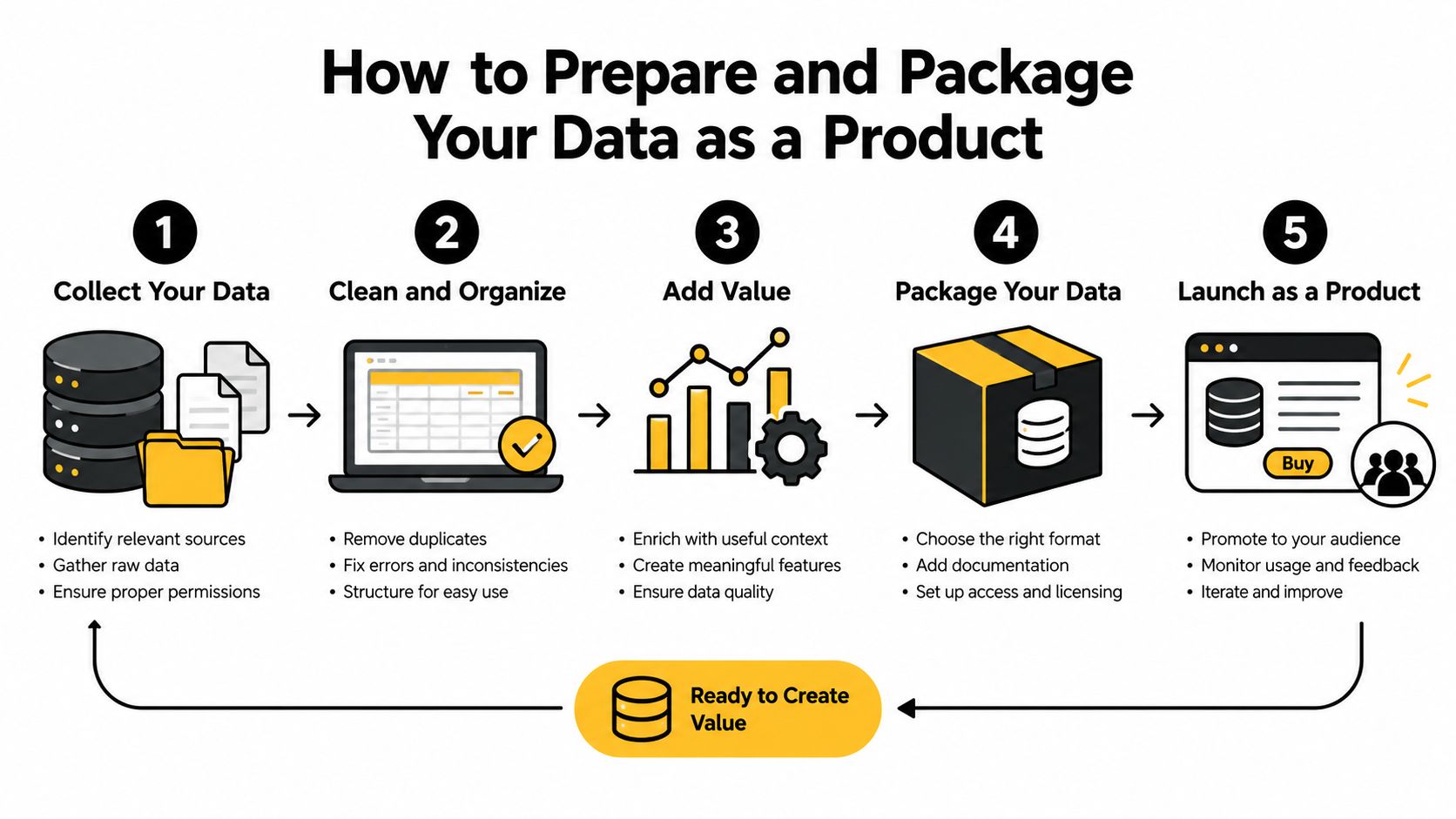
1. Inventory the asset before you promise anything
Create an inventory for every candidate dataset. Record its source systems, owners, fields, historical depth, update process, known gaps, and dependencies. Include the information a buyer's legal and security teams will ask for:
- Provenance: Where did each field originate, and which system recorded it?
- Rights: Who owns the data, and which agreements govern collection, processing, licensing, or resale?
- Schema: What does every field mean, and how do values change over time?
- Quality: How do you measure completeness, accuracy, duplicates, freshness, and error rates?
- Permissions: What consent or contractual basis supports the intended use?
- Restrictions: Are there geographic limits, retention requirements, purpose limits, or restrictions on model training?
- Availability: How often can you refresh the product, and which historical periods are usable?
Don't label an entire database “owned by the company” just because it sits in your infrastructure. Customer records, employee information, vendor data, licensed third-party fields, and derived scores may carry different rights.
2. Map the commercial product to a buyer workflow
A dataset becomes sellable when you define what the customer receives and what it can do with it. Possible formats include an aggregated benchmark, recurring dashboard, scored signal, API, machine-readable feed, or constrained research report.
Choose the least sensitive format that still solves the buyer's problem. If a buyer needs market-level movement, identifiable records may add risk without adding value. If a workflow needs account-level matching, you may need a controlled API with field restrictions rather than a downloadable file.
A product page should explain coverage, update logic, field definitions, exclusions, sample outputs, allowed uses, and known limitations. Buyers trust a documented limitation more than an inflated promise. Resources on turning data into data-driven insights are useful here because the commercial unit is the insight or action, not the storage layer.
3. Define the service level
A data product needs operational commitments. Your agreement should specify uptime, update frequency, latency, accuracy expectations, support channels, and incident response. These commitments affect both pricing and architecture.
Don't promise real-time access if the source refreshes irregularly. Don't describe a field as accurate without defining the validation method. If a value can be corrected retroactively, document how corrections appear and whether historical versions remain available.
A service-level agreement also clarifies what happens when the product fails. Buyers need to know whether you notify them, replace affected files, pause billing, or provide a remediation report.
4. Minimize and test before release
Remove data that the buyer doesn't need. Use aggregation, pseudonymization, or differential privacy where appropriate, and test whether combinations of remaining fields could identify individuals. Simple deletion of names isn't enough if dates, locations, rare attributes, or account relationships allow linkage.
Run structured linkage and re-identification tests before creating a buyer sample. Have privacy and security reviewers examine the output, not just the source dataset. Record the transformation steps so you can explain what changed, what remained, and why the released granularity is necessary.
Release standard: If you can't explain how a buyer could use a field and why it must be included, don't include it.
5. Enforce the approved purpose
Governance must continue after delivery. Apply role-based access, field-level masking, encryption, policy-as-code, audit logs, and automated deletion where the contract or retention policy requires it.
Then run a controlled pilot with a small group of design partners. Track activation, repeat usage, data-quality incidents, support effort, retention, and customer impact against a baseline. McKinsey reports that high-performing organizations are three times more likely than others to say data monetization contributes more than 20% of company revenue, while also identifying failed market entry and weak business and IT collaboration as recurring barriers (McKinsey data-monetization framework). The practical lesson is that commercialization needs product, legal, engineering, and sales alignment from the beginning.
Choosing the Right Delivery Model and Pricing Strategy
The delivery model is part of the product. It determines what the buyer can do, how tightly you can enforce permitted use, how much support you inherit, and whether the asset stays valuable after the first transaction. Teams that treat this as a packaging choice usually underprice risk and overpromise access.
Since no universal valuation method exists, price against uniqueness, accuracy, freshness, permissioning, coverage, interoperability, and business utility. In practice, the highest-value offers are rarely raw exports. They are controlled, privacy-preserving products with clear rights, narrow use cases, and delivery terms you can actually operate.
Compare the delivery choices
| Delivery Model | Best For | Recurring Revenue Potential | Implementation Complexity |
|---|---|---|---|
| Governed API | Systems that need refreshed signals or automated decisions | High | High |
| One-time license | Static research assets or historical datasets | Low | Moderate |
| Subscription dashboard | Teams that need recurring analysis without building an integration | High | Moderate |
| Machine-readable feed | Buyers with data pipelines and scheduled ingestion | High | Moderate to high |
| Aggregated report | Narrow decisions and low-technical buyers | Moderate | Low to moderate |
A governed API fits buyers who need current data inside a workflow or model. It also creates ongoing obligations: authentication, approval logic, rate limits, logging, version control, uptime expectations, and incident response. If your team cannot support that stack, the margin on paper will not survive contact with production.
A dashboard works better when buyers need interpretation, benchmarks, or trend monitoring rather than field-level access. It gives you stronger control over visibility and retention, which matters when permissioning is narrow. The trade-off is adoption. Some customers like the lower integration burden, while others see any separate interface as extra work.
One-time licenses are easier to close because the scope feels concrete. They also create the biggest governance risk if you release more than the buyer needs, because control drops sharply after delivery. Use them for bounded historical snapshots, research archives, or datasets whose value does not depend on constant refresh.
Feeds sit between APIs and file delivery. They suit buyers with scheduled ingestion and internal pipelines, but they still require schema discipline, refresh reliability, and change management. Aggregated reports are the lightest model to operate and often the best starting point when buyers want decisions, not raw records.
Match pricing to cost and buyer value
Flat pricing works for bounded deliverables: a fixed report, a defined historical extract, or a dashboard tier with stable usage. Procurement likes it because budgeting is simple. The risk is that broad rights, high support needs, or heavy usage get hidden inside one number.
Usage-based pricing makes sense when infrastructure and servicing costs rise with consumption, especially for APIs and feeds. Buyers often resist it unless they can forecast spend, so give them hard limits, usage reporting, and contract language that prevents surprise overages.
Tiered pricing is usually the most practical structure. The lesson from this Shopify app pricing guide for app founders carries over well: customers buy based on how they experience value, not on your internal architecture. For data products, that usually means separating access level, refresh cadence, support, historical depth, and permitted use.
A simple three-tier model might look like this: an entry tier with monthly refreshed aggregates and standard support, a professional tier with weekly refreshes, broader coverage, and limited analyst access, and an enterprise tier with daily delivery, stronger service terms, custom fields, and tighter contractual controls on use and retention. The point is not the labels. The point is that each tier changes buyer utility and your cost to serve.
Test the unit model before scaling
Model the full cost stack before you expand distribution: source maintenance, consent handling, deidentification, security controls, refresh operations, support, sales effort, and legal review. Then test that against likely contract value, renewal behavior, implementation drag, and any revenue sharing or contributor incentives.
I have seen smaller, tightly scoped products outperform broader datasets because the rights were cleaner, delivery was easier, and the buyer could reach value faster. A good data business does not maximize the number of files shipped. It keeps rights, delivery cost, and recurring utility aligned.
How SourceX Can Help
Some companies have valuable operational data but lack the internal capacity to map systems, validate rights, prepare deidentified extracts, negotiate terms, and coordinate delivery. SourceX is an enterprise data transaction layer designed to help companies license operational datasets to AI labs and other data buyers through a controlled workflow.
Its fit assessment starts without requiring uploads, then moves into structured mapping across systems and historical periods. The platform can create a private inventory from sources such as Zendesk, Salesforce, GitHub, Jira, SharePoint, and Google Workspace, summarizing fields, depth, origin, and availability.
The important distinction is supplier control. Nothing is shared until the supplier authorizes it, and the agreement defines permitted use. SourceX supports rights and provenance review, dataset-specific deidentification, pricing and terms, buyer outreach, contracting, payment coordination, and an evidence packet documenting the origin and release conditions.
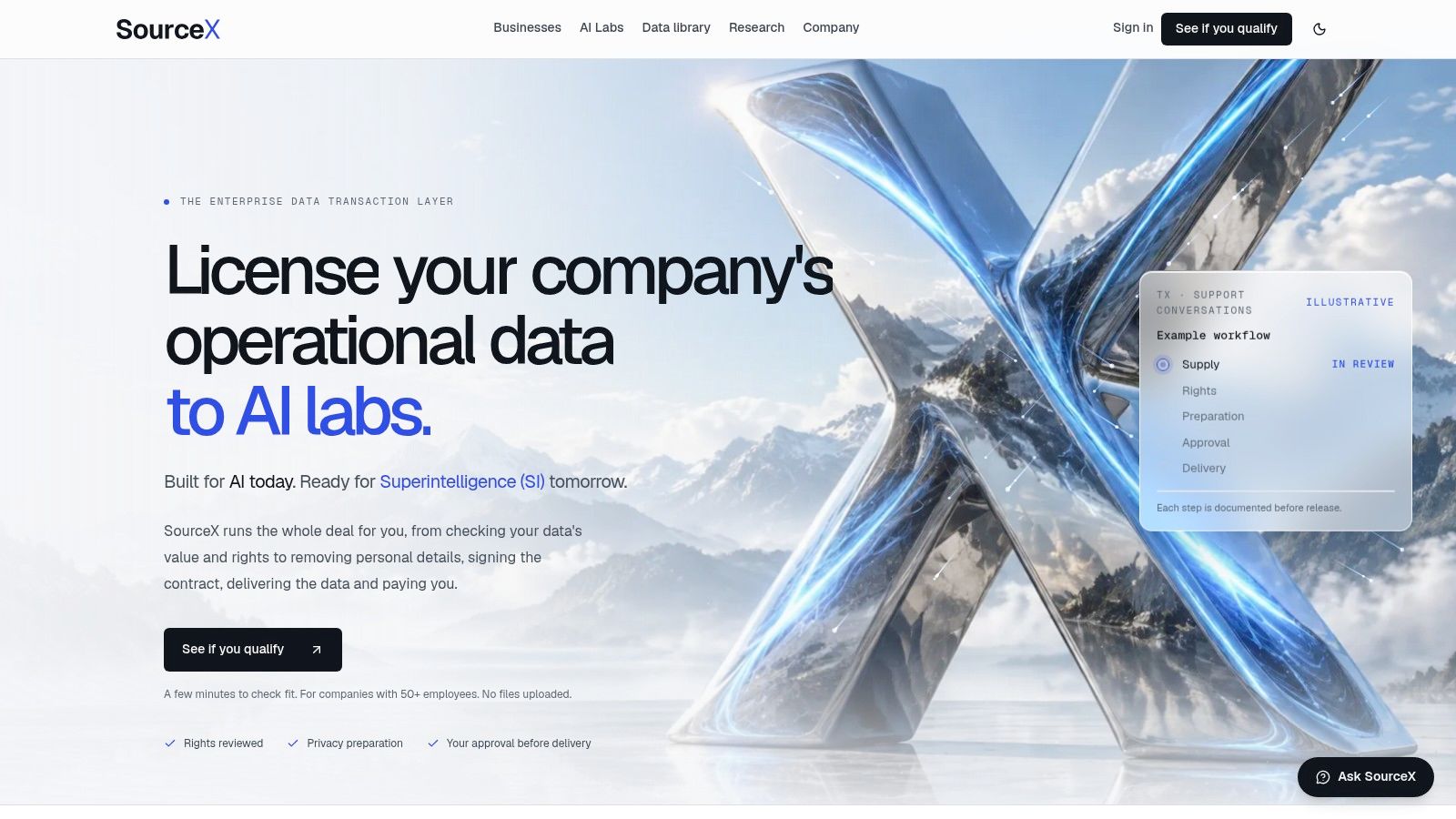
This is a sensible route when your problem is not just finding a buyer, but managing the transaction safely. It can reduce coordination across legal, engineering, privacy, and commercial teams while preserving ownership of original data and recording preparation steps. It isn't a substitute for your own rights assessment, and it won't make an unsuitable dataset valuable. It fits best when you have potentially useful enterprise records, clear authority to evaluate them, and a need for structured buyer access.
If that matches your situation, review the process and apply to sell data with SourceX before preparing a broad export. A fit assessment can help determine whether the asset merits deeper mapping and licensing work.
Navigating Consumer Trust and Privacy Constraints
Data products fail on trust long before they fail on demand. Consumers will often share information when the upside is clear, but they punish poor handling fast. 53% of U.S. consumers say sharing personal information is worthwhile when it makes brand interactions smoother, while 93% say mishandling that data would cause them to lose trust, according to PwC's customer experience survey (PwC customer experience and data findings).
That gap should shape the product itself, not just the legal review. A company can have lawful access to data and still damage the business if the permission flow is vague, the value exchange is weak, or deletion requests disappear into a support queue. Buyers see the same risk from the other side. If they license a dataset and later face questions about consent, retention, or provenance, the commercial upside shrinks quickly.
Make permission visible and useful
Consent banners do very little on their own. People want to know what is being collected, why it is collected, who may receive it, how long it will be kept, and what they get in return. If those answers are buried in a policy page, expect lower participation and more internal friction when support tickets arrive.
Granular controls usually outperform all-or-nothing permission because they match how real buyers and contributors think. Someone may be comfortable with analytics use, but not third-party licensing. Someone else may accept a limited retention period, but not open-ended reuse. Those distinctions matter because they determine what you can sell later.
Operational reliability matters as much as disclosure copy. Opt-outs, deletion requests, and preference changes need to be easy to find and they need to work. I have seen teams spend months packaging a dataset, then discover the consent state was never connected to downstream exports. At that point, the problem is no longer marketing. It is rework, legal exposure, and a buyer who now doubts the whole asset.
Permission records should flow into the systems that govern release and use. If a person withdraws permission, your process should suppress future use, update derived assets where required, and communicate restrictions to buyers with enough precision that they can enforce them.
Prefer privacy-preserving products
Raw personal data is usually the weakest version of the offer. It creates more exposure for the contributor, the seller, and the buyer, and it often gives the buyer far more detail than the actual use case requires.
Better products usually sit one layer above the raw record:
- Aggregated benchmarks that remove individual-level access.
- Cohort analytics that answer a market question without exposing identities.
- Clean-room matching where parties compare approved signals without exchanging raw records.
- First-party insights licensed under restricted-use terms.
- Privacy-preserving scores delivered through controlled interfaces rather than downloadable files.
The economics improve here. A permissioned product with transparent provenance, granular opt-outs, deletion workflows, and a clear customer benefit often holds value longer than a detailed dataset with weak controls. Governance here functions as product experience. Buyers renew when they can inspect the rules, trust the provenance, and see that your team can enforce the limits in the contract.
Treat trust as a commercial control
Document collection purpose, lawful reuse, enrichment sources, security measures, and buyer audit rights. Keep records of which fields were released and under what restrictions. Train sales teams to avoid promising uses that legal or engineering cannot support.
Consistency closes deals. If you describe a deletion process, execute it. If you limit a license to aggregated analysis, enforce that limit in the product and in the contract. Buyers are usually more comfortable with a narrower asset whose controls they can inspect than with a broad export that depends on goodwill.
Calculating Willingness to Share and Incentivizing Contributions
A contributor-funded data product has two transactions to price correctly. The buyer pays money. The contributor gives attention, information, and permission. Founders usually model the revenue side first, then discover later that contribution economics, consent handling, and support load determine whether the product works at all.
Consumer willingness is real, but it is conditional. KPMG's 2025 U.S. Consumer Pulse survey found that 47% of respondents were willing to trade personal data for financial incentives, while 22% were unwilling to share it (KPMG Consumer Pulse survey). Other market research points in the same direction. Discounts and offers can motivate sharing for some people, while a meaningful minority will refuse regardless of the reward. That is why data selling is not a packaging exercise. It is a governance exercise. The asset only keeps value when contributors understand the exchange, trust the limits, and can withdraw without friction.
Separate the two prices
Model buyer pricing and contributor economics independently, because they break for different reasons. A product can look profitable on paper and still lose money once you count what it takes to collect permissioned data safely and keep it usable over time.
Your cost base may include:
- Contributor incentives: Discounts, loyalty benefits, cash, or access to a premium feature.
- Consent operations: Permission capture, preference management, disclosures, and support.
- Compliance work: Reviews, records, deletion handling, and contract administration.
- Security: Access control, monitoring, encryption, and incident response.
- Data preparation: Cleaning, validation, deduplication, and quality checks.
- Refresh operations: The labor and infrastructure required to keep the product current.
Each incentive changes the shape of the business. Cash can drive quick participation, but it can also create a recurring acquisition cost that buyer revenue never catches up with. Discounts are often cheaper when margins support them, but they fail if the offer is weak or irrelevant. Loyalty benefits can improve retention, yet they also attract contributors who want the reward and care little about giving accurate information.
Test contribution quality alongside sign-up volume
Volume by itself is a vanity metric. A large pool of contributors does not help if submissions are incomplete, outdated, inconsistent, or withdrawn after the first support email.
Test incentives against the quality and durability of the resulting data. Track permission completion, field completeness, repeat contribution, correction rates, opt-outs, support contacts, and the cost to acquire a contributor who stays active long enough to matter. Those measures show whether you are building a stable, permissioned asset or buying low-quality records with future compliance debt attached.
Run simple experiments with plain language. Offer one group a discount, another a loyalty benefit, and another a cash option where appropriate. Keep the intended use explicit. Then compare the cost of usable data, not the number of initial permissions.
Pricing insight: The cheapest incentive is the one that produces reliable, permissioned data without creating a support or compliance burden you cannot sustain.
Build a credible sales path
Marketplace listings and direct enterprise deals both force the same question. Why should a buyer trust how this data was collected?
Answer that directly. Explain how permission works, what buyers can and cannot do, how withdrawals are handled, and what the contributor receives in return. For enterprise sales, expect harder questions about bias, representativeness, and revocation. Incentives can skew who participates. Say so when they do.
I have seen narrower datasets outsell broader ones for a simple reason. Clear limits beat vague abundance. If the asset is not ready for resale, sell an insight, benchmark, or software feature first. Lower headline revenue is sometimes the right trade if it avoids building a data product that buyers will question and contributors will not maintain.
Entering Marketplaces and Closing Direct Enterprise Deals
A marketplace can give you distribution and standardized discovery. A direct enterprise sale can produce a better-fit contract and deeper relationship. Neither route removes the need for rights, security, documentation, and operational discipline.
Third-party exchanges and cloud marketplaces may simplify procurement, but they also make comparison easier. Buyers can see competing products, evaluate sample documentation, and move on quickly when coverage or permissions are unclear. Direct sales give you more room to explain the asset, but they also bring longer security reviews and more bespoke negotiation.
Prepare the license before the listing
A solid data license should define:
- Scope of use: The permitted business purpose, users, systems, geographies, and downstream activities.
- Prohibited use: Resale, re-identification, unauthorized enrichment, or uses outside the agreed purpose.
- Delivery rights: Whether the buyer may download, cache, transform, or retain derivatives.
- Duration: The access period, renewal rules, and treatment of historical copies.
- Indemnification: Which party bears responsibility for specific rights or compliance failures.
- Audit rights: What evidence the buyer or seller may request, with appropriate confidentiality limits.
- Security duties: Required controls, incident notification, access restrictions, and subcontractor obligations.
- Deletion and return: What happens to source files, copies, and derived assets when the license ends.
Don't accept a buyer's standard software agreement without checking whether it addresses data-specific risks. A clause permitting broad model training, onward transfer, or indefinite retention may conflict with your contributor permissions or vendor contracts.
Make security evidence easy to review
Enterprise buyers will want evidence that the product is controlled. Maintain documentation for encryption, access management, logging, backup procedures, vulnerability handling, employee access, and incident response. Demonstrate which roles can export data and how you investigate unusual access.
A security page is helpful, but it doesn't replace evidence. Provide a data dictionary, provenance summary, sample agreement, permitted-use matrix, quality process, and escalation contact. Buyers should be able to answer their internal review questions without repeated meetings.
Protect your marketplace reputation
The first deal creates expectations for every later deal. Publish limitations, refresh schedules, coverage boundaries, and known exclusions. Respond quickly when a customer reports a defect, and document corrections rather than replacing files without notice.
Use a qualification checklist before accepting an order:
- Rights confirmed: Ownership, permission, vendor terms, and intended use are documented.
- Product defined: Fields, transformations, refresh logic, quality measures, and exclusions are clear.
- Controls tested: Access, masking, logging, deletion, and incident workflows work in practice.
- Contract aligned: The license matches the actual product and buyer use case.
- Support assigned: A named owner handles questions, incidents, corrections, and renewals.
- Economics validated: Preparation, delivery, incentives, and support costs leave a defensible margin.
The best first deal is not necessarily the largest one. Choose a buyer whose use case fits your permissions, whose technical requirements match your delivery model, and whose feedback can improve the product without forcing risky promises.
If you're building a SaaS product with a potential data asset, start by documenting its source, rights, fields, refresh process, and buyer decision before creating an export. Then compare a governed benchmark, API, dashboard, or embedded insight against the costs of consent, security, support, and maintenance. For further practical research on SaaS, software, ecommerce, and data-enabled growth, explore The SaaS Hub.