Local Social Media: The Complete Guide for Business Growth
Master local social media to connect with nearby customers. Learn platform tactics, SEO integration, KPIs, and an implementation checklist
By Yuvraj Kewate · 2026-10-04
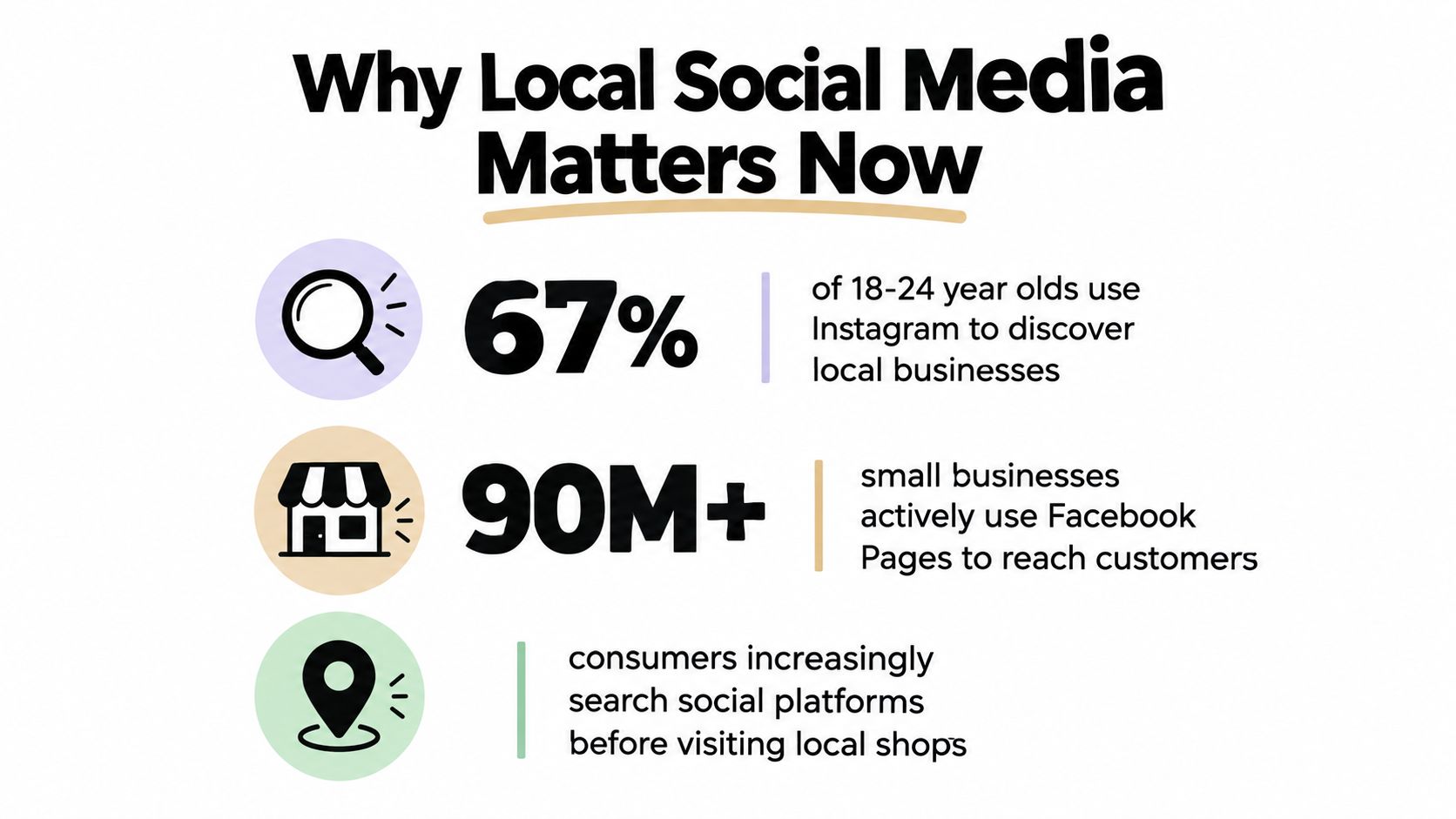
67% of people ages 18–24 use Instagram to discover local businesses, while 62% use TikTok. For local businesses, social media has become a primary discovery channel, not just a place to build brand awareness.
That shift changes the job of local marketing. A social profile is no longer a decorative extension of a website. It can function as a storefront, recommendation engine, customer-service desk, review surface, and location signal at the moment someone is deciding where to go.
The strongest local social media strategies connect three things: geographic relevance, useful content, and a clear next action. A restaurant might show what's available tonight, a dentist might answer a neighborhood question about emergency appointments, and a retailer might publish a short video that makes the shop worth visiting today. The common thread is specificity. Generic brand content competes with the entire internet. Local content competes for attention within a community.
Table of Contents
- Why Local Social Media Matters Now
- Understanding Local Social Media and Its Business Value
- Platform Selection for Local Audiences
- How Synup Can Help
- Integrating Local Social Media with SEO
- Paid Advertising Strategies for Local Reach
- Measuring Success and Key Performance Indicators
- Real-World Examples and Implementation Checklist
Why Local Social Media Matters Now
Younger consumers increasingly begin local discovery inside social apps. In addition to the 67% of 18–24-year-olds using Instagram and 62% using TikTok to discover local businesses, 54% of people aged 25–34 use Instagram to look up local businesses after Google, according to Birdeye's analysis of local social media. Those figures describe a change in behavior, not merely a preference for short-form video.
A traditional local funnel often begins with a search, moves to a website, and ends with a call or visit. Social discovery makes that path less linear. Someone can see a neighborhood recommendation, inspect a business profile, watch a product demonstration, read comments, check recent posts, and send a direct message without leaving the platform. Search still matters, but social platforms increasingly influence whether the business feels current, relevant, and trustworthy before a formal search happens.
Discovery now happens in context
Location gives social content practical meaning. A post about a new pastry has more value to someone near the bakery than to a national audience. A video from a local fitness studio can answer questions that a polished corporate advertisement can't, such as what the entrance looks like, who teaches the class, or whether the atmosphere feels welcoming.
Mobile behavior strengthens this effect. People often discover businesses while they're already moving through a city, planning an outing, or asking friends for recommendations. A profile with an accurate address, current opening information, visible reviews, and recent location-specific content reduces friction. A neglected profile creates uncertainty, even if the business itself is excellent.
The change also affects how businesses should define awareness. Broad reach can introduce a name, but local relevance creates a reason to act. A national campaign may generate recognition without helping a customer decide which branch to visit. A neighborhood post can generate fewer total impressions while producing more useful attention from people who can become customers.
The local funnel is becoming conversational
Social profiles also give customers a place to test responsiveness. Questions about availability, parking, bookings, delivery areas, accessibility, or pricing often appear in comments and messages. A fast, useful answer can move someone closer to a visit. Ignoring those questions leaves the public conversation to assumptions, outdated comments, or competitors.
This doesn't mean every business needs to publish constantly on every platform. It means the chosen channel should support the customer journey. A local service provider may need educational posts and direct messages. A shop may benefit from visual product discovery. A multi-location brand may need a disciplined system for keeping each branch accurate and locally recognizable.
Practical rule: Treat every local profile as a decision page. Someone should be able to understand what you offer, where you are, whether you're active, and what to do next without searching elsewhere.
The strategic mistake is measuring local social media as a national awareness channel. Follower totals and broad reach can be useful context, but they don't answer the operational question: did the right people in the right area notice, trust, and contact the business?
Understanding Local Social Media and Its Business Value
Local social media connects paid distribution, organic discovery, and digital word of mouth. A business profile gives nearby customers a public place to inspect the offer, while posts and conversations show how the business operates now. That evidence is more persuasive than a static advertisement because people can see activity, responsiveness, and relevance to their area.
The scale is substantial. More than 90 million small businesses use Facebook Pages to connect with customers, 77% of small businesses use social media for functions such as marketing, customer service, and recruiting, and 73% say social media marketing has been somewhat or very effective, according to Boomp's local business social media research. Social media has become part of ordinary operations for local businesses, not an occasional experiment.
A profile is a digital storefront
A strong local profile answers practical questions before a customer searches elsewhere:
- What you sell: Describe the offer in plain language rather than hiding it behind slogans.
- Where you serve: Name the town, neighborhood, branch, or service area accurately.
- When you're available: Keep opening hours, temporary closures, and holiday changes current.
- How customers act: Provide a clear path to book, call, request directions, order, or enquire.
- Why people should trust you: Show recent work, customer feedback, staff expertise, and local involvement.
These details also give location-based systems clearer information to interpret. Consistent business names, categories, service areas, contact details, and activity help platforms match a profile with nearby searches. Social engagement does not directly guarantee a higher local ranking, yet it can increase the profile visits, branded searches, website visits, reviews, mentions, enquiries, and links that support a business's wider local presence.
Reviews sit within the same decision journey. 97% of consumers read reviews for local businesses before visiting, and 78% of local mobile searches lead to an offline purchase within 24 hours, according to the same research summary. Social posts do not replace reputation management. They add context around it. A recent review, a useful response, and visible evidence of current activity can make the business easier to trust.
Engagement is useful, but not automatically an SEO factor
Likes and comments are not guaranteed direct ranking signals in local search. A popular post will not automatically move a location higher in Google results. The useful connection is operational: a relevant conversation can lead a nearby customer to visit the profile, search for the brand, ask a question, leave a review, visit the website, or make contact. Those actions create stronger evidence of activity and local relevance.
Proximity changes the value of attention. A viral post seen mainly outside the service area may produce impressive reach with little commercial return. A smaller exchange with nearby customers can generate visits, reviews, repeat interactions, and useful feedback. Measure engagement by quality and proximity, not volume alone.
Manage the profile as a public business asset. Keep facts accurate, publish current evidence, respond promptly, and connect each post to a real local need. The goal is to reduce uncertainty and make the next action easy.
Platform Selection for Local Audiences
Platform choice should follow customer behavior and operating capacity. A business that can produce strong visual content but can't answer messages quickly has a workflow problem, not a platform problem. A multi-location company that publishes one national post while leaving branch pages empty has a distribution problem.
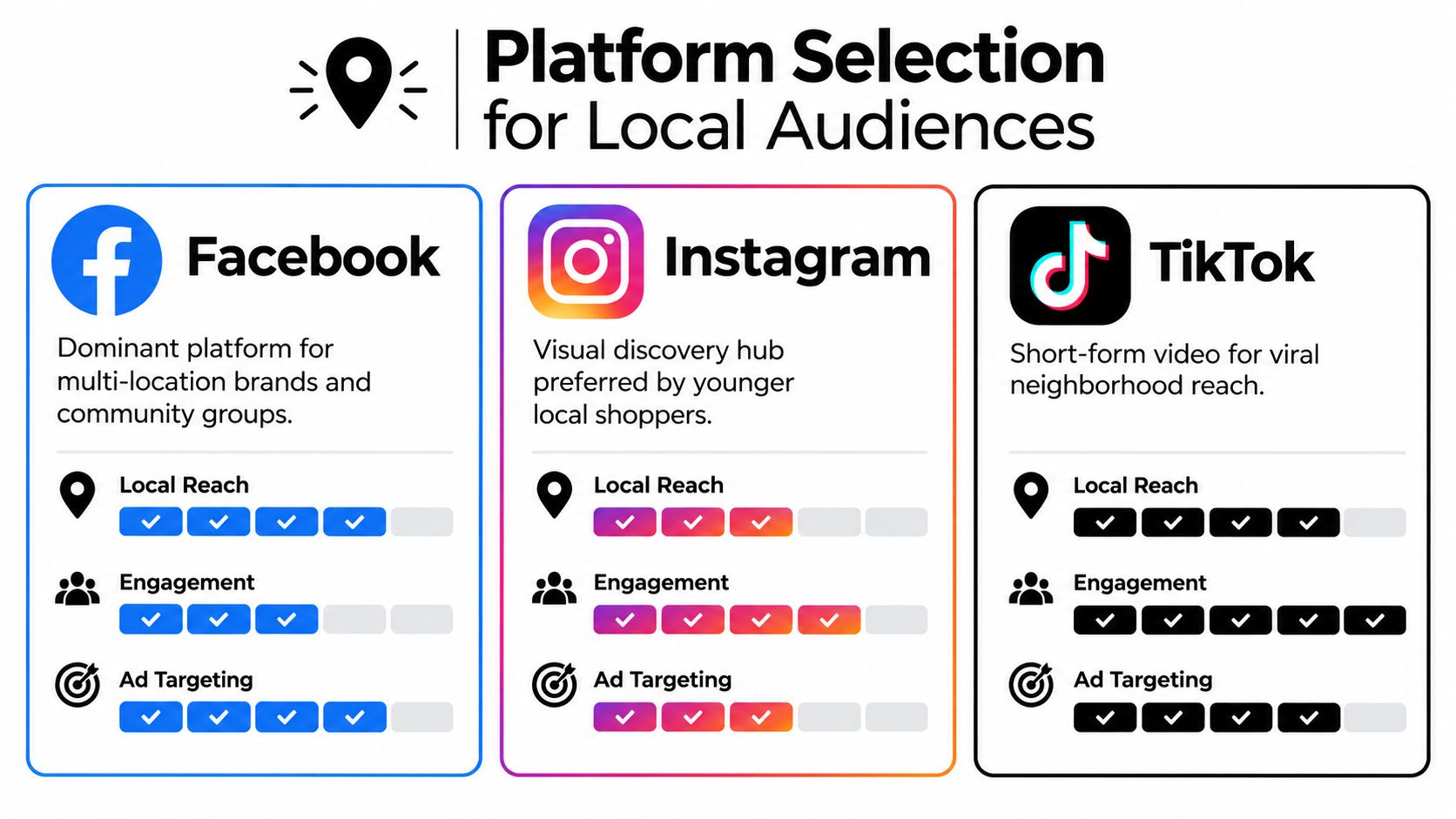
Facebook remains especially important for localized programs. A platform analysis citing a 2024 research report found that more than 70% of brand engagement on social happened at the local page level, with Facebook Local Pages generating nearly twice the impressions of brand pages and nearly three-quarters of user engagement. The report also identified Facebook as the dominant platform for localized marketing among multi-location brands. These figures appear in Glow Social's platform analysis.
Facebook for community infrastructure
Facebook is often the practical choice for businesses that depend on local groups, events, family audiences, and repeat customers. It supports an information-rich presence where people can find opening updates, event details, service announcements, reviews, and community discussions.
For multi-location brands, separate local pages can make sense when each branch has distinct hours, staff, offers, or community relationships. The trade-off is governance. Each page needs accurate information, a defined voice, moderation, and a process for responding to reviews and messages.
Instagram for visual discovery
Instagram suits businesses where appearance, atmosphere, transformation, or product detail influences the decision. Cafes, salons, retailers, hospitality businesses, studios, and design-led services can show the experience more effectively through images and short video than through text alone.
Its discovery strength is particularly relevant for younger local audiences, as the Birdeye data cited earlier demonstrates. Instagram works best when posts include a recognizable place, a useful caption, a local context, and a clear route to booking or visiting. A polished feed without practical information may attract attention while failing to convert it.
TikTok for human, local reach
TikTok can help a business demonstrate personality, answer common questions, and participate in local culture. The strongest videos often feel native to the platform rather than repurposed advertisements. Staff explanations, behind-the-scenes processes, neighborhood references, and quick demonstrations can travel beyond existing followers.
Virality is the trade-off. A video can attract broad attention from people who will never visit. Track comments, profile actions, enquiries, and local audience quality rather than celebrating reach alone.
LinkedIn for local B2B services
LinkedIn deserves consideration for consultants, agencies, commercial property firms, recruiters, technology providers, and other B2B operators. Recent reporting found that local advertiser usage rose from 35% in 2025 to 41% in 2026, while 14% of local advertisers bought ads there. The same reporting identified Facebook as the top platform for local ad buying and Instagram as second, while 14% used X and 4% bought ads on X. These figures come from Inside Radio's coverage of local advertising allocation.
Choose one primary platform first. Expand only when the team can maintain accurate profiles, regular publishing, and prompt responses. Businesses evaluating adjacent software can also review social media marketing apps for Shopify, but the tool should support the chosen strategy rather than decide it.
How Synup Can Help
Synup fits teams that need local social media to work alongside listings and reputation management, not as a separate task. Its AI agent, Sydekick, handles research, content, publication, approvals, playbooks, memory, and a full audit trail. That setup helps multi-location teams keep posts tied to location facts and approval rules, while a single-owner business that posts occasionally may not need that much structure.
The platform brings listings synchronization, review monitoring, review response workflows, review-generation campaigns, location-level social publishing, local rank tracking, store locators, and location landing pages into one place. It syncs business information across Google Business Profile, Apple Business Connect, Bing, Facebook, and more than 100 publishers, and its audits and corrections surface mismatched records before they weaken trust.
For local social media, the main advantage is central control with local variation. Teams can schedule by location, keep each branch's voice consistent, and still tailor content to neighborhood events, service areas, and store-level offers. That matters because local discovery often starts with profile signals, post relevance, and audience engagement that reinforces location authority. Agencies and multi-location brands can also work from a multi-client command center with branded portals, scoped permissions, white-labeling, scheduled reporting, APIs, and model connectors.
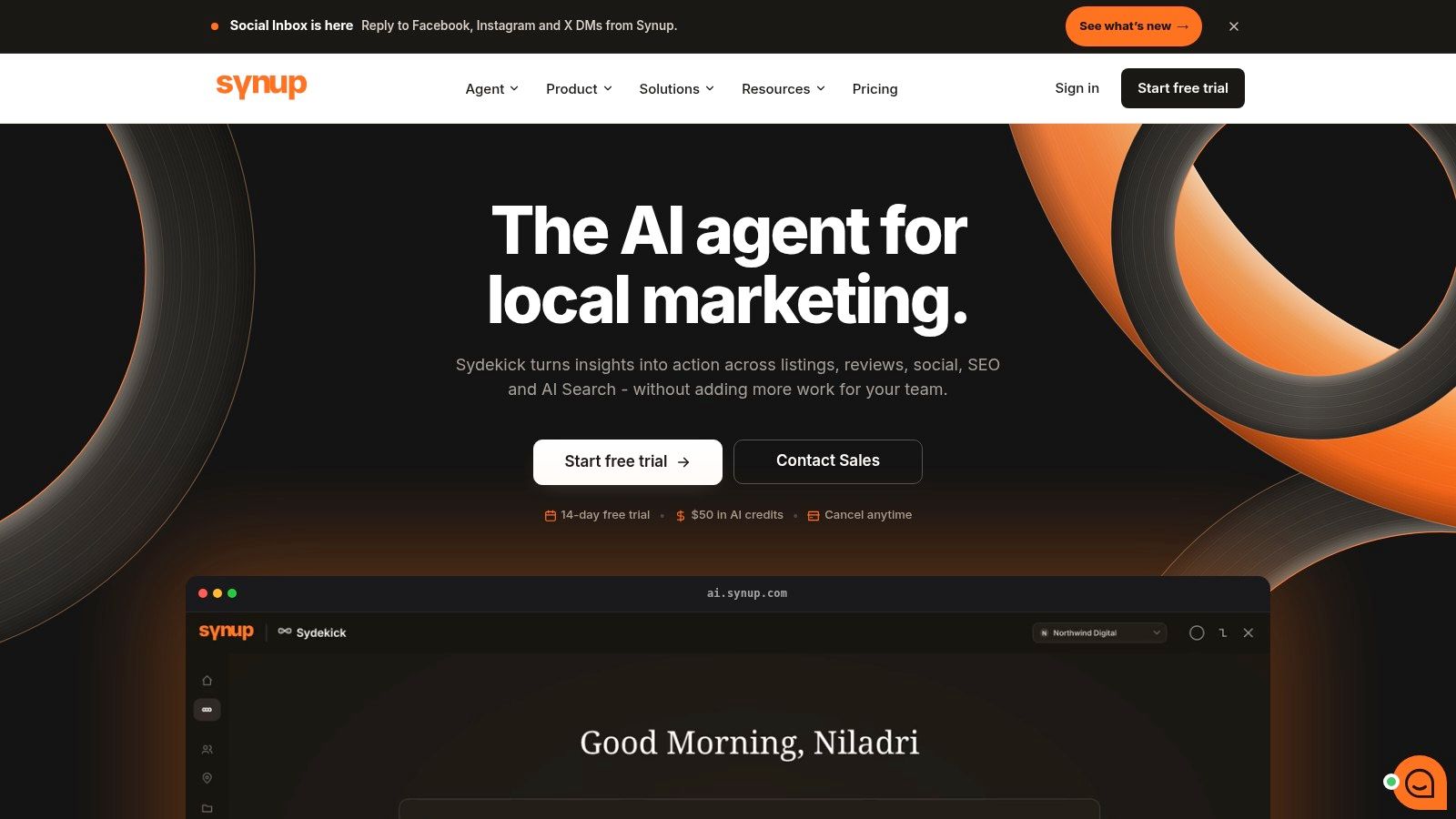
A practical setup sequence
Create a location source of truth. Confirm the business name, address, phone number, hours, service area, URL, and approved descriptions for every branch. Social profiles, location pages, and listings should all pull from the same base record.
Standardize profile language. Put the main service and location in bios where it reads naturally. Avoid stuffing bios with keywords, but do make the geography clear enough for nearby customers and location-based algorithms.
Build approval rules. Define which posts Sydekick can prepare, which actions need human approval, and which claims staff must verify before publication. Faster publishing matters, but so does avoiding copy that conflicts with store hours, inventory, or local offers.
Connect reputation workflows. Monitor reviews, draft replies, request approval, and publish responses through one process. Social engagement and review activity both feed the local trust signals that shape how nearby customers judge the branch.
Review the audit trail. Check what the agent proposed and performed, especially after changes to hours, services, offers, or location details. That record is useful when a branch update creates inconsistency across profiles.
Businesses that want a dedicated workflow can evaluate Synup's local social media management platform. It suits teams dealing with repeated updates, fragmented listings, slow review responses, and inconsistent branch publishing. A small independent business with one location may prefer a lighter tool, while franchises, agencies, and brands with many locations are more likely to benefit from centralized controls and automation.
Integrating Local Social Media with SEO
Local SEO and social media should share the same location data and content priorities. They don't need identical posts, but they should communicate the same business facts. If a social profile says one thing about the address or hours while the website and listings say another, customers receive mixed signals.
Start with NAP consistency, meaning the business name, address, and phone number. Use the same official format across social profiles, directory listings, location pages, and contact sections. Add the relevant service area without implying a physical presence where none exists. For multi-location businesses, assign each profile and landing page to a specific branch instead of forcing every customer through a generic national page.
Make location visible in useful ways
Use geographic signals as context, not decoration:
- Profile language: Include the town, district, or service area in the bio when it helps customers understand where you operate.
- Post copy: Mention the location when the content is specific to that place, such as a local event, branch update, or neighborhood service.
- Geotags: Tag the relevant place when the post was created there or directly concerns that location.
- Visual evidence: Show recognizable storefront details, local streets, staff, products, or events when appropriate.
- Links: Send users to the matching location page, booking page, menu, service page, or directions route.
A 2026 analysis of platform behavior identifies explicit and inferred location signals such as geotags, device location, IP region, and local engagement patterns. It also reports that locally relevant content can achieve about a 25% engagement uplift compared with generic global content in target metropolitan areas, and describes TikTok's 2026 Local Feed as using location, topic, and recency as ranking inputs. Those findings are detailed in Inkbot Design's analysis of social media algorithms.
Connect content planning to search demand
Build a calendar around customer situations rather than arbitrary themes. A seasonal service, local event, recurring question, new branch announcement, or change in opening hours can become a social post, a location-page update, a review prompt, and a customer-service script.
Don't assume social engagement directly controls rankings. Instead, track the behaviors that connect the channels: profile visits, clicks to location pages, calls, direction requests, branded searches, review volume, and enquiries. A post that generates fewer reactions but sends qualified visitors to the correct branch may be more valuable than a post that reaches a larger, distant audience.
Paid distribution belongs in the same system. Organic content helps reveal which messages resonate. Local ads can then extend a proven offer to a carefully defined area. Keep the creative and landing destination aligned, so an ad about a branch promotion doesn't send people to a generic homepage.
Paid Advertising Strategies for Local Reach
A local paid campaign should begin with a business outcome, not a platform button. “Boost this post” is an execution choice. The core objective might be filling appointments, promoting an event, generating calls, increasing visits, or introducing a new service in a defined area.
Facebook remains the leading platform for local ad buying, with Instagram in second place, according to the local advertiser reporting cited earlier. That doesn't make Facebook the right choice for every business. It means local advertisers continue to see practical value in its audience controls, community context, and mature location options.
A campaign built around one neighborhood offer
Consider a neighborhood cafe promoting a new breakfast menu. The weak approach is to run a broad awareness ad with a generic product image and a national-sounding message. The stronger approach is to create a short video showing the actual location, explain when the menu is available, target people who can reasonably reach the cafe, and send clicks to a page with the menu, hours, address, and directions.
The cafe can then separate campaigns by intent:
- Reach campaign: Introduce the menu to nearby people with a simple local message.
- Engagement campaign: Promote a useful video or event post that answers common questions.
- Lead campaign: Collect enquiries for catering or group bookings.
- Conversion campaign: Send people to ordering, booking, or directions with one clear action.
The same structure works differently for a tradesperson, clinic, retailer, or B2B firm. A service business may value qualified calls over online purchases. A retailer may care about store visits and product availability. A professional firm may need a form submission followed by a consultation.
Control the geography and the message
Avoid targeting an area so broad that the ad reaches people who can't become customers. Avoid making it so narrow that delivery becomes unstable or the audience lacks enough relevance. Use the actual service radius, branch coverage, travel constraints, and customer data to define the area.
Audience overlap can waste spend when several campaigns compete for the same people. Separate campaigns by objective or location only when the distinction changes the message or conversion path. Otherwise, consolidate enough to let the platform learn from meaningful responses.
Use organic results as a creative testing layer. If customers save, share, comment on, or ask questions about one type of local post, that response can inform paid creative. It isn't proof of revenue, but it gives the team a better starting point than guessing.
For measurement, connect ad platforms to analytics, landing pages, call tracking, and point-of-sale questions where possible. A pixel or event setup can help attribute digital actions, and teams using Shopify can review options such as Zotek's TikTok Pixel and Facebook Pixel app. Don't judge a local campaign by impressions alone. Compare the cost and quality of the action that matters.
Measuring Success and Key Performance Indicators
Local social media measurement fails when teams stop at follower growth. Followers can include people outside the service area, existing customers, casual viewers, and accounts that will never buy. A useful dashboard connects social activity to local intent and business outcomes.
Set up measurement in layers:
- Exposure: Record reach, video views, and local audience composition where the platform provides it.
- Interest: Track profile visits, saves, shares, comments, direct messages, and link clicks.
- Intent: Measure calls, booking starts, direction requests, quote requests, menu views, and location-page sessions.
- Outcome: Connect those actions to appointments, sales, visits, qualified leads, and repeat business.
Build attribution into the workflow
Use distinct UTM parameters for platform, campaign, creative, and location. Send each branch campaign to the relevant location page rather than a generic destination. Give campaigns their own call tracking route where appropriate, and ask customers how they heard about the business at the point of booking or purchase.
Offline attribution will never be perfect, especially for spontaneous visits. That isn't a reason to ignore it. Compare online signals with store feedback, campaign timing, booking records, offer codes, and changes in branded enquiries. Look for consistent patterns rather than claiming certainty from one metric.
A monthly report should answer practical questions:
- Which locations received qualified attention?
- Which content generated meaningful conversations or visits?
- Which platform produced the strongest actions for this business type?
- Which campaigns created leads that staff could serve?
- Which profile or listing problems blocked conversion?
- What will change next month?
Don't invent universal benchmarks for likes or engagement. A local emergency service, a restaurant, and a commercial consultant have different buying cycles and different definitions of value. Set a baseline for each location, then compare performance against its own prior activity and commercial capacity.
Keep the report readable. Include spend, reach, qualified actions, conversion outcomes, response time, review activity, and next actions. For teams that want a wider view of retention and customer value, this guide to AI analytics, Shopify retention, and LTV provides relevant analytical context, but local social reporting should still stay tied to the business model.
Real-World Examples and Implementation Checklist
A local social media plan becomes useful when it reflects the way a business operates. A salon can publish a stylist's explanation of a common hair problem, tag the branch, answer booking questions, and direct people to the correct appointment page. A home-services company can show the preparation process, explain service boundaries, and respond to neighborhood questions without promising work outside its coverage area.
A local retailer might build content around product arrivals, staff recommendations, customer questions, and nearby events. A professional firm can publish practical guidance for local businesses, comment on relevant community developments, and use LinkedIn to start conversations with decision-makers in its service area. These examples work because each connects content to a real customer situation.
A practical implementation checklist
- Audit every profile: Confirm names, addresses, phone numbers, hours, categories, URLs, service areas, and booking paths.
- Choose a primary channel: Select the platform where customers already discover and discuss businesses like yours.
- Create location rules: Decide which terms, geotags, images, offers, and claims are appropriate for each branch.
- Prepare content themes: Balance useful guidance, staff or process content, local relevance, customer proof, and direct offers.
- Plan response ownership: Assign someone to monitor comments, messages, and reviews, with escalation rules for complaints.
- Match destinations: Link every campaign to the correct branch page, booking route, menu, product page, or enquiry form.
- Tag campaigns: Use consistent UTM values, creative names, location labels, and conversion events.
- Review monthly: Keep the content that produces qualified actions, revise weak messages, and remove outdated information.
A simple content rhythm
A workable calendar might include a useful local answer early in the week, a human or behind-the-scenes post midweek, a product or service demonstration later in the week, and a timely community or offer post when there's a genuine reason to act. The exact cadence matters less than maintaining quality and responding to people who engage.
Low engagement usually has a specific cause. The audience may be too broad, the content may lack local detail, the opening may be weak, or the post may ask for a sale before earning attention. Test one variable at a time. Change the topic, location context, format, call to action, or destination, then compare qualified actions rather than surface reactions.
There's also a civic dimension that businesses and city teams shouldn't oversimplify. A 2025 study of 2,789 Reddit users found stronger local community attachment and political participation intention among members of city-based groups than among users in non-place-based groups, but the research focused on Reddit and intention, not verified offline action or every local market. The findings are discussed in the study of place-based online groups and civic participation. Local social media can strengthen belonging and trust, but teams should distinguish those signals from confirmed visits, purchases, or civic behavior.
Start with one location, one platform, and one measurable business objective. Audit the profile this week, publish a genuinely useful local post, respond to every meaningful interaction, and connect the next campaign to a specific landing page or conversion path. If you're evaluating software and growth tools alongside the strategy, explore the practical research and curated technology coverage at The SaaS Hub, then choose only the tools your team can operate consistently.