
Online Continuing Education Courses Explained for Pros
Discover how online continuing education courses work, from accreditation and CEUs to costs, formats and ROI. Choose the right program with confidence.
By Yuvraj Kewate · 2026-09-12
You're a licensed professional with a renewal deadline approaching, a full work schedule, and a browser full of course options that all promise flexibility. One program offers a certificate, another advertises CEUs, and a third appears to lead to a valuable credential. The difficult part isn't finding an online course. It's finding one that your licensing board, employer, or professional association will recognize, and that you'll realistically finish.
Online continuing education courses can solve that scheduling problem, but convenience alone doesn't make a course useful. You also need to examine delivery format, accreditation, documentation, completion requirements, provider capacity, and career relevance. This guide builds those ideas in order, starting with what online continuing education means, then moving through CEUs and compliance, course formats, provider evaluation, selection criteria, ROI, and practical next steps.
The same questions apply at different scales. An individual may need one approved course before a renewal date. An employer may need to assign training, monitor completion, retain audit records, and confirm that every employee receives the right content. The right choice depends on which problem you're solving.
Table of Contents
- Introduction to Online Continuing Education Courses
- What Online Continuing Education Courses Really Are
- How Accreditation CEUs and Compliance Work
- How Premiere Education Can Help
- Course Formats Delivery Platforms and Learning Experience
- How to Choose the Right Course for Your Goals
- Costs ROI and Career Impact You Should Expect
- Next Steps and Tools to Manage Your Continuing Education
Introduction to Online Continuing Education Courses
A hospital nurse may need to complete a required course before a license renewal. A teacher may need approved professional learning related to classroom practice. A manager may need a reliable way to assign mandatory training across a distributed team. All three might search for online continuing education courses, but they're not looking for exactly the same outcome.
For the nurse, regulatory acceptance and documentation may matter most. For the teacher, course relevance and state approval may carry more weight. For the manager, the platform's assignment, reporting, and recordkeeping features can matter as much as the lessons themselves.
That distinction prevents a common mistake: choosing a course because it's short, inexpensive, or visually polished without checking whether it satisfies the actual requirement. A completion certificate can show that you finished something. It doesn't automatically prove that a licensing board or employer accepts it.
Practical rule: Start with the requirement, not the catalog. Identify the credential, board, employer policy, subject, and documentation standard before comparing providers.
Online continuing education has also inherited assumptions from general online learning. People often expect flexible access, recorded lessons, mobile learning, and self-directed progress. Those features can be valuable, especially for professionals balancing work and study, but they also place more responsibility on the learner. Research summarized in a 2024 Open Praxis study of online learning completion found that completion outcomes vary widely, and that enrollment totals can present a very different picture from completion among active learners. The implication is straightforward: access is not the same as attainment.
This guide treats course selection as a decision about trust and execution. You'll learn how to distinguish fully online programs from blended offerings, how to test accreditation claims, how to compare asynchronous and live formats, and how to judge whether a credential is likely to support your work rather than just add another line to your profile.
By the end, you should be able to answer four practical questions:
- Will it count? Does the relevant board, association, employer, or organization recognize the provider and course?
- Will I finish it? Does the schedule, assessment model, and support match your working life?
- Will it help me perform? Does the content address a real skill or compliance need?
- Can someone verify it? Will you receive records that remain useful during renewal, audit, hiring, or internal review?
What Online Continuing Education Courses Really Are
Online continuing education is best understood as structured professional learning delivered through a distance-education model. It isn't merely a collection of videos placed on a website. A legitimate course normally has defined learning objectives, organized content, an assessment or completion process, and documentation connected to a recognized provider or authority.
UNESCO's TVETipedia glossary definition of distance education describes education in which the teacher and student are separated in time and space. The definition includes online delivery as well as older remote methods such as printed materials, radio, television, telephone, and computer-based instruction. Online continuing education therefore belongs to a longer history of remote learning, rather than appearing suddenly with modern learning platforms.
Think of delivery as a spectrum
The easiest way to understand the formats is to place them on a line:
- Fully online: At least 80% of the content is delivered online, which UNESCO treats as online education within its distance-education framework.
- Blended: Between 30% and 79% of content is delivered online, with the remaining learning provided through another format.
- Primarily in person: Online tools may support registration, reading, or recordkeeping, but most instruction happens face to face.
The percentages matter because “online” can describe very different experiences. A self-paced compliance module is not the same as a university course with live virtual seminars and an in-person skills assessment. Both may appear in an online catalog, yet their scheduling demands, learner interactions, and recognition rules can differ.
Know what you're buying
A continuing education course usually sits below a full degree in scope. It may be a single module, a short certificate, a microcredential, a professional certification preparation course, or one component of a larger stackable pathway. A degree normally involves a broader curriculum and formal academic award. A casual tutorial may teach something useful, but it may not include recognized credit, identity verification, assessment, or regulatory documentation.
The terms also describe different kinds of value:
- Certificate of completion: Evidence that you completed a provider's course.
- CEUs or contact hours: Recorded learning units that may satisfy a professional requirement when issued and accepted under the applicable rules.
- Microcredential: A focused recognition of a particular skill or topic.
- Professional certification: A credential that generally involves defined eligibility or assessment requirements beyond watching course content.
- Academic credit: Credit awarded under an institution's academic policies, which isn't interchangeable with CEUs.
Before enrolling, ask what the course produces, who recognizes it, and whether the credential applies to your specific renewal or employment goal. That three-part check will prevent many expensive misunderstandings.
How Accreditation CEUs and Compliance Work
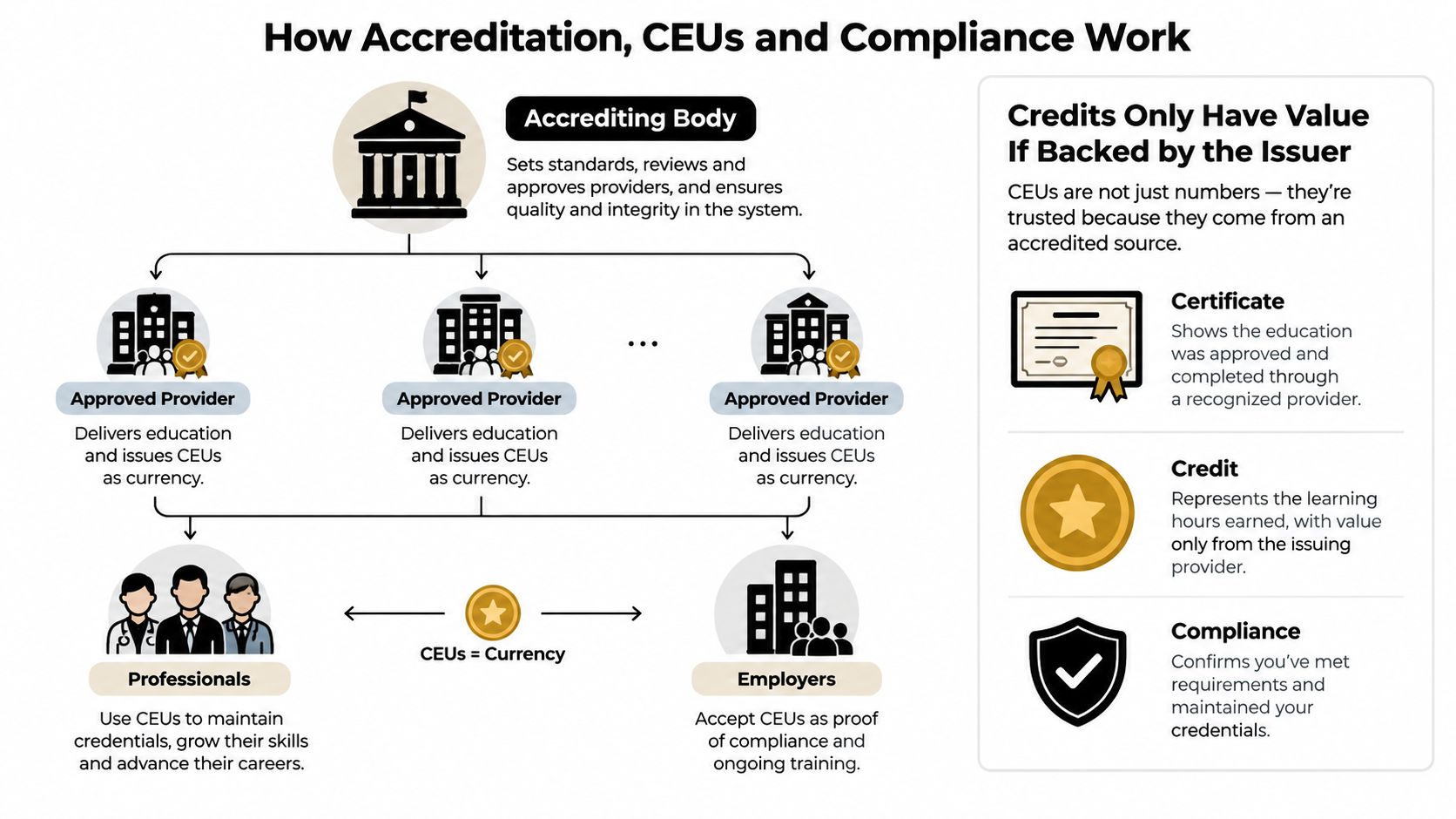
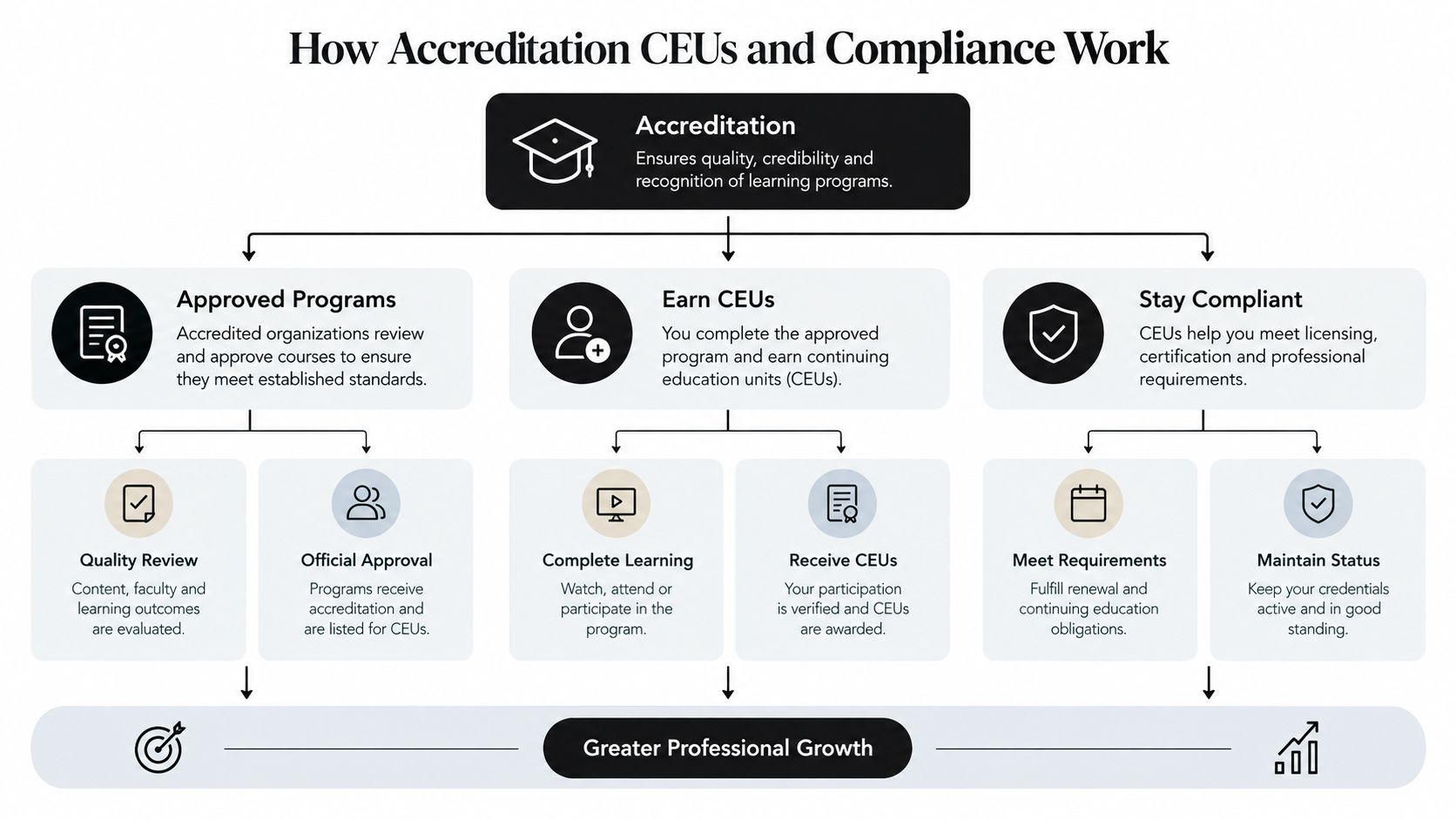
Accreditation is the trust layer behind continuing education. It helps a licensing board, employer, or professional association decide whether a course meets an accepted standard. The provider may create the lessons, but another recognized body, board, or institutional framework may determine whether the activity qualifies.
A useful analogy is currency. A printed certificate resembles a banknote, but the paper itself has no practical value unless the issuer is trusted and the recipient accepts it. In the same way, a course certificate may look official while failing to satisfy your renewal requirement if the provider, subject, format, or credit type isn't recognized.
Separate the provider from the requirement
Several parties may be involved:
- A regulator or accrediting body sets standards or defines acceptable education.
- An approved provider develops and delivers the course.
- The professional completes the content and any required assessment.
- The employer or licensing authority reviews the documentation and determines whether the requirement has been met.
The approval relationship matters. A provider can be reputable in general while offering a particular course that doesn't match your state, profession, specialty, or renewal category.
CEUs also aren't universal tokens with identical value everywhere. Their meaning depends on the rules of the organization receiving them. Some authorities may accept a specific course category, while others may require a particular provider, subject, assessment, reporting method, or completion record.
Verify before you pay
Use the following sequence before enrolling:
- Name the receiving authority: Identify the board, employer, association, payer, or agency that will review your education.
- Read the current rule: Don't rely on a provider's general statement that its catalog is accredited. Find the applicable requirement.
- Match the course: Confirm the title, subject, credit type, delivery format, and completion deadline.
- Check documentation: Look for the certificate fields, provider identifiers, completion date, learner name, and credit information you'll need.
- Confirm reporting: Determine whether the provider reports completion directly or whether you must submit the records yourself.
- Save your evidence: Keep certificates, transcripts, receipts, and course descriptions in a location you control.
A certificate and an accredited credit aren't the same thing. The certificate records an event. Recognition determines whether that event satisfies a rule.
Employers should apply the same logic to team training. A manager needs more than a list of employees who opened a module. The organization may need completion status, course assignment history, dates, certificates, and an audit trail. If a provider can't explain how those records are created and retrieved, the organization may inherit avoidable compliance work.
How Premiere Education Can Help
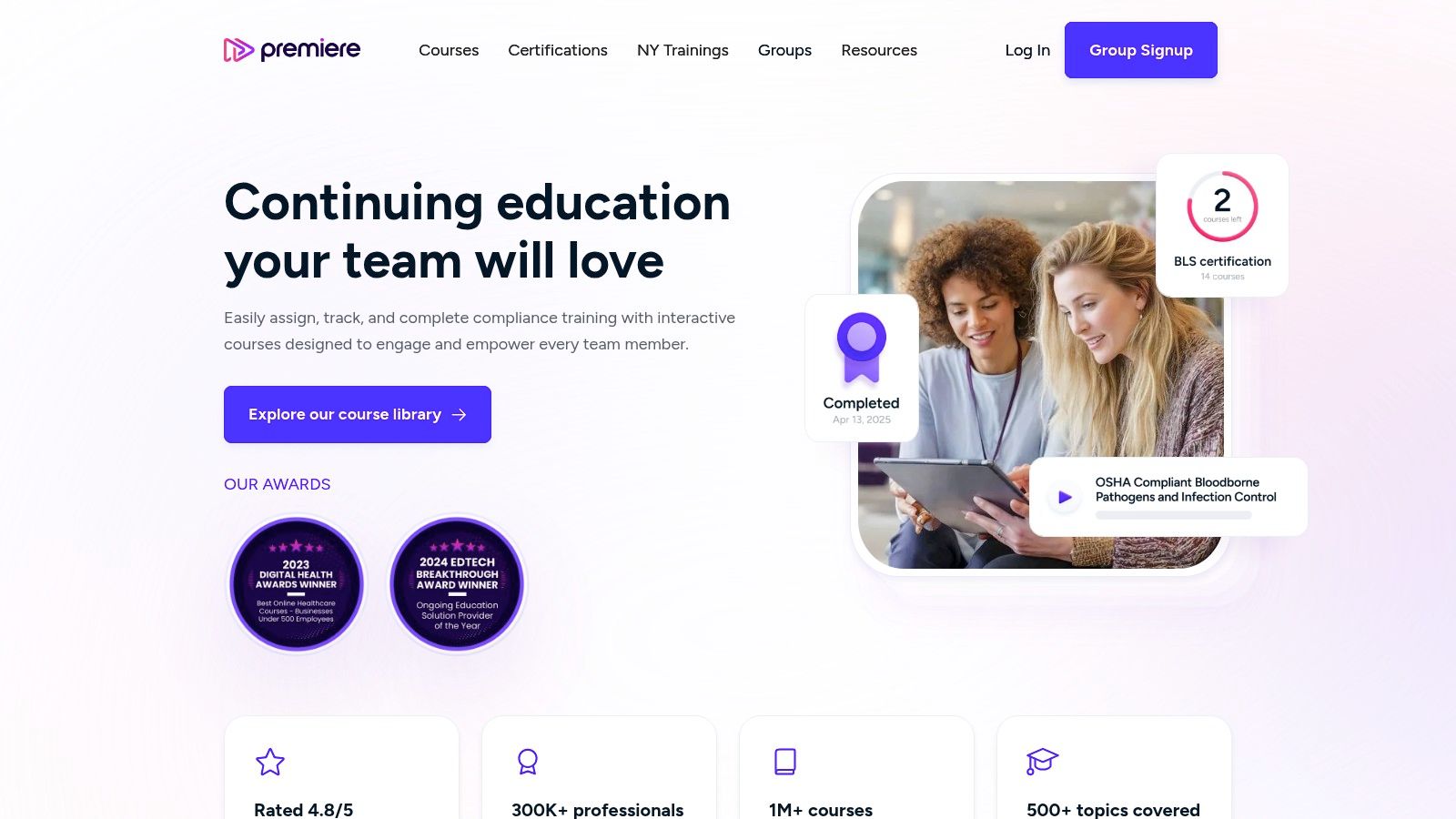
Premiere Education is a U.S.-based online continuing education platform serving healthcare, education, and adjacent industries. Its offering combines accredited CE courses and certifications with tools for assignment, progress tracking, completion records, and documentation. That combination makes it more relevant to professionals who need recognized learning and to organizations that need evidence of completion.
Its catalog includes interactive courses across healthcare, education, and hospitality, along with state-mandated topics such as New York Dignity for All Students Act training, child abuse identification and reporting, OSHA Bloodborne Pathogens training under 29 CFR 1910.1030, and infection control modules. Clinical certifications include ACLS, BLS, and PALS, while membership options provide continued access to a professional course library.
Professionals can review the Premiere Education course catalog when they need to compare subject coverage, credential types, and state-specific options in one place. The platform also supports organizational workflows, including seat purchasing, learner enrollment, course assignment, dashboards, and completion monitoring.
The platform may be a suitable choice when you need self-paced access, compliance-oriented content, certificates, agency reporting where applicable, or centralized team administration. It's less suitable to assume any provider is automatically right for every profession. You should still verify the specific course against your board, employer, or credentialing rule before enrolling.
Course Formats Delivery Platforms and Learning Experience
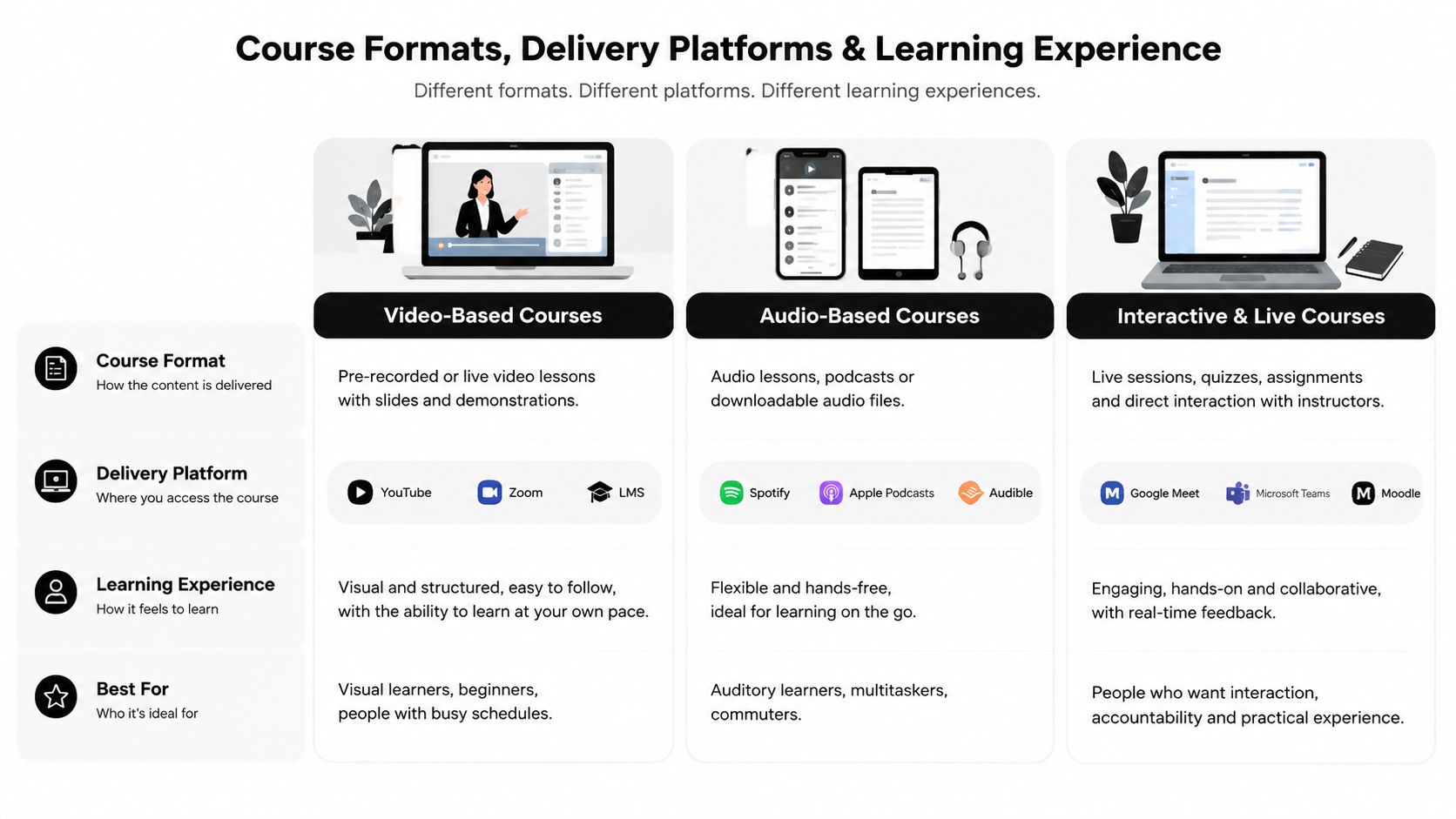
The best format is the one you can complete while meeting the recognition requirements. A self-paced course may fit a rotating shift schedule, while a live virtual classroom may be better for learners who need discussion and instructor accountability. A hybrid program can work when the subject requires demonstration, supervised practice, or in-person evaluation.
Compare the main delivery models
Asynchronous courses let learners read, watch, listen, complete activities, and take assessments on their own schedule. They're efficient for independent professionals, but the flexible design can make procrastination easier.
Synchronous courses use scheduled video sessions, live discussion, and real-time instructor access. They create structure and immediate interaction, but they require calendar coordination.
Blended courses combine online materials with live sessions or in-person requirements. They can offer a richer experience, though the learner must understand exactly which activities happen remotely and which don't.
Platforms shape the experience
A university learning management system may provide faculty access, academic structure, and formal records. A professional association portal may connect content directly to membership and industry standards. A MOOC marketplace may offer broad subject variety and peer learning. A dedicated CE provider may focus more directly on board requirements, certificates, reporting, and professional workflows.
The platform also determines how much effort sits outside the lesson itself. Look for clear navigation, progress indicators, accessible media, knowledge checks, searchable transcripts, mobile compatibility, support channels, and downloadable records. If you're evaluating a tool for selling or distributing digital learning products, a practical comparison of apps for selling digital downloads on Shopify can help clarify how delivery infrastructure differs from a regulated CE platform.
Use this decision matrix
| Situation | Strong starting format | What to prioritize | Main risk |
|---|---|---|---|
| Individual with irregular shifts | Asynchronous | Pause and resume, mobile access, clear completion rules | Delayed completion |
| Individual preparing for a complex skill | Live or blended | Instructor feedback, practice, assessment | Schedule conflicts |
| Employer assigning mandatory training | Dedicated CE platform or LMS | Bulk enrollment, dashboards, certificates, exports | Incomplete records |
| Team needing discussion and shared practice | Synchronous cohort | Facilitation, attendance, collaboration | Low live attendance |
| Professional seeking a portable credential | Provider with recognized certification | Issuer reputation, assessment, employer acceptance | Credential may not transfer |
Completion deserves special attention. The Open Praxis research summarized earlier found that rates can look modest when calculated across every enrollee, while active-learner measures produce substantially different results. That pattern makes support, reminders, cohort structure, and shorter modules practical design considerations, not decorative features.
How to Choose the Right Course for Your Goals
Start by writing the outcome in one sentence. “I need an approved course for renewal” leads to a different choice from “I need to become competent with a new clinical procedure” or “I need to train a team and produce an audit report.”
Then test every candidate against six questions:
- Recognition: Who accepts the course, and can you verify that independently?
- Relevance: Does the content address the exact requirement or workplace skill?
- Evidence: What assessment proves participation or learning?
- Support: Can learners contact a real support team or instructor?
- Usability: Can people access the course on the devices and schedules they use?
- Records: Can individuals and managers retrieve durable documentation?
Buyer priorities are different
| Selection Criteria | Individual Professional Focus | Business or Team Buyer Focus |
|---|---|---|
| Accreditation alignment | Match the course to your board, license, or association | Confirm coverage across roles, jurisdictions, and policies |
| Completion design | Choose a workload you can finish around shifts and obligations | Set deadlines, reminders, assignments, and escalation rules |
| Content quality | Look for practical relevance and credible authors | Standardize required content while allowing role-based options |
| Reporting | Download and store your own certificate or transcript | Review dashboards, exports, completion history, and audit records |
| Support | Confirm help is available when you're stuck | Evaluate response capacity during enrollment and renewal periods |
| Cost model | Compare one-time purchase, membership, and credential value | Compare seats, administration time, reporting, and renewal needs |
| Outcome | Seek compliance, improved performance, or a portable credential | Reduce tracking burden, risk, and duplicated training work |
Provider capacity deserves a place on the checklist. The 2025 State of Continuing Education study reports that 27% of respondents cited staffing gaps. For a learner, that can translate into slower support or delayed issue resolution. For a business, it can affect onboarding, reporting, content updates, and the provider's ability to handle a large rollout.
The same study's discussion of demand for AI, microcredentials, and learning-employment records points to a wider operational issue. Providers need systems and staff to support those offerings. A large catalog doesn't tell you whether the organization can maintain accurate mappings, answer compliance questions, or keep the platform dependable.
Selection test: Don't ask only whether a provider has the course. Ask whether it can support the entire journey from enrollment to verified record.
Shortlist no more than a few plausible options, then compare their recognition evidence, course sample, assessment method, support promise, and record format. If the answers remain vague, a lower price won't compensate for the risk of taking a course that doesn't count.
Costs ROI and Career Impact You Should Expect
The price of an online continuing education course reflects more than instructional content. Providers may charge per course, per credit, through a membership, or through an organizational license. The total cost can also include assessment fees, certification renewal, required materials, administration time, and the cost of repeating training if the first choice isn't accepted.
Judge value through a simple equation:
Practical value = recognized outcome + useful skill + credible record, minus learner time and administrative friction.
A compliance-only course may deliver strong value if it prevents a lapse or satisfies an employer requirement. It may deliver limited career value beyond that. A skills-focused certificate may support a promotion conversation or a change in responsibilities, but only if employers understand and value the credential.
The OECD's adult-learning research emphasizes participation patterns and delivery modes rather than treating enrollment alone as proof of impact. Eurostat reports that 28.1% of adults participated in education or training during the previous 12 months, a finding that shows adult learning remains uneven even in mature markets. Participation can indicate access and interest, but it doesn't establish that a particular course improves wages, hiring outcomes, or mobility.
Separate compliance ROI from career ROI
Compliance ROI asks whether the course satisfies a defined obligation with acceptable documentation. You can assess this by checking recognition, deadline, credit type, reporting, and record retention.
Skill ROI asks whether you can apply the knowledge at work. Look for scenarios, demonstrations, practice, feedback, and assessments rather than passive content alone.
Career ROI asks whether the credential travels beyond your current employer. Ask hiring managers, professional associations, or the target organization whether they recognize the issuer and understand the credential.
Microcredentials, stackable credentials, and skills-based records may make learning easier to combine over time, but their value still depends on recognition and evidence. A sequence of small credentials isn't automatically stronger than one carefully chosen course. Employers need to understand what the learner can do, not just what the learner completed.
Use these questions before purchasing:
- Who recognizes this credential outside the provider?
- Does it satisfy a specific job, license, or advancement requirement?
- What work sample, assessment, or demonstration accompanies completion?
- Can the record be verified later?
- Will the skill remain relevant if I change employers or locations?
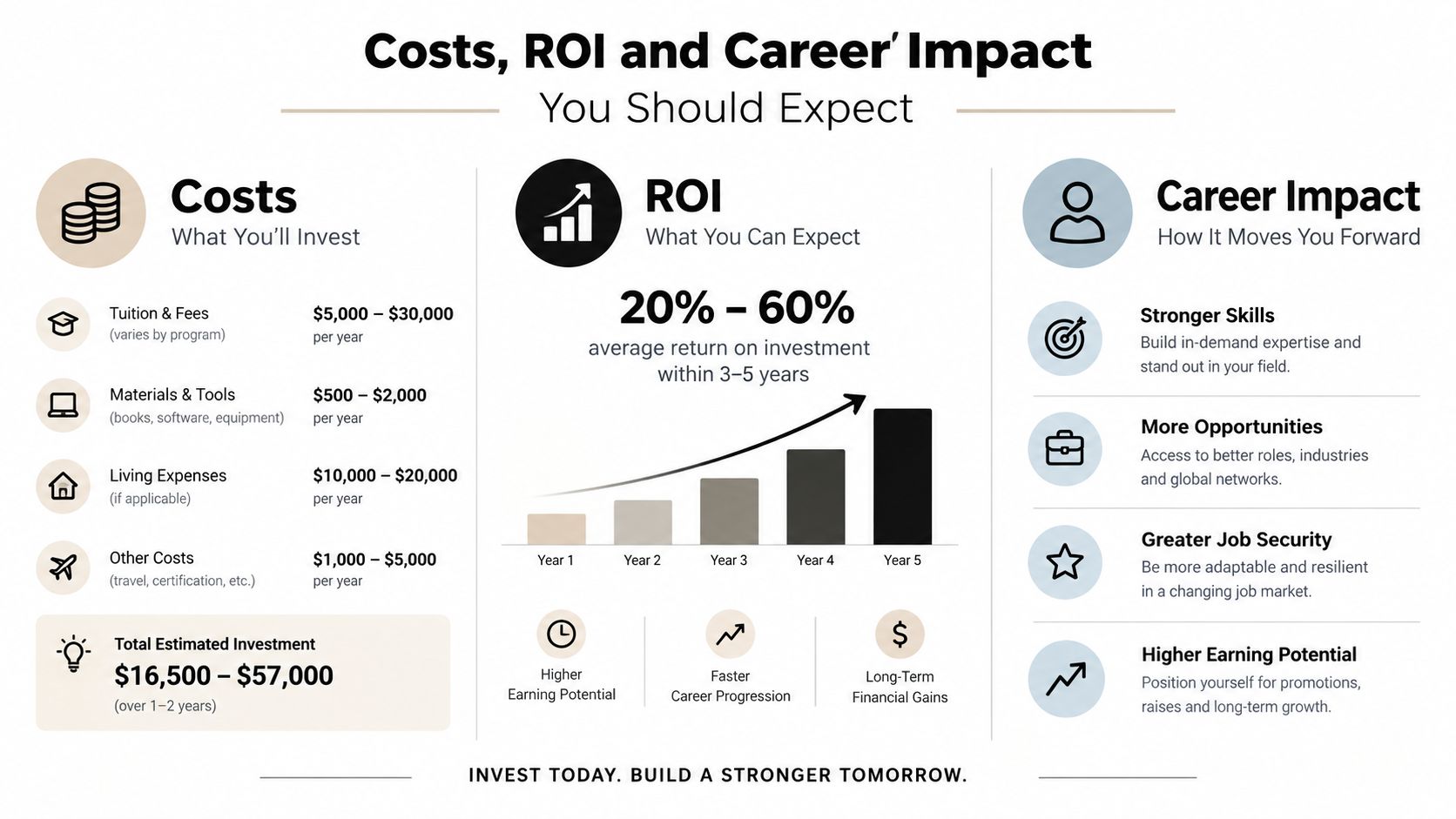
Don't assume that every online continuing education course produces a wage gain. A realistic forecast may be modest: the course keeps a license current, closes a specific competency gap, strengthens an application, or gives a manager reliable evidence of training. Those are worthwhile outcomes, but they're different from a guaranteed promotion or salary increase.
Next Steps and Tools to Manage Your Continuing Education
Give yourself a short implementation cycle rather than browsing indefinitely.
Days one through seven: Collect your requirements. Write down the credential, receiving authority, subjects, credit type, renewal date, documentation, and reporting obligations. Store the official rule and your current certificates together.
Days eight through fourteen: Shortlist accredited providers. Compare recognition, course format, assessment, support, device access, certificate design, and record retention. Contact the receiving authority if the provider's language is unclear.
Days fifteen through twenty-one: Test the learner experience. Review a sample lesson, confirm the assessment process, check whether you can pause and resume, and verify how completion appears in your records. For a team, pilot the workflow with a small group before assigning it broadly.
Days twenty-two through thirty: Complete the first course or launch the assignment plan. Set calendar reminders, create a renewal folder, and record completion as soon as it happens.
Different tools support different parts of the process:
- Learning management systems: Useful for structured courses, assignments, assessments, and learner access.
- Credential wallets: Useful for keeping certificates and professional records available across employers.
- Compliance trackers: Useful for renewal dates, required subjects, expiration monitoring, and audit preparation.
- Communication tools: Useful for reminders and follow-up. A guide to email marketing tools can help teams compare communication software categories, though messaging tools shouldn't replace an actual compliance record.
The strongest online continuing education plan is simple enough to maintain. Choose recognized learning, make completion realistic, preserve the evidence, and review career value separately from compliance value. When you're ready to compare software that can support learning, documentation, and business workflows, use The SaaS Hub to discover and evaluate relevant tools by category and use case.