
How to Land Remote Marketing Jobs in 2026
Land remote marketing jobs in 2026 with a step-by-step guide to targeting roles, building portfolios, sourcing openings, acing interviews, and negotiating pay.
By Yuvraj Kewate · 2026-09-12
Stop chasing generic remote marketing jobs like it's still 2022. The market doesn't reward spray-and-pray applications anymore, and the jobs that stay remote are concentrated in specific specialties, not in vague “marketing manager” listings. If you want a real shot in 2026, you need to aim at the functions that still hire remotely, prove you can work async, and stop wasting time on roles that went hybrid.
The hiring data backs that up. Recent U.S. snapshots put fully remote marketing roles in a durable minority of openings, with neutral-industry estimates clustering around 14% to 21% of postings, while hybrid remains the dominant flexibility model in major markets (salaryguide.com). Remote marketing also surged early in the decade, then normalized, which means the easy opportunities are gone and the market is now sharper, not bigger (Search Engine Journal). If you want to land one of these roles, you need to think like a hiring manager, not a hopeful applicant.
Table of Contents
- The 2026 Remote Marketing Market in One Page
- Matching Your Skills to Roles That Still Hire Remotely
- Building a Remote-Ready Portfolio and Resume
- How growthroles Can Help
- Where Remote Marketing Jobs Actually Live
- Outreach and Networking That Doesn't Feel Spammy
- Acing the Remote Interview Loop
- Negotiating Pay, Contracts, and Timezone Terms
The 2026 Remote Marketing Market in One Page
The blunt read on the market
The biggest mistake candidates make is treating remote marketing jobs as one broad category. They're not. Some specialties remain remote-friendly because the work lives in cloud tools, dashboards, docs, and campaign systems. Others have slid back toward hybrid because the hiring side wants more live collaboration, faster feedback loops, or closer coordination with product and brand teams.
Remote share still exists across the market, but it's uneven and increasingly selective. A recent market analysis shows remote and hybrid roles make up only about 20% of postings but attract roughly 60% of applications, which means competition is concentrated where flexibility is most attractive (MarketingHire). Another live hiring report said fully remote marketing roles fell from 15% of new U.S. postings in Q4 2024 to 11% in Q4 2025, a sign that overpromising “remote” is no longer enough (MarketingHire). That's the market you're applying into.
Practical rule: if a role can't be executed cleanly in writing, with metrics, and across time zones, assume it's becoming hybrid unless the posting proves otherwise.
What to target and what to deprioritize
The specialties that still stay remote-friendly are the ones built on artifacts. Think content, SEO, lifecycle, marketing ops, and parts of growth. Those roles reward people who can write, document, analyze, and own a funnel without needing hallway conversations all day.
The roles that are drifting back toward office-heavy collaboration are brand, community, CRM in some orgs, and field marketing. They can still be remote in the right company, but the burden is on you to prove why that team can trust you off-site. If you're still chasing generic “remote marketing manager” openings, you're using the wrong map.
The compensation picture also matters. Remote-first companies, especially in SaaS, often compete on scope and specialization, not just location. That's why the strongest openings usually sit in functions with direct revenue proximity, cleaner documentation habits, and easier async execution. For a broader view of how those markets intersect with SaaS hiring patterns, the research on Shopify and ecommerce hiring in the The SaaS Hub state of Shopify 2026 is a useful comparator for how focused digital teams hire around tools and workflows.
| Specialization | US remote share (%) | EMEA remote share (%) |
|---|---|---|
| Content marketing | High | High |
| SEO | High | High |
| Lifecycle marketing | High | High |
| Marketing ops | High | High |
| Product marketing | Medium to high | Medium to high |
| Demand generation | Medium | Medium |
| Performance marketing | Medium | Medium |
| Brand marketing | Low to medium | Low to medium |
| Community marketing | Low to medium | Low to medium |
| Field marketing | Low | Low |
The hiring-side takeaway
AI tooling, vendor consolidation, and return-to-office pressure have all compressed funnels. That means fewer roles, tighter specs, and less tolerance for vague resumes. If your positioning is generic, you'll get filtered out before anyone sees your work.
The candidates who still win are the ones who match a specialty, not a job title. “Remote marketing” is not the strategy. Remote SEO lead, lifecycle marketer, or product marketing manager for platform is the strategy.
Matching Your Skills to Roles That Still Hire Remotely
Start with your proof, not your preferences
Before you apply anywhere, list your last three shipped projects, the tools you used, and the metric you moved. Not the vanity metric, the actual one. If you can't connect the work to a shipped artifact, a process, and an outcome, you're not ready for remote screening.
That self-audit tells you which lane you belong in. Someone who has run content refreshes, internal briefs, and search performance analysis belongs closer to content or SEO. Someone who has built email journeys, trigger logic, and retention workflows belongs closer to lifecycle. Someone who has owned launches, messaging, and sales alignment belongs closer to product marketing. Don't force yourself into a category that doesn't fit your evidence.
Hiring truth: remote managers don't buy potential first, they buy proof that you can work independently without losing pace or clarity.
Match artifacts to the role family
Use your work samples like a sorting mechanism.
- Senior SEO Editor (remote, US): best if you can show content briefs, refresh plans, crawl fixes, and ranking movement. Tools like Ahrefs, Clearscope, and GA4 matter more than a glossy portfolio.
- Lifecycle Marketing Lead (remote, EU): best if you've built journeys in Customer.io or Iterable, owned CRM logic, and collaborated across sales or support.
- Product Marketing Manager, Platform (remote, global): best if you can show positioning docs, launch plans, and customer feedback synthesis in Amplitude, Notion, or Hex.
- Paid Growth Manager (remote): best if you know campaign structure in Meta Ads, attribution tradeoffs, and how to read performance without panicking over noisy data.
- Marketing Ops Manager (remote): best if you've touched routing, reporting, segmentation, and systems hygiene, often across HubSpot, Webflow, or related stacks.
Deprioritize roles that depend on in-person influence unless you've already done that work remotely. Brand and community can still be remote, but they're not the first stop for most candidates trying to break in from a distance.
Use a one-page decision matrix
Score each target role from 1 to 5 on three things. First, how well your past work maps to it. Second, how much the role depends on async execution. Third, how easily you can show evidence in a portfolio or interview. Apply only to roles that score high on all three.
If the role fits your background but you can't prove it in writing, skip it. If you can prove it but it doesn't match your recent work, skip it. The point is to stack the odds, not to collect rejections.
Building a Remote-Ready Portfolio and Resume
Treat every bullet as evidence
Hiring managers don't care that you “thrived in fast-paced environments.” They care whether you can work without constant follow-up, hand off cleanly, and defend your decisions in writing. Your portfolio and resume need to make that obvious.
Build each case study around five parts, Problem, Constraints, Actions, Metrics, Lessons. That structure forces you to show how you worked, not just what happened. Include the artifacts you used, such as briefs, Looms, dashboards, post-mortems, or internal docs. If the artifact can't survive a live interview, it doesn't belong on the page.
Keep the resume lean and remote-specific
Use a two-page resume, not four. Add a small Remote-readiness sidebar with overlap hours, async tooling fluency, and the environments you've worked in before. That sidebar should make it obvious that you can collaborate in distributed teams without needing hand-holding.
Your portfolio should stay tight. Five case studies are enough, fewer is often better. Carrd or Notion is fine if the presentation is clean and the evidence is real. Avoid redesign projects, mock branding exercises, and anything that exists only because you wanted to look busy. Those pieces impress no one who has hired for remote roles.
Show the full chain, brief, execution, handoff, and result. If you only show the result, the interviewer has to guess how you worked.
Use the playbook, not the fantasy
The safest way to build this is to make every bullet answer a hiring question. What problem did you own. What constraints did you work around. How did you communicate across time zones. What would your manager say you handled well or poorly.
The portfolio playbook is useful if you want a cleaner structure for turning raw work into interview-ready proof. The important thing is not design polish, it's defensibility.
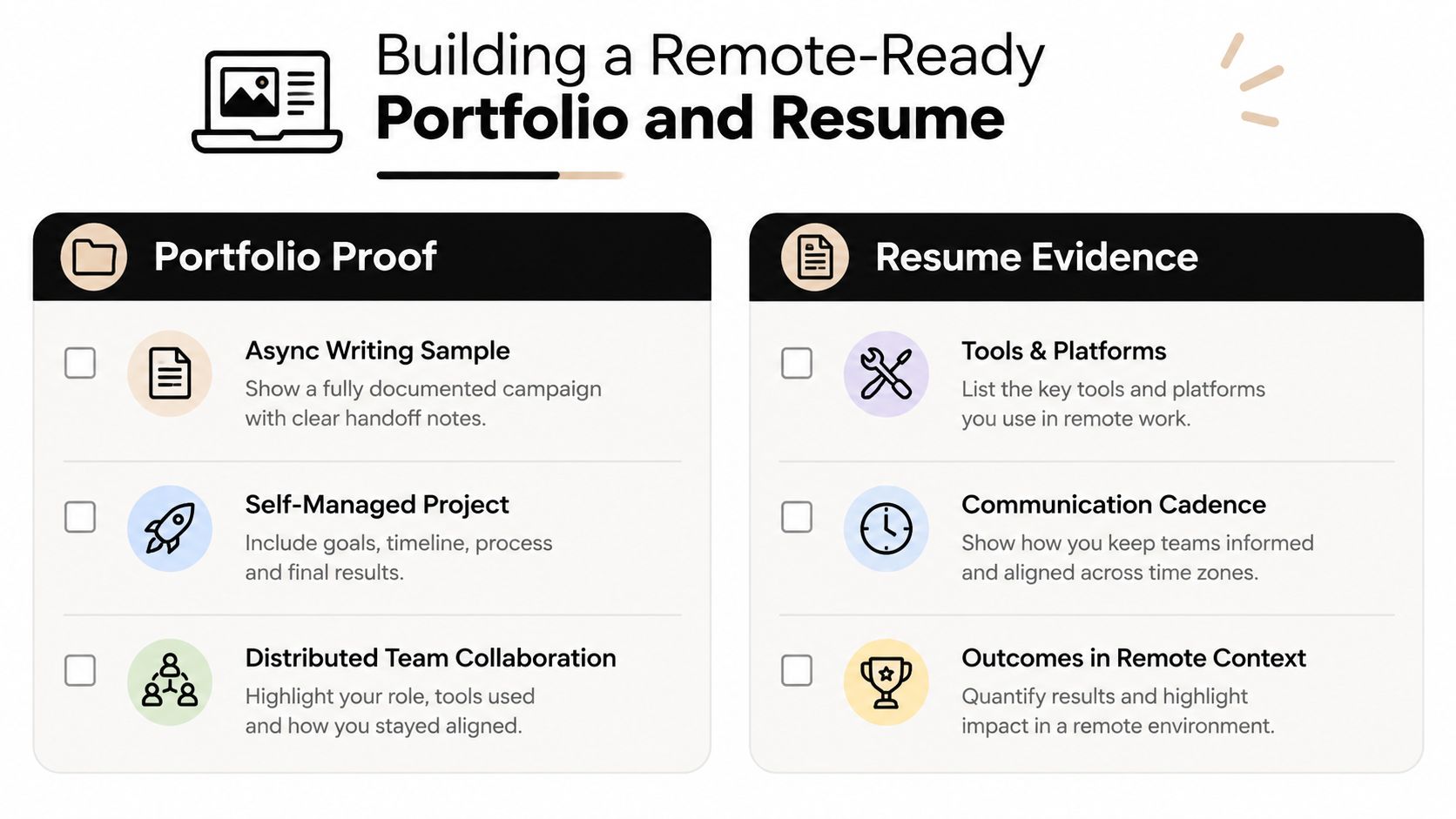
- Do include: async writing samples, self-managed projects, and examples of distributed collaboration.
- Do include: tooling names, communication cadence, and outcomes in remote contexts.
- Don't include: vanity metrics with no business context.
- Don't include: work you can't explain live without bluffing.
- Don't include: fifty screenshots when two clear artifacts will do the job.
How growthroles Can Help
Why a marketing-only job board matters
Most job boards are noisy because they're built for everyone. That's a problem if you're narrowing your search to remote marketing jobs, because you don't need more volume, you need more signal. A marketing-only platform cuts out irrelevant roles, lets you filter by category and seniority, and makes it easier to compare openings without tab-hopping through unrelated fields.
That's where remote marketing jobs on growthroles can help. It's built around marketing roles only, with live postings, company pages, remote-only filtering, pay visibility where available, and a structured taxonomy that spans many marketing categories. If you're comparing content, product marketing, growth, SEO, or email roles, that specialization saves time fast.
When it's the right tool
Use it when you want a fast read on the market, especially if you're trying to avoid generic aggregators that bury remote roles under irrelevant listings. It's also useful if you care about compensation transparency and want to compare roles across title, seniority, and function without opening ten separate tabs.
The strongest value is in how it reduces search friction. You can see which companies are hiring across multiple marketing functions, spot remote-only opportunities, and get a quicker sense of what skills are showing up repeatedly in live postings. That's a better starting point than doomscrolling LinkedIn and hoping the algorithm understands your niche.
For candidates deciding where to spend time, it's a good fit when you want a focused, marketing-specific search layer rather than a general job board. It won't replace company career pages or direct outreach, but it makes the top of the funnel a lot cleaner.
Where Remote Marketing Jobs Actually Live
Don't confuse volume with quality
The easiest place to find openings is not the best place to get hired. General job boards like LinkedIn and Indeed flood you with broad reach, but they also flood every role with applicants. That means you spend more time competing against noise and less time getting to relevant hiring teams.
Niche boards and direct career pages usually win on signal. When a company posts directly, especially for growth or product marketing, the listing tends to be more specific and the target audience smaller. That's why the best remote jobs often show up first on company sites, not in a search feed that everyone else is refreshing too.
| Channel | Signal Quality | Competition | Time Investment | Best For |
|---|---|---|---|---|
| LinkedIn and Indeed | Low to medium | Very high | Medium | Broad discovery, quick scanning |
| Niche marketing boards | High | Medium | Low to medium | Specialized roles, cleaner filtering |
| Company career pages | Very high | Medium | Medium | High-intent applications, premium roles |
| Recruiters and agencies | Medium | Medium | Low | Senior roles, confidential searches |
| Communities and newsletters | Medium to high | Low to medium | Medium | Hidden roles, referral pathways |
Read the listing like a skeptic
A remote title doesn't guarantee a remote job. Scan for timezone restrictions, office-day language, and HQ clauses that narrow the role. If the post says “remote” but also wants weekly travel, local time overlap only, or mandatory proximity to a city, you're not looking at a clean distributed role.
The best filter is the description itself. Real remote roles talk about async collaboration, documentation, and ownership. Weak ones lean on vague flexibility language while still describing a local-office workflow.
Use a weekly routine, not random browsing
Spend most of your search time on company pages and niche boards, then use LinkedIn and communities for discovery and relationship-building. Recruiters matter more once your specialty is clear and your proof is tight. The point is to allocate your energy to channels that produce replies, not to habits that just feel productive.
Outreach and Networking That Doesn't Feel Spammy
Lead with something they built
If you're targeting a senior content role at a Series B SaaS company, stop saying you “love their mission.” That line tells the hiring side nothing. Reference a specific asset, campaign, or content engine they built, then connect it to your own experience in one sentence.
A better cold message sounds like this.
Hi Maya, I noticed your team's teardown on partner-led content and the way you structured the comparison pages around intent. I've led similar content programs in B2B SaaS, and I'd love to share how I approached topic clustering, refreshes, and conversion tracking.
That works because it names real work, not flattery. It also gives the recipient a reason to believe you looked at the company.
Use referral asks that are easy to answer
A referral ask should be short, specific, and low-friction.
Hi Jordan, I'm applying for the Senior Content Marketing Manager role and noticed you work on the growth team. I'm coming from a B2B SaaS content background and have shipped SEO programs, launch pages, and lifecycle content. If you think it's relevant, would you be open to a quick yes or no on whether my background fits the role?
That message respects the employee's time. It doesn't demand a coffee chat, it doesn't oversell, and it gives them a simple action.
The recruiter reply should do the same job from the other side.
Thanks for reaching out. I'm happy to confirm the role is remote, the comp band is within X to Y, and the next step is a written exercise followed by a panel. If you'd like, send over your resume and a short note on your most relevant work.
Keep the volume tight
Run five to ten targeted outreaches a week, not fifty. Once your messages start sounding templated, reply rates drop and you start training yourself to care about quantity over relevance. Focus on three target companies, one real contact each, and a message that proves you paid attention.
If you need a starter framework, the outreach starter kit gives a practical baseline for writing messages that feel human instead of mass-produced.
Acing the Remote Interview Loop
Understand what they're really testing
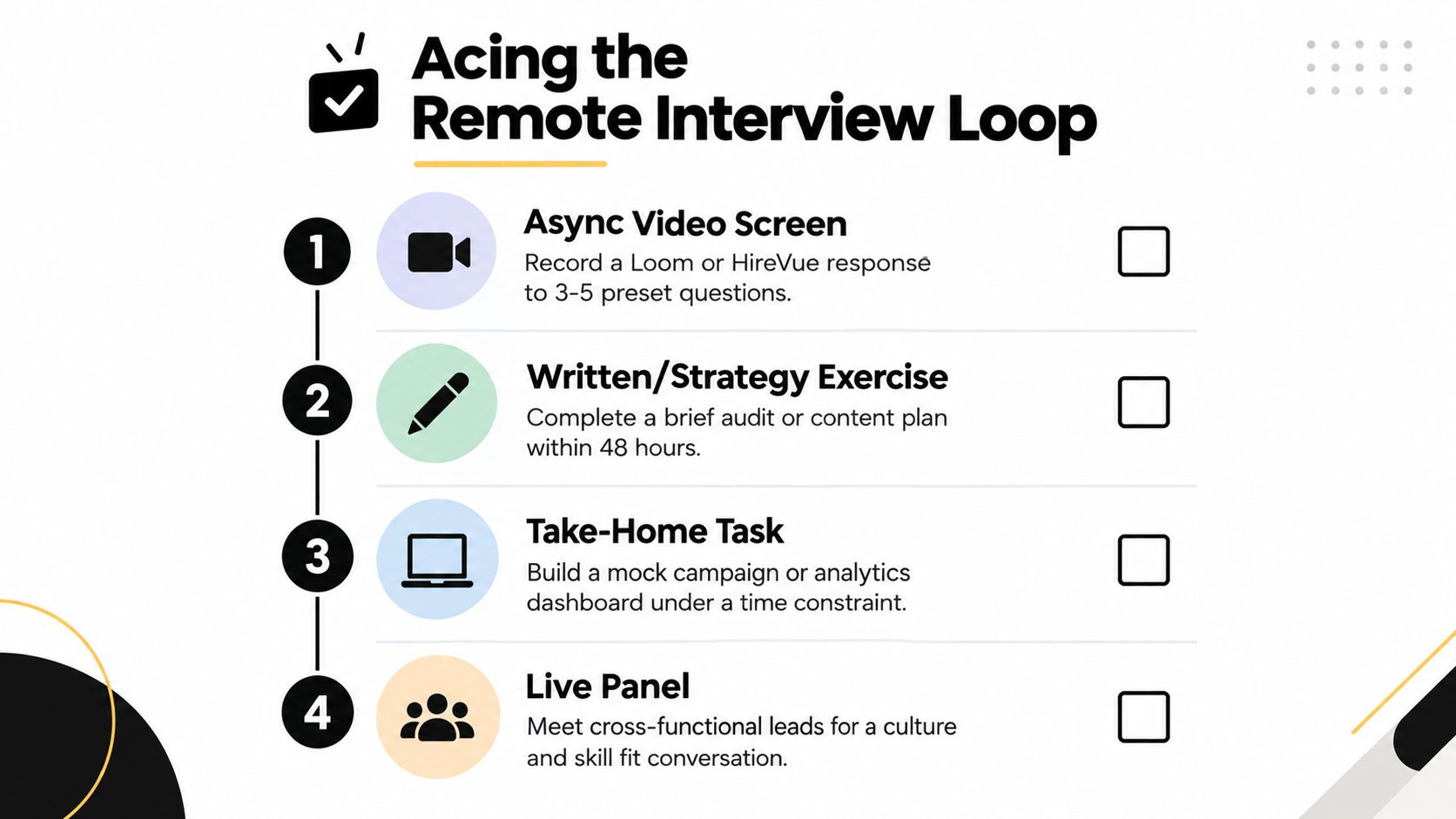
Remote interview loops are less about charisma and more about evidence of working style. The async screen tests whether you can communicate clearly without live rescue. The written exercise tests how you think under constraints. The take-home shows whether you can scope work and stop at the right point. The panel tests whether you can coordinate with cross-functional partners without losing the thread.
If you treat every round like a live performance, you'll overtalk and under-structure. Hiring teams want concise thinking, not polished rambling. They're asking, can this person work independently, explain choices cleanly, and keep stakeholders aligned when nobody's in the room together.
Prep for each stage without burning your week
Build one reusable exercise template you can adapt quickly. Have a framework for audits, a structure for campaign plans, and a simple way to show tradeoffs. For take-homes, set a four to six hour cap and define your stop conditions before you start. That protects you from turning a screening task into unpaid consulting.
A system-design prompt for marketers usually means showing how you'd own a funnel metric end-to-end. Don't memorize frameworks. Explain where the data comes from, what you'd inspect first, and how you'd communicate the next step to sales, product, or leadership. If you can do that cleanly, you look senior even without theatrics.
Red flag: if the company wants a full website rewrite, a giant campaign build, or work that clearly goes beyond screening, stop and ask what success really means.
Ask questions that prove remote fluency
Ask how the team documents decisions, how often they expect overlap, and what the handoff looks like between functions. Ask how feedback travels in async settings. Ask what a strong first ninety days looks like for the person who gets the role.
Those questions don't sound combative. They signal that you know distributed work has mechanics, and that you intend to use them well.
Negotiating Pay, Contracts, and Timezone Terms
Anchor the ask before they do
Stop negotiating from guesses. Negotiate from the role, the stage, and a researched range you can defend. For remote-friendly SaaS marketing roles, compensation still varies by specialization, scope, and whether the company is hiring a contractor or a full-time employee, so a title alone tells you very little.
Use the posted band when it exists. If it doesn't, check the band on the employer's site or job board, then cross-reference two comparable postings at similar-stage companies and write down your target number before the first call. A mid-stage SaaS company often treats a content marketing lead very differently from a marketing operations manager, even if both sit inside the same marketing org.
Know the structure you're accepting
A full-time W-2 role gives you benefits, payroll tax handling, and cleaner long-term stability. A 1099 contract can pay more per hour on paper, but you absorb more tax burden, benefits costs, and downtime risk. If a recruiter sells contract work as flexibility, force the conversation back to the full tradeoff before you say yes.
Timezone overlap needs to be specific too. Don't accept “flexible hours” if the team expects live collaboration every day. Ask for the overlap window in writing, and make sure it matches how the team really works. If they need four hours of overlap, get that spelled out clearly.
If the offer comes in low, do not argue emotionally. Restate your fit, restate the scope, and ask whether there is room to move on base, equity, or sign-on.
Push back without burning the relationship
Say this when you need to hold the line. “I'm excited about the role and the scope fits what I've done well. Based on my background and the market for this specialization, I'd be targeting a higher base or an adjusted package that closes the gap.” That keeps the conversation professional and gives the hiring team a concrete path to respond.
If they cannot move base, ask about equity refreshes, sign-on support, or additional PTO. For contractor roles, ask for the exact pay cadence, expected hours, and whether the scope can expand without a rate change. Do not bluff. Strong negotiators stay calm, stay specific, and walk away when the package does not match the job.