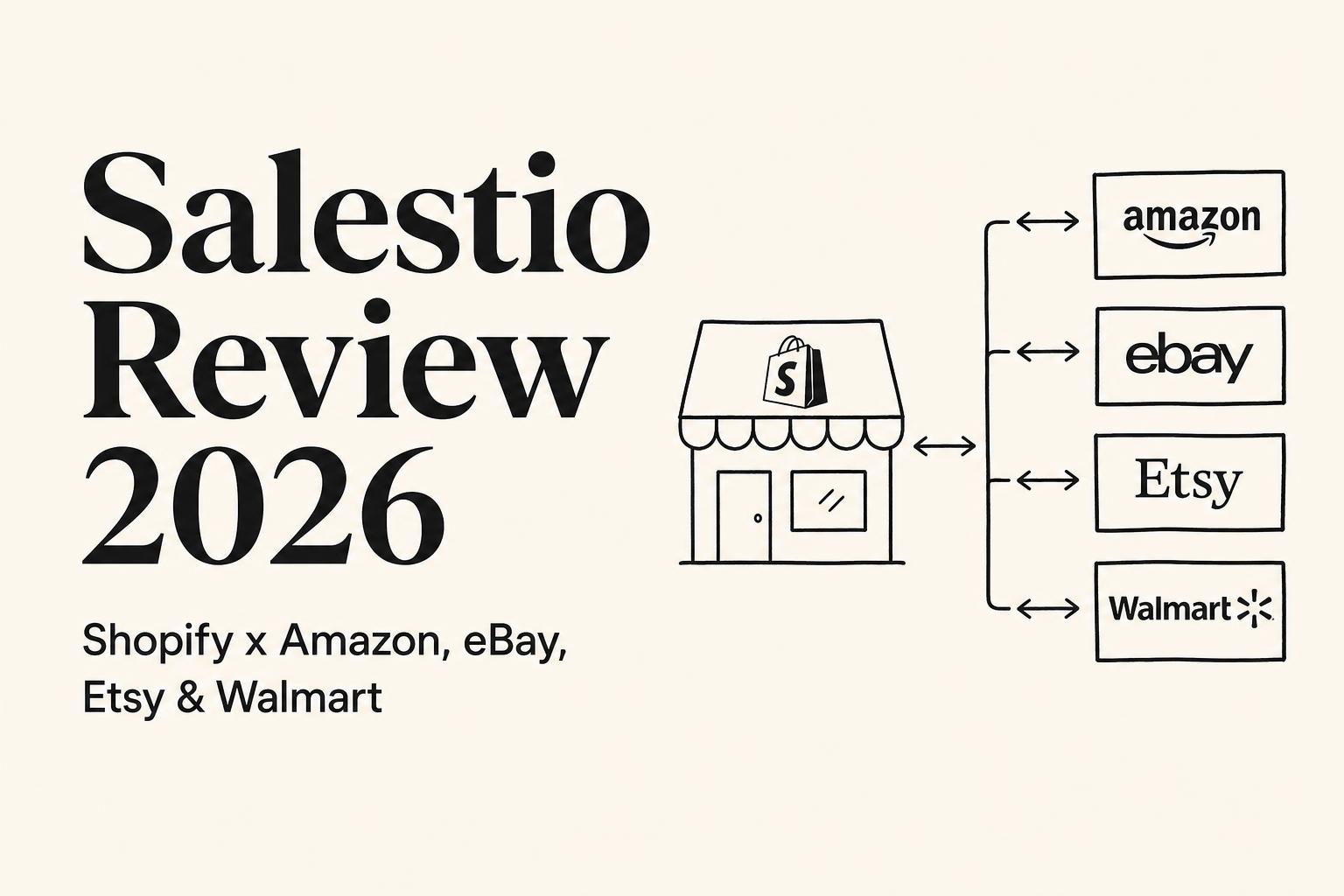
Salestio Review (2026): The Complete Shopify Marketplace Integration for Amazon, eBay, Etsy & Walmart
An in-depth review of Salestio, the Shopify marketplace integration for Amazon, eBay, eBay Motors, Etsy and Walmart: features, automation, use cases, pros, limitations and alternatives.
By Yuvraj Kewate · 2026-08-17
Selling on multiple marketplaces has become one of the fastest ways for Shopify merchants to expand their reach. Amazon, eBay, Etsy and Walmart each attract millions of active shoppers, offering businesses access to audiences that may never visit an independent online store.
However, multi-channel selling introduces a new operational challenge.
Products need to be listed on multiple marketplaces, inventory must remain accurate across every sales channel, pricing often varies by marketplace, and orders arrive from several different platforms. Managing these tasks manually quickly becomes unsustainable as product catalogs grow.
This is where marketplace integration software plays an increasingly important role. Rather than treating Amazon, eBay, Etsy, Walmart and Shopify as separate systems, integration platforms synchronize products, inventory, pricing, and orders so merchants can manage everything from a central location.
Among the growing number of marketplace connectors available for Shopify, Salestio positions itself as a comprehensive solution for merchants selling across multiple marketplaces. Instead of replacing Shopify, it extends Shopify''s capabilities by allowing merchants to use their store as the operational hub while automating much of the work involved in marketplace selling.
In this review, we take an in-depth look at Salestio, including its features, supported marketplaces, automation capabilities, strengths, limitations, and the types of businesses that can benefit most from the platform.
Executive Summary
Best for: Shopify merchants selling on Amazon, eBay, eBay Motors, Etsy or Walmart.
Primary use case: Marketplace listing management, inventory synchronization, order imports, and fulfillment automation.
| Marketplace | Product Export | Inventory & Price Sync | Order Import | Fulfillment Sync |
|---|---|---|---|---|
| Amazon | Yes | Yes | Yes | Yes |
| eBay | Yes | Yes | Yes | Yes |
| eBay Motors | Yes | Yes | Yes | Yes |
| Etsy | Yes | Yes | Yes | Yes |
| Walmart | Beta | Not yet available | Yes | Yes |
Salestio helps merchants centralize marketplace operations inside Shopify. Products can be exported directly from Shopify, inventory levels remain synchronized across connected channels, marketplace orders are imported into Shopify, and fulfillment updates are automatically sent back to the originating marketplace.
For merchants managing several sales channels simultaneously, Salestio reduces manual work while helping maintain consistent inventory and order workflows.
Why Marketplace Integrations Matter More Than Ever
A decade ago, many Shopify merchants focused almost exclusively on growing their own online stores. Today, commerce looks very different.
Customers discover products across a wide range of channels: Amazon, eBay, Etsy, Google Shopping, social commerce, retail marketplaces and brand websites. Rather than replacing a Shopify store, these marketplaces often complement it by introducing products to new audiences.
The challenge is operational rather than strategic. Every additional marketplace creates another source of product listings, inventory updates, pricing changes, customer orders and fulfillment notifications.
Without integration software, merchants frequently duplicate work across multiple dashboards. Common challenges include:
- Inventory mismatches. Selling the last available product on Amazon while it remains available on Shopify can result in overselling and cancelled orders.
- Duplicate product management. Updating product descriptions or images separately on each marketplace becomes increasingly time consuming as catalogs expand.
- Fragmented order management. Orders arriving from four different systems create unnecessary complexity for fulfillment teams.
- Marketplace-specific requirements. Each marketplace requires different attributes, categories, identifiers, and listing formats.
As businesses grow, these manual processes often become the limiting factor rather than customer demand. Marketplace integration platforms are designed to solve exactly this problem: merchants maintain one central product catalog while synchronization software handles the repetitive operational work behind the scenes.
What Is Salestio?
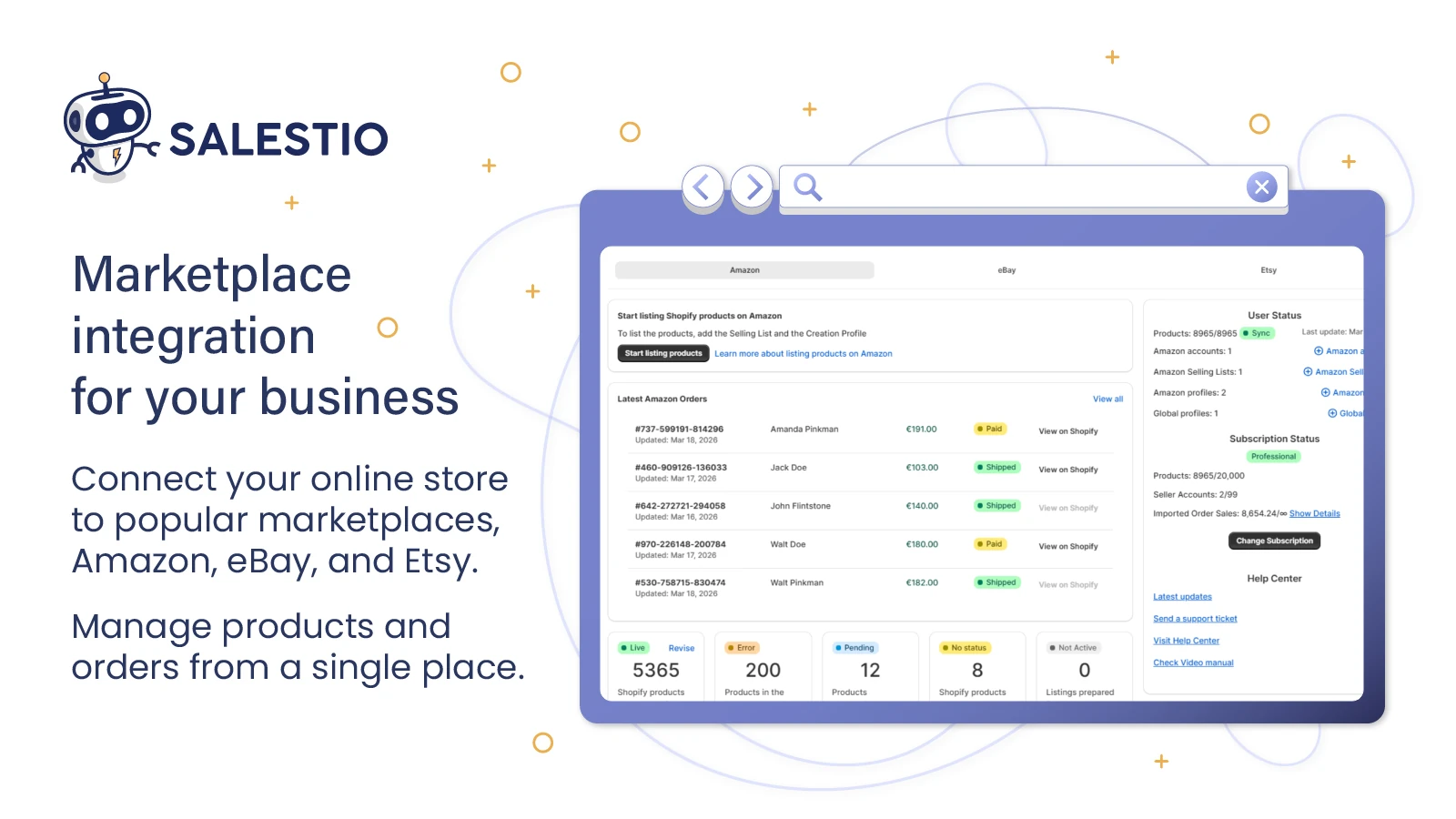
Salestio is a Shopify marketplace integration platform that connects Shopify with leading online marketplaces, allowing merchants to manage products, inventory, pricing, orders, and fulfillment from within Shopify.
Rather than acting as a separate ecommerce platform, Salestio works alongside Shopify by synchronizing data between Shopify and supported marketplaces. At the time of writing, supported marketplaces include Amazon, eBay, eBay Motors, Etsy and Walmart (open beta).
Merchants can export Shopify products to these marketplaces, synchronize stock and pricing, import marketplace orders into Shopify, and automatically update fulfillment information after orders have been shipped.
The platform also supports Shopify Plus merchants, multiple marketplace accounts, and advanced product mapping options for businesses with larger catalogs or more complex operations.
One notable aspect of Salestio is that it operates primarily through the Shopify Admin interface. This means merchants can continue using Shopify as their primary operational workspace rather than switching constantly between multiple marketplace dashboards.
How Salestio Works
At a high level, Salestio keeps Shopify at the center of the commerce workflow. Instead of maintaining separate product catalogs for each marketplace, Shopify becomes the primary source of product information.
The workflow typically follows this sequence:
- Products are created and maintained in the Shopify catalog.
- Salestio exports those products to Amazon, eBay, eBay Motors and Etsy.
- Inventory and pricing updates flow automatically to connected marketplaces.
- Marketplace orders are imported back into Shopify.
- Fulfillment happens inside Shopify.
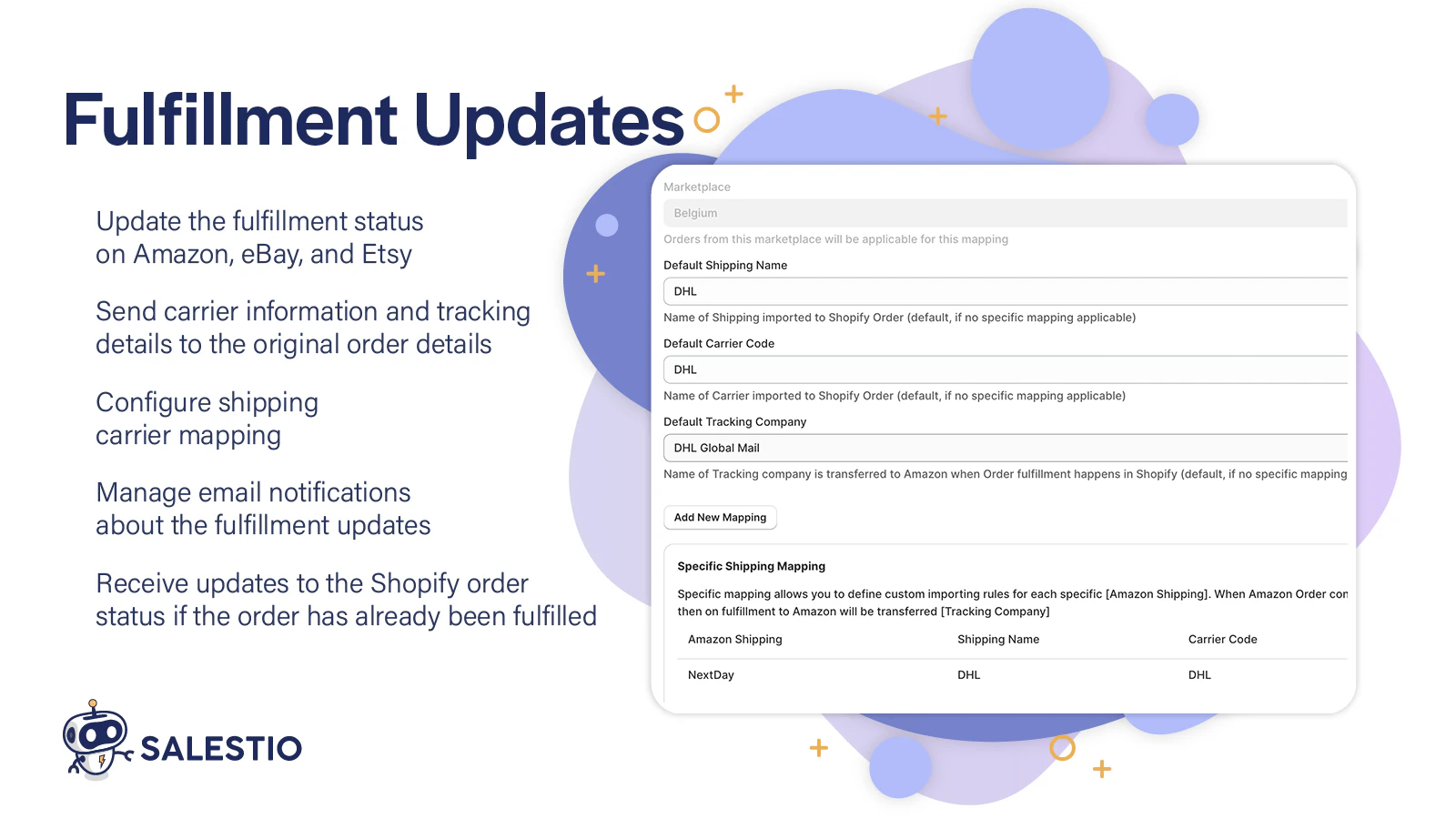
- Tracking and carrier details are synchronized back to the marketplace.
Note: Walmart is currently in open beta with order import and fulfillment synchronization only.
For merchants managing hundreds or thousands of SKUs, this significantly reduces repetitive administrative work.
Supported Marketplaces
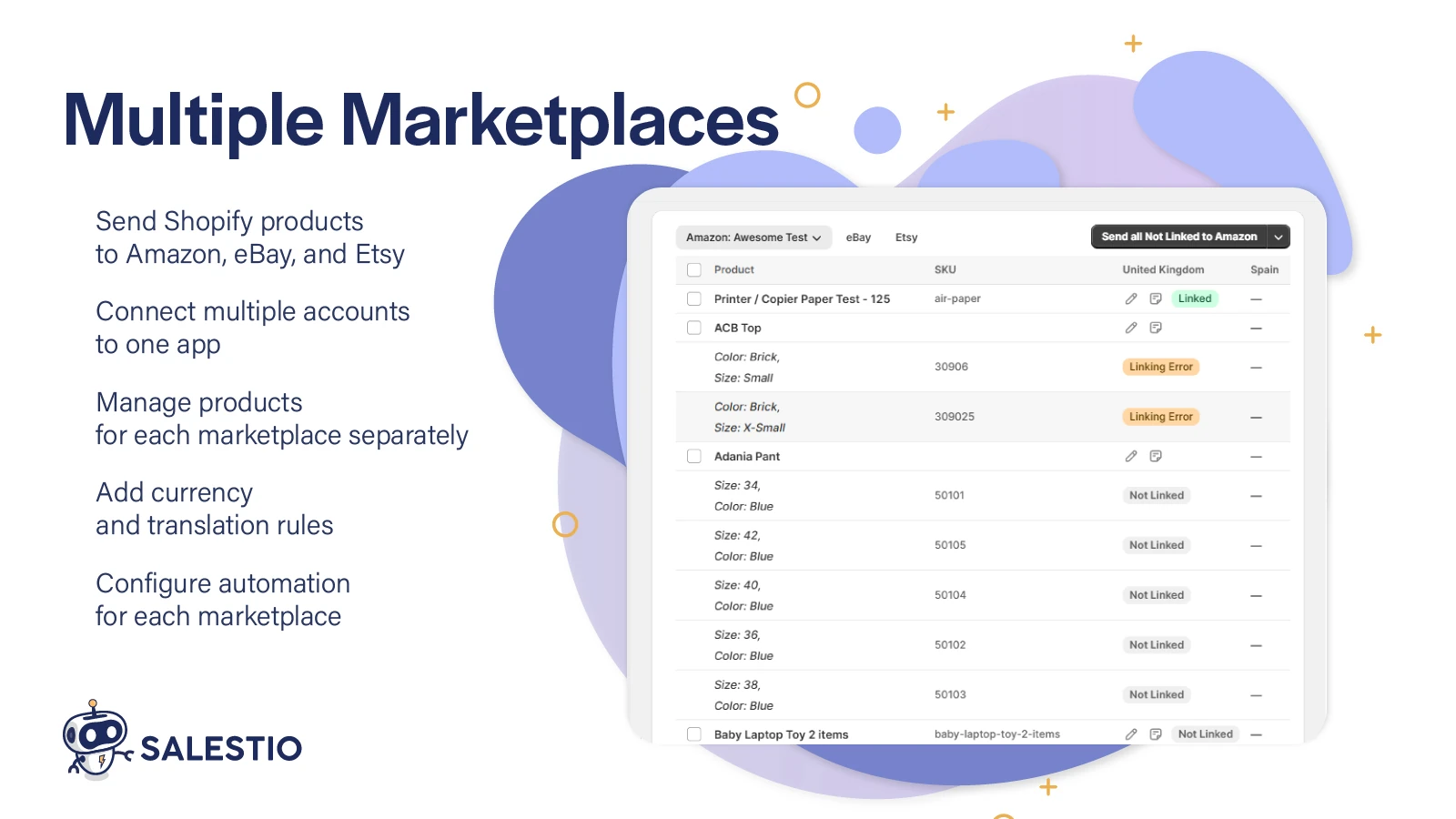
One of Salestio''s biggest strengths is its focus on major online marketplaces rather than attempting to support dozens of smaller channels. Each supported marketplace has different technical requirements and listing standards, and Salestio accommodates these differences while allowing merchants to maintain a centralized workflow.
Amazon
Amazon remains the world''s largest ecommerce marketplace and is often the first expansion channel for Shopify merchants. Salestio supports product exports, inventory synchronization, price synchronization, Amazon FBM and FBA order imports, and fulfillment synchronization.
Merchants can create Amazon listings directly from Shopify while maintaining centralized inventory management. For businesses already selling on Amazon, existing listings can also be connected to Shopify products instead of being recreated from scratch.
eBay
eBay continues to serve millions of buyers across both consumer and specialist product categories. Salestio allows merchants to publish listings, synchronize inventory, import orders and automate fulfillment updates, making it easier to operate both Shopify and eBay without maintaining separate inventories.
Etsy
Etsy has become an important marketplace for handmade products, vintage goods, personalized items, and independent brands. Salestio enables Etsy sellers to manage inventory from Shopify while automatically importing Etsy orders for centralized processing.
For growing brands that originally started on Etsy, Shopify often becomes the operational backbone while Etsy remains an important acquisition channel. Salestio supports that transition by keeping the two platforms synchronized.
Walmart
Walmart is the newest marketplace integration available through Salestio and is currently in open beta. The current integration supports Walmart order imports, fulfillment synchronization, Walmart US, Canada and Mexico, and multiple Walmart marketplace accounts.
Merchants can import Walmart orders directly into Shopify and manage fulfillment from their Shopify workflow. Once an order is fulfilled, Salestio can send the carrier and tracking information back to Walmart.
Open beta note: The current Walmart integration does not yet support product listing creation or Walmart inventory and price synchronization. These capabilities are available for other supported marketplaces but are not currently part of the Walmart integration.
eBay Motors
Automotive sellers often require marketplace-specific product identifiers that general marketplace software does not support well. Salestio includes support for automotive fields including KType and ePID. These identifiers simplify product matching for automotive parts and accessories while helping merchants comply with marketplace requirements.
A Centralized Commerce Hub
Perhaps the biggest advantage of Salestio is not any single feature. It is the operational model it encourages.
Rather than treating Amazon, eBay, Etsy, and Shopify as four independent businesses, Salestio allows merchants to manage them as one connected commerce ecosystem. Products originate in Shopify, inventory remains synchronized, orders flow back into Shopify, and fulfillment updates return automatically to each marketplace.
For growing businesses, this centralized approach reduces administrative overhead while allowing teams to spend more time on merchandising, customer experience, and growth instead of repetitive operational tasks.
Core Features: A Deep Dive into Salestio
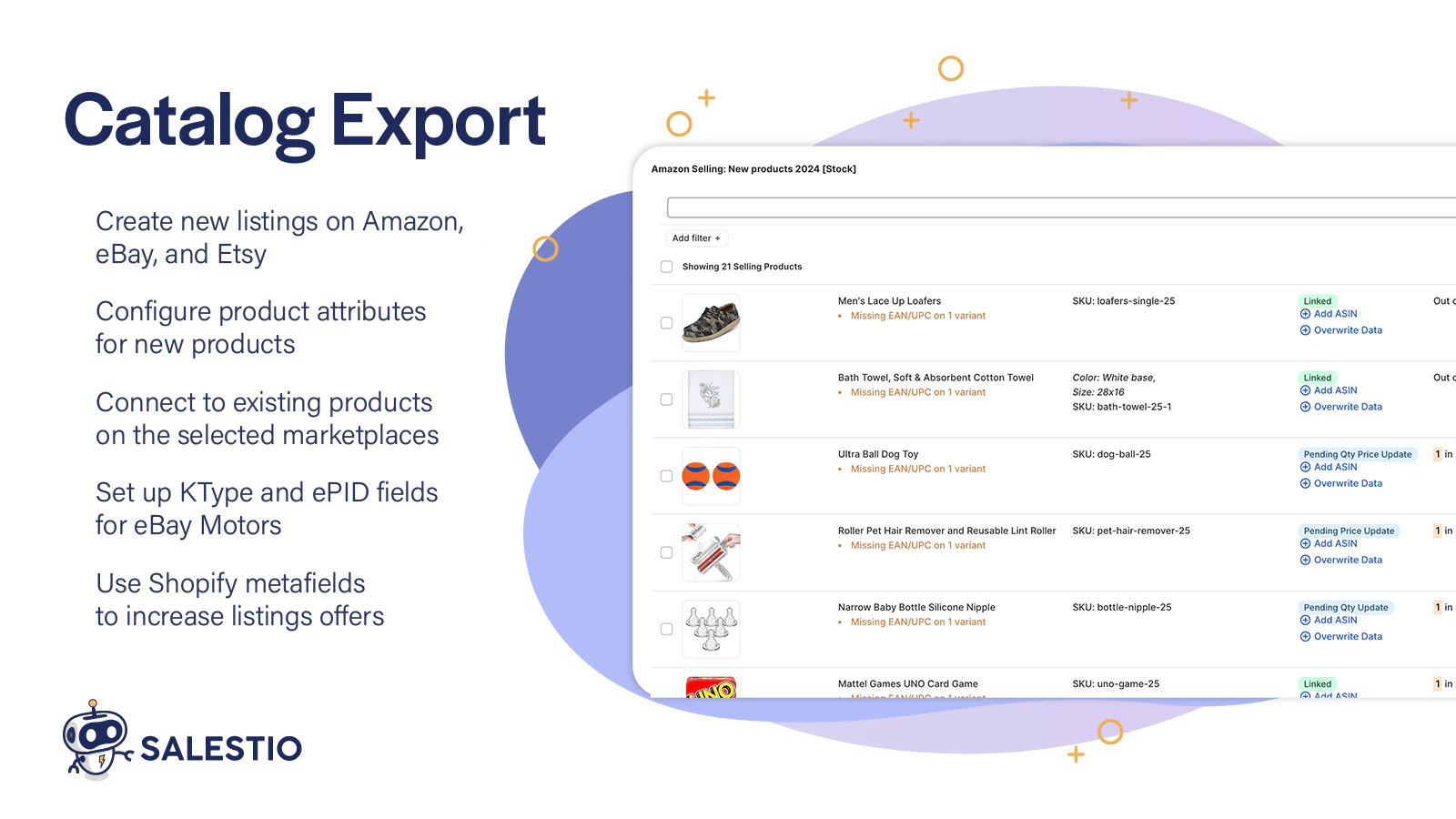
While many marketplace connectors promise to simplify multichannel selling, their capabilities often stop at basic product synchronization. Salestio takes a broader approach by supporting the complete operational lifecycle: from publishing products and synchronizing inventory to importing marketplace orders and updating fulfillment statuses.
Product Export and Marketplace Listing Management
Creating marketplace listings is often the most time-consuming part of expanding to a new sales channel. Without integration software, merchants typically recreate products manually on Amazon, eBay, or Etsy, entering titles, descriptions, pricing, images, attributes, and inventory for each marketplace separately.
Salestio eliminates much of this repetitive work by allowing merchants to export products directly from Shopify. Key capabilities include:
- Export products to Amazon, eBay, eBay Motors and Etsy
- Bulk product publishing
- Support for product variants
- Existing listing synchronization
- Marketplace-specific field mapping
For merchants launching large catalogs, bulk publishing dramatically reduces the time required to establish a presence across multiple marketplaces.
Support for Marketplace-Specific Attributes
One of the challenges of multichannel commerce is that every marketplace requires different product information. Amazon uses category-specific attributes, eBay often requires item specifics, automotive products require identifiers such as KType and ePID, and Etsy emphasizes handcrafted, vintage, and personalized product information.
Rather than applying a one-size-fits-all approach, Salestio supports marketplace-specific fields that help merchants create more complete listings. The platform also supports Shopify metafields, allowing businesses with enriched product data to map additional information to supported marketplaces.
Flexible Pricing Rules
Pricing strategies often vary between marketplaces. Amazon fees differ from Etsy fees, shipping costs vary, marketplace competition changes daily, and some merchants intentionally charge different prices on different channels.
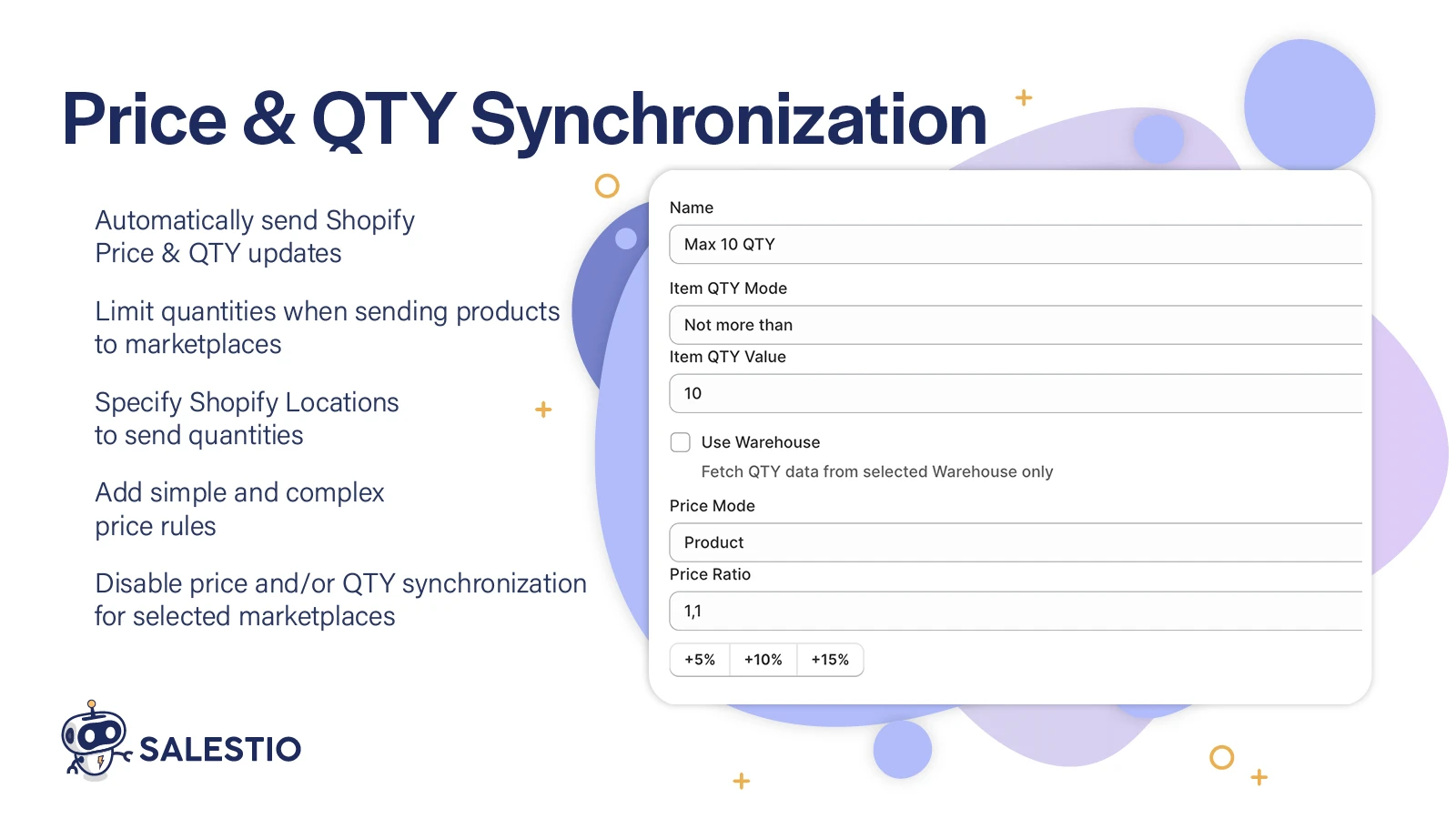
Salestio allows merchants to configure custom pricing rules rather than forcing identical pricing everywhere, including marketplace-specific price adjustments, fixed price increases, percentage-based markups and marketplace pricing templates.
Inventory Synchronization
Inventory management is arguably the most valuable capability of any marketplace integration platform. When inventory is managed manually, overselling becomes almost inevitable.
Imagine a merchant with only one product remaining. If that product sells on Shopify but inventory is not immediately updated on Amazon and eBay, another customer could purchase an item that is no longer available. This results in cancelled orders, poor customer experiences, marketplace penalties and negative seller metrics.
Salestio addresses this problem through automated inventory synchronization. Whenever inventory changes inside Shopify, updated stock levels can be synchronized across connected marketplaces, covering inventory quantities, stock availability, product status and inventory updates after orders.
Inventory Buffers
Many merchants intentionally reserve a small amount of stock to reduce the risk of overselling. A product may have 100 units available but only 95 displayed on marketplaces. This buffer provides additional protection during periods of high sales volume or temporary synchronization delays. Salestio supports configurable inventory quantities, giving merchants greater control over marketplace availability.
Order Import
Marketplace selling often becomes difficult because orders originate from multiple systems. Without centralized management, merchants may process Shopify, Amazon, eBay and Etsy orders in separate dashboards.
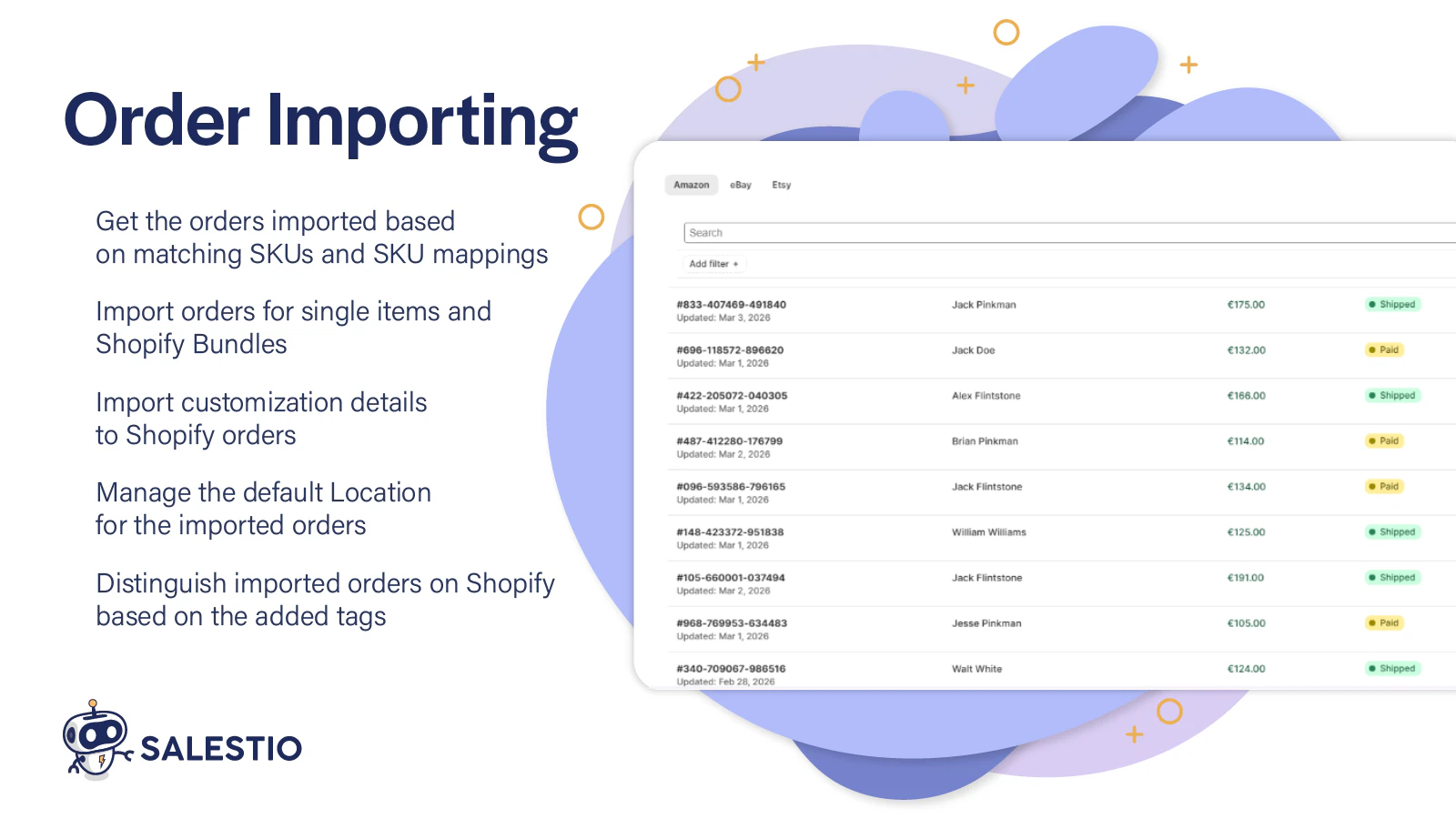
Salestio imports marketplace orders directly into Shopify, allowing fulfillment teams to work from a single operational interface. Supported order imports include Amazon FBM, Amazon FBA, eBay, Etsy and Walmart.
Once imported, orders appear alongside native Shopify orders. Teams no longer need to constantly switch between marketplace dashboards, order reporting becomes more consistent, inventory updates happen automatically, and shipping workflows remain centralized.
Fulfillment Synchronization
The workflow does not end once an order is shipped. Marketplaces also require merchants to update fulfillment information. Without automation, merchants must manually enter tracking numbers, carrier information and shipment confirmations for every marketplace.
Salestio automates this process by synchronizing fulfillment updates back to connected marketplaces. When an order is fulfilled inside Shopify, shipping information can automatically be transmitted to the originating marketplace, which pairs well with the rest of your orders and shipping stack.
Existing Listing Synchronization
Many merchants already have active listings before installing marketplace software, and starting over is rarely practical. Salestio allows merchants to connect existing marketplace listings with Shopify products instead of creating duplicate listings, which makes migration considerably easier for established marketplace sellers.
Multiple Marketplace Accounts
Growing ecommerce businesses often sell internationally, which frequently involves maintaining separate marketplace accounts for different countries or brands: Amazon US, Amazon UK, Amazon Germany, eBay US, eBay UK and more.
Salestio supports multiple marketplace accounts, allowing merchants to manage several storefronts from a single Shopify environment. This capability is particularly valuable for international brands, distributors, enterprise merchants and multi-brand businesses.
Shopify Plus Support
Enterprise merchants often have operational requirements that exceed the capabilities of basic marketplace connectors. Salestio includes support for Shopify Plus, making it suitable for businesses managing large product catalogs, high order volumes, multiple inventory locations, complex fulfillment operations and international marketplace expansion.
Automation That Reduces Repetitive Work
Perhaps the biggest strength of Salestio is not a single feature but the way those features work together. A typical sequence looks like this:
- Create or update a product in Shopify.
- Export the product to Amazon, eBay, and Etsy.
- Inventory synchronizes automatically.
- A customer places an order on Amazon.
- The order appears in Shopify.
- The merchant fulfills the order in Shopify.
- Tracking information is automatically sent back to Amazon.
- Inventory updates across every connected marketplace.
User Experience and Shopify Integration
One aspect that differentiates Salestio from some marketplace management platforms is its emphasis on working within the Shopify ecosystem.
Rather than requiring merchants to manage day-to-day operations through a separate external platform, Salestio integrates with Shopify''s existing workflows. Products originate in Shopify, marketplace orders flow back into Shopify, and fulfillment can continue through the merchant''s established processes. For teams already familiar with Shopify Admin, this approach can reduce the learning curve.
Selling on Amazon with Shopify
For many Shopify merchants, Amazon is the first marketplace they expand into. It offers enormous customer reach, but it also comes with operational complexity. Product listings must meet Amazon''s requirements, inventory needs to stay accurate, and fulfillment updates must be sent promptly to maintain seller performance.
Salestio helps simplify this workflow by connecting Amazon with Shopify. Merchants can export Shopify products to Amazon, synchronize inventory and pricing, import Amazon orders into Shopify, and send fulfillment updates back to Amazon once orders have been shipped. The app supports both FBM and FBA order imports.
For merchants already selling on Amazon, Salestio also supports linking existing listings rather than forcing users to recreate their catalog from scratch.
Best suited for: consumer brands, electronics retailers, home and garden, health and beauty, sporting goods, and businesses scaling internationally.
Selling on eBay with Shopify
Although Amazon often dominates discussions around marketplace commerce, eBay remains one of the world''s largest online marketplaces with millions of active buyers across electronics, automotive, collectibles, fashion and refurbished goods.
Salestio allows merchants to publish Shopify products to eBay, synchronize inventory, update pricing, import eBay orders into Shopify and automatically send fulfillment updates. Rather than maintaining two separate operational systems, Shopify becomes the primary catalog while Salestio keeps eBay synchronized in the background.
Selling on Etsy with Shopify
Etsy serves a different audience than Amazon or eBay. Many Etsy merchants focus on handmade goods, personalized products, vintage items, craft supplies and independent brands.
As businesses grow, many eventually adopt Shopify to gain greater control over branding, customer relationships and ecommerce operations. Instead of replacing Etsy, many successful merchants operate both channels simultaneously.
Salestio supports this hybrid approach by allowing merchants to manage inventory centrally while continuing to sell through Etsy. Orders placed on Etsy can be imported into Shopify, helping merchants manage fulfillment from a single location.
Selling on Walmart with Shopify
Walmart is the newest marketplace connection in Salestio and is currently available in open beta. The current integration focuses on bringing Walmart orders into Shopify and sending fulfillment information back to Walmart.
Walmart order import
Walmart orders can be imported directly into Shopify with buyer, shipping and marketplace-specific information. Salestio uses SKU mapping to match Walmart orders with the corresponding Shopify products, which is another reason to keep your SKU and barcode data clean.
Walmart fulfillment synchronization
Once a Walmart order is fulfilled in Shopify, Salestio sends the shipping carrier and tracking number back to Walmart automatically. This keeps fulfillment information consistent without requiring merchants to update Walmart Seller Center manually.
Walmart US, Canada, and Mexico
The current integration supports Walmart US, Walmart Canada and Walmart Mexico. Each marketplace is connected separately with its own API credentials, and Salestio also supports multiple Walmart accounts.
What Walmart does not support yet
The current Walmart beta does not yet support product listing creation or Walmart stock and price synchronization. Those capabilities are available for other supported marketplaces, but should not be presented as Walmart features until Salestio officially adds them.
This makes Walmart an interesting addition for merchants who primarily need centralized Walmart order and fulfillment management today, while the integration continues to develop.
eBay Motors Support
Automotive ecommerce presents unique technical challenges. Unlike many retail categories, automotive parts require compatibility data and marketplace-specific identifiers to ensure buyers purchase components that fit their vehicles.
Salestio supports automotive-specific fields including KType and ePID. These identifiers are particularly important for merchants selling vehicle parts and accessories through eBay Motors, and this functionality distinguishes Salestio from many general-purpose marketplace connectors.
Real-World Use Cases
Fashion Brands
A clothing retailer manages seasonal collections in Shopify while automatically publishing products to Amazon and eBay. Inventory updates are synchronized across every channel, helping reduce overselling during peak sales periods.
Handmade Goods
An artisan business continues selling through Etsy while using Shopify as its primary ecommerce platform. Salestio imports Etsy orders into Shopify, allowing the business to process all orders from one place.
Automotive Parts Retailer
An auto parts supplier uses Salestio''s support for KType and ePID fields to manage eBay Motors listings while maintaining inventory centrally in Shopify.
International Merchant
A business operating multiple Amazon regional accounts can manage products, inventory, and pricing from a single Shopify catalog instead of maintaining separate workflows for each marketplace.
Pros
- Shopify-centric workflow. Rather than replacing Shopify, Salestio extends it. Merchants continue using Shopify as the operational hub while marketplaces become connected sales channels.
- Broad marketplace coverage. Supporting Amazon, eBay, eBay Motors, Etsy and Walmart allows merchants to reach diverse customer segments without adopting multiple integration tools.
- Comprehensive automation. Product publishing, inventory synchronization, price synchronization, order imports and fulfillment updates are all covered.
- Flexible product mapping. Support for Shopify metafields and marketplace-specific attributes enables richer marketplace listings without duplicating product information.
- Multi-account support. Businesses selling internationally or operating multiple marketplace accounts can manage those channels within a centralized workflow.
Things to Consider
No marketplace integration platform is completely hands-off, and Salestio is no exception. Merchants should keep the following in mind:
- Every marketplace has its own listing policies and requirements.
- Product optimization for Amazon, eBay, and Etsy still requires ongoing attention.
- Initial setup, including product mapping and marketplace configuration, takes planning, particularly for larger catalogs.
- Marketplace success depends on pricing, customer service, fulfillment performance, and product quality in addition to software automation.
Salestio simplifies operations, but merchants remain responsible for their marketplace strategy.
Salestio vs. Shopify Marketplace Connect
Many Shopify merchants evaluating Salestio will also consider Shopify Marketplace Connect. While both solutions aim to connect Shopify with external marketplaces, their focus and feature sets differ.
| Feature | Salestio | Shopify Marketplace Connect |
|---|---|---|
| Amazon integration | Yes | Yes |
| eBay integration | Yes | Yes |
| Etsy integration | Yes | No |
| eBay Motors support | Yes | No |
| Order import | Yes | Yes |
| Inventory sync | Yes | Yes |
| Fulfillment sync | Yes | Yes |
| Shopify metafields support | Yes | Limited |
| Multiple marketplace accounts | Yes | Varies by marketplace |
Merchants primarily selling on Amazon and eBay may find either solution suitable, while businesses that also rely on Etsy or eBay Motors may appreciate Salestio''s broader marketplace coverage and marketplace-specific functionality.
Alternatives to Salestio
While Salestio offers a comprehensive feature set, it is not the only marketplace integration platform available to Shopify merchants. Depending on your business requirements, you may also consider:
- Shopify Marketplace Connect: Shopify''s own marketplace connector for Amazon, eBay, Walmart, and Target Plus.
- LitCommerce: supports a broad range of marketplaces with multichannel listing management.
- CedCommerce: offers integrations for numerous global marketplaces with extensive customization options.
- Sellbrite: focuses on multichannel inventory and order management for ecommerce businesses.
The best choice depends on supported marketplaces, automation requirements, international operations, catalog complexity and existing workflows.
Frequently Asked Questions
What is Salestio?
Salestio is a Shopify app that helps merchants sell on Amazon, eBay, eBay Motors, Etsy and Walmart by synchronizing products, inventory, orders, pricing, and fulfillment between Shopify and connected marketplaces.
Can Salestio import Amazon orders into Shopify?
Yes. Salestio supports importing Amazon orders into Shopify, including both FBM and FBA orders, allowing merchants to manage marketplace orders alongside their Shopify orders.
Does Salestio synchronize inventory?
Yes. Inventory changes made in Shopify can be synchronized across connected marketplaces to help reduce overselling and maintain accurate stock levels.
Can Salestio export products to multiple marketplaces?
Yes. Merchants can publish Shopify products to Amazon, eBay, eBay Motors and Etsy while managing those listings from a centralized Shopify workflow.
Does Salestio support Shopify Plus?
Yes. According to the vendor, Salestio supports Shopify Plus, including multi-location inventory and more complex operational requirements.
Is Salestio suitable for international sellers?
Yes. Support for multiple marketplace accounts makes the platform well suited to merchants operating across different countries or regional marketplaces.
Final Verdict
As ecommerce becomes increasingly multichannel, operational efficiency matters just as much as customer acquisition. Selling on Amazon, eBay, and Etsy can unlock significant growth opportunities, but managing those channels manually often creates unnecessary complexity.
Salestio addresses this challenge by positioning Shopify as the operational center of a merchant''s business. Rather than maintaining separate product catalogs, inventories, and order workflows for each marketplace, merchants can centralize these processes within Shopify while synchronizing data across Amazon, eBay, eBay Motors, Etsy and Walmart.
The addition of Walmart also broadens Salestio''s marketplace coverage, although the current Walmart integration remains in open beta and is more limited than its mature Amazon, eBay, and Etsy connections.
Its strengths lie in comprehensive marketplace automation, flexible product mapping, centralized order management, and support for marketplace-specific requirements such as KType and ePID. These capabilities make it particularly appealing for merchants with growing catalogs, multi-channel operations, or international marketplace ambitions.
Salestio will not replace the need for a strong marketplace strategy: success still depends on competitive pricing, optimized listings, and excellent customer service. But it can significantly reduce the operational burden of managing multiple sales channels.
For Shopify merchants looking to scale beyond their online store while keeping Shopify at the heart of their operations, Salestio is a capable marketplace integration solution that deserves serious consideration.
About This Review
This editorial review is based on publicly available product documentation, feature descriptions, marketplace support information, and vendor resources available at the time of publication. Features and integrations may evolve over time, so merchants should consult Salestio''s official documentation and Shopify App Store listing for the latest capabilities before making purchasing decisions.