
Virtual Assistants Latin America
Virtual assistants Latin America. Learn how to hire and manage virtual assistants in Latin America. Explore costs, platforms, legal compliance, and AI trends
By Yuvraj Kewate · 2026-10-14
Latin America represented approximately 7.4% of global virtual-assistant revenues in 2025 and is projected to grow at 21.6% annually through 2034. Typical rates range from $15 to $35 per hour, depending on skill level, but the real return comes from matching the hiring structure and task design to the work.
That opening sounds like a cost story. It isn't.
A business can hire an excellent assistant in Latin America and still lose money through poor classification, weak access controls, unclear ownership, or an AI workflow that creates more review work than it removes. The region's advantage isn't lower labor cost. It's the combination of Spanish and Portuguese fluency, cultural familiarity, compatible working hours, and a deepening digital-services ecosystem.
The counterintuitive point is that the cheapest arrangement often creates the highest operating cost. A contractor who works like an employee can create classification exposure. A highly capable assistant given repetitive work without automation becomes an expensive human queue. A chatbot trained on generic Spanish may sound fluent while mishandling local vocabulary, sensitive requests, or escalation decisions.
Table of Contents
- Introduction to the Latin American Virtual Assistant Market
- Market Dynamics and Cost Advantages
- Navigating Platforms and Hiring Channels
- How LatHire Can Help
- Legal and Tax Considerations for Cross-Border Hiring
- The Impact of AI on Virtual Assistant Roles
- Vetting and Onboarding Your Latin American Assistant
Introduction to the Latin American Virtual Assistant Market
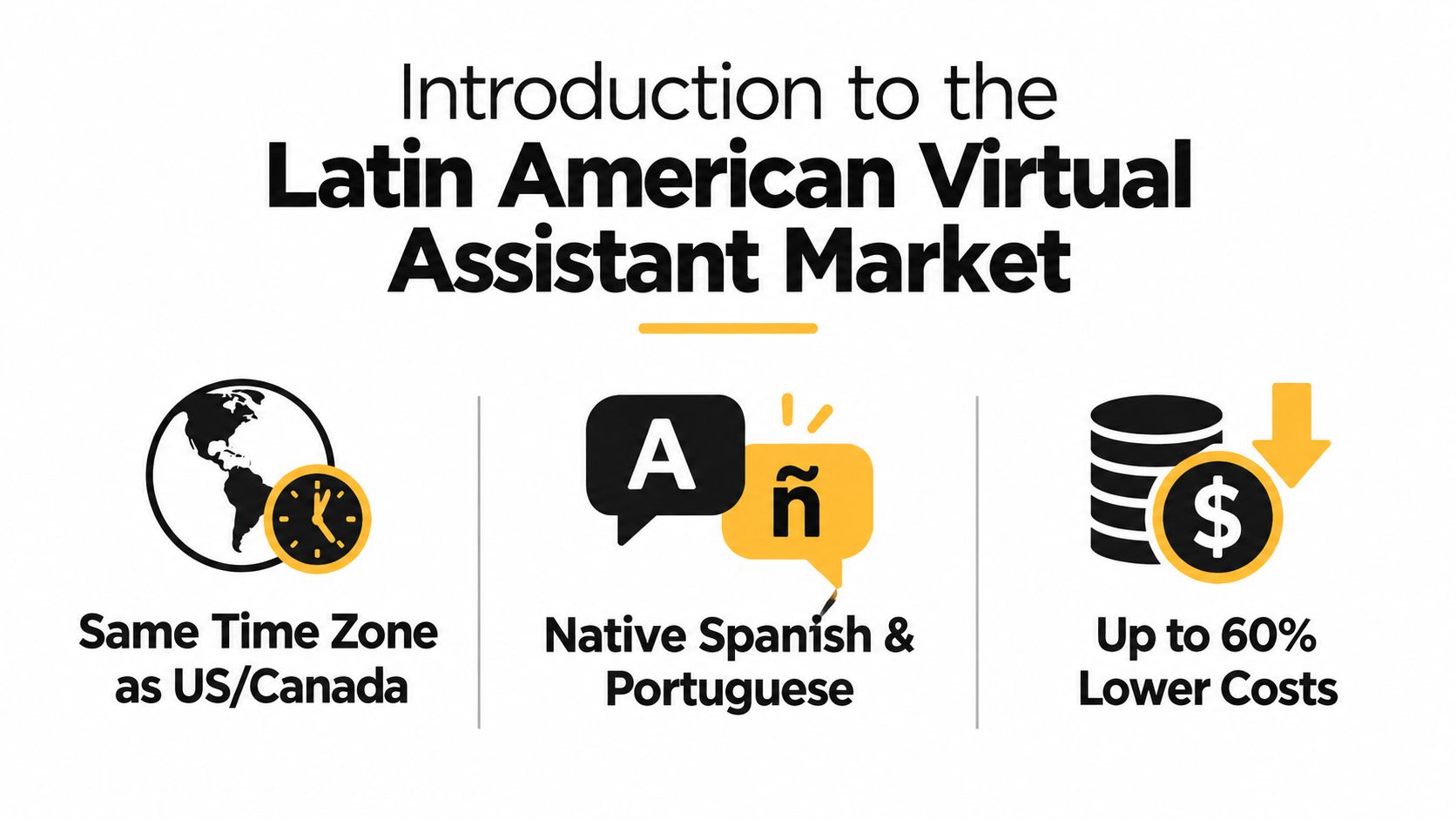
Latin America is no longer just a lower-cost hiring region. It is a practical operating base for companies that need bilingual support, real-time collaboration, and assistants who can work inside structured, AI-assisted workflows without losing judgment. According to regional virtual-assistant market estimates, the region accounted for an estimated 7.4% of global virtual-assistant revenues in 2025 and is projected to grow at a 21.6% compound annual growth rate through 2034. Brazil and Mexico stand out as major drivers, helped by fintech service automation and retail chatbot adoption.
That growth matters because the role itself has changed. A strong virtual assistant may still handle calendars and inboxes, but the more valuable hires now sit closer to operations. They update CRMs, monitor customer conversations, coordinate follow-up, prepare reports, supervise AI-generated drafts, and escalate exceptions before they become customer-facing problems.
I have seen companies hire for a narrow task and discover that the bigger gain comes from process ownership. A SaaS team may start by covering customer emails during North American business hours. Once the assistant understands the product and the edge cases, the role often expands into issue tagging, help-center updates, account checks, and feeding clean information back into the support knowledge base. That is where ROI depends on matching the hiring structure and task design to the work.
Why geography still matters
Time-zone overlap remains a major advantage. Teams in Latin America can often work during North American business hours, which helps with live support, sales coordination, approvals, and incident response. Managers feel the difference quickly. Questions get answered the same day, handoffs are cleaner, and small blockers do not sit overnight.
Language fit matters just as much. Brazil is a Portuguese-first market. Spanish-speaking countries are not interchangeable either, especially in customer service, payments, and campaign work where tone and local vocabulary affect trust. A candidate with polished English still needs role-specific testing in Spanish or Portuguese if they will handle customer conversations or review AI output for regional accuracy.
AI adds another layer. Many companies now want assistants who can work with chatbots, inbox copilots, and templated replies. That only pays off if the person is placed in the right legal and operating structure. A contractor managed like an employee can create classification risk. An assistant given raw AI output without clear escalation rules can create quality and compliance problems just as fast.
Practical rule: Choose the country and hiring model after defining the customer channel, live hours, language requirements, AI touchpoints, and data access. Starting with the cheapest market usually creates avoidable cost later.
For growing software companies, the opportunity is clear. Latin American talent can extend coverage and absorb operational work quickly, but the hire becomes strategic only when decision boundaries, access controls, and workflow ownership are set from day one.
Market Dynamics and Cost Advantages
Latin America can lower operating cost, but the genuine return shows up only when the role, legal structure, and workflow design fit together.
Published commentary places typical rates for virtual assistants at $15 to $35 per hour depending on specialization, language ability, responsibility, and engagement structure. Salary guides and hiring platforms present that range as directional rather than fixed market pricing. A general admin assistant, a bilingual support rep, an executive assistant, a bookkeeper, and someone reviewing AI-generated output are not interchangeable jobs, and they should not be priced as if they are.
That is why the useful question is operational, not cosmetic. What matters is the cost to complete a workflow accurately, on time, under the right supervision, without creating classification or data-handling problems that erase the savings.
Three cost layers buyers miss
The first cost layer is obvious. It is the rate paid to the worker or staffing provider.
The second layer is where many teams start losing money. It includes manager time, QA review, software seats, payment administration, rework, and replacement effort if the hire does not hold. A cheap engagement that consumes founder time is rarely cheap in practice.
The third layer is risk, where cross-border hiring gets mispriced. If a company treats an independent contractor like an employee, sets fixed hours, directs the work minute by minute, and folds the person into the core org chart without the right structure, the legal exposure can outweigh the labor savings. Add customer data, internal systems, and AI tools to that setup, and the margin for error gets smaller.
Use a simple operating model:
| Cost area | Questions to answer |
|---|---|
| Direct work | What tasks will the assistant complete, and what level of judgment do they require? |
| Supervision | Who reviews the work, and how often? |
| Technology | Which systems, AI tools, passwords, and customer records are involved? |
| Compliance | Who handles contracts, payroll, tax documentation, privacy obligations, and offboarding? |
| Continuity | What happens if the assistant is unavailable or the engagement ends? |
This framework changes hiring decisions quickly. A lower-cost hire may still be the wrong choice if the role requires exception handling, customer judgment, or careful review of AI output before anything reaches a client.
Where the savings become meaningful
Savings are strongest when the work is defined at the task level. Companies get better value when they separate routine execution from judgment-heavy work, then assign each part to the right person. In practice, that often means letting a Latin American assistant handle inbox triage, CRM updates, scheduling, research prep, and first-pass drafting, while a manager retains approval rights for edge cases, policy decisions, or sensitive customer conversations.
The regional advantage is also practical. Time-zone overlap reduces waiting, shortens approval cycles, and makes live support easier to run without duplicate staffing. That matters for work that breaks when it sits overnight, including escalations, sales qualification, payment follow-up, account verification, and executive calendar management.
As noted earlier, businesses across the region also operate in mobile-first service environments. That affects tool choice and workflow design. A hire who is effective in WhatsApp-based support, voice notes, shared inboxes, and lightweight CRM processes may create more value than someone with a polished resume built around desktop-only office support.
What works and what doesn't
Works well: documented, repeatable tasks with clear escalation rules, bilingual support, CRM hygiene, research with source verification, customer-service triage, meeting coordination, and AI-assisted drafting with human review.
Works poorly: vague “help with anything” roles, high-risk financial decisions without supervision, unrestricted access to every company system, and payment models that reward visible activity instead of completed, accurate work.
The strongest operators track cost per completed task, review time, error frequency, customer impact, and data exposure alongside hourly spend. That is the point many hiring guides miss. Lower wages create potential savings. Clear worker classification and disciplined AI workflow design determine whether those savings survive contact with actual business operations.
Navigating Platforms and Hiring Channels
The hiring channel determines how much screening, administration, and risk your company must carry. No option is automatically superior. The right choice depends on whether you have local legal support, a capable hiring manager, and enough process maturity to supervise the relationship directly.
Global freelance marketplaces
Marketplaces offer breadth and speed. You can publish a role, compare profiles, review ratings, and begin conversations without building a regional recruiting function. They're useful for bounded projects, short trials, and clearly defined administrative work.
The trade-off is uneven quality. Profile descriptions may not reveal spoken-language ability, judgment, data-handling habits, or the person's actual availability. The platform may protect payments, but it usually doesn't solve worker classification, local payroll, privacy agreements, or long-term performance management.
A marketplace works best when the buyer can define a paid test, verify references, restrict access, and handle the legal relationship responsibly.
Specialized regional staffing
A regional staffing provider can reduce the administrative burden by sourcing candidates, testing skills, managing contracts, coordinating payroll, and supporting replacement or offboarding. This route usually costs more than finding someone independently, but the comparison should include the internal time and legal coordination the provider replaces.
Ask how the provider evaluates language, role-specific skill, identity, availability, and data security. “Pre-vetted” isn't enough. You need to know what was tested and whether the test resembles your actual work.
Direct networking
Referrals, professional communities, and personal introductions can produce strong matches because trust develops before the formal interview. Direct networking is particularly useful for specialists who work with sensitive customer data or complex workflows.
The limitation is time. You still need a structured assessment, written agreement, payment process, privacy controls, and a defensible classification decision. A referral doesn't transfer those obligations.
| Channel | Strongest use | Main weakness |
|---|---|---|
| Marketplace | Defined projects and fast sourcing | Variable quality and limited compliance support |
| Regional staffing | Ongoing roles with cross-border administration | Service fees and less direct control |
| Direct networking | Trusted, specialized relationships | Slow, manual, and operationally demanding |
For technical roles, the same sourcing principle applies. A guide to hiring software engineers is useful because it reinforces the need to test actual work rather than rely on polished profiles. The role may be administrative, operational, or technical, but the evaluation should mirror the decisions the person will make.
A hiring channel is not a compliance strategy. It only changes who performs the work of finding, checking, contracting, and supporting the person.
Before choosing, document who owns the following: worker classification, invoicing, tax records, confidentiality, data-processing terms, access provisioning, performance management, and termination. If nobody owns a responsibility, assume it will become a problem later.
How LatHire Can Help
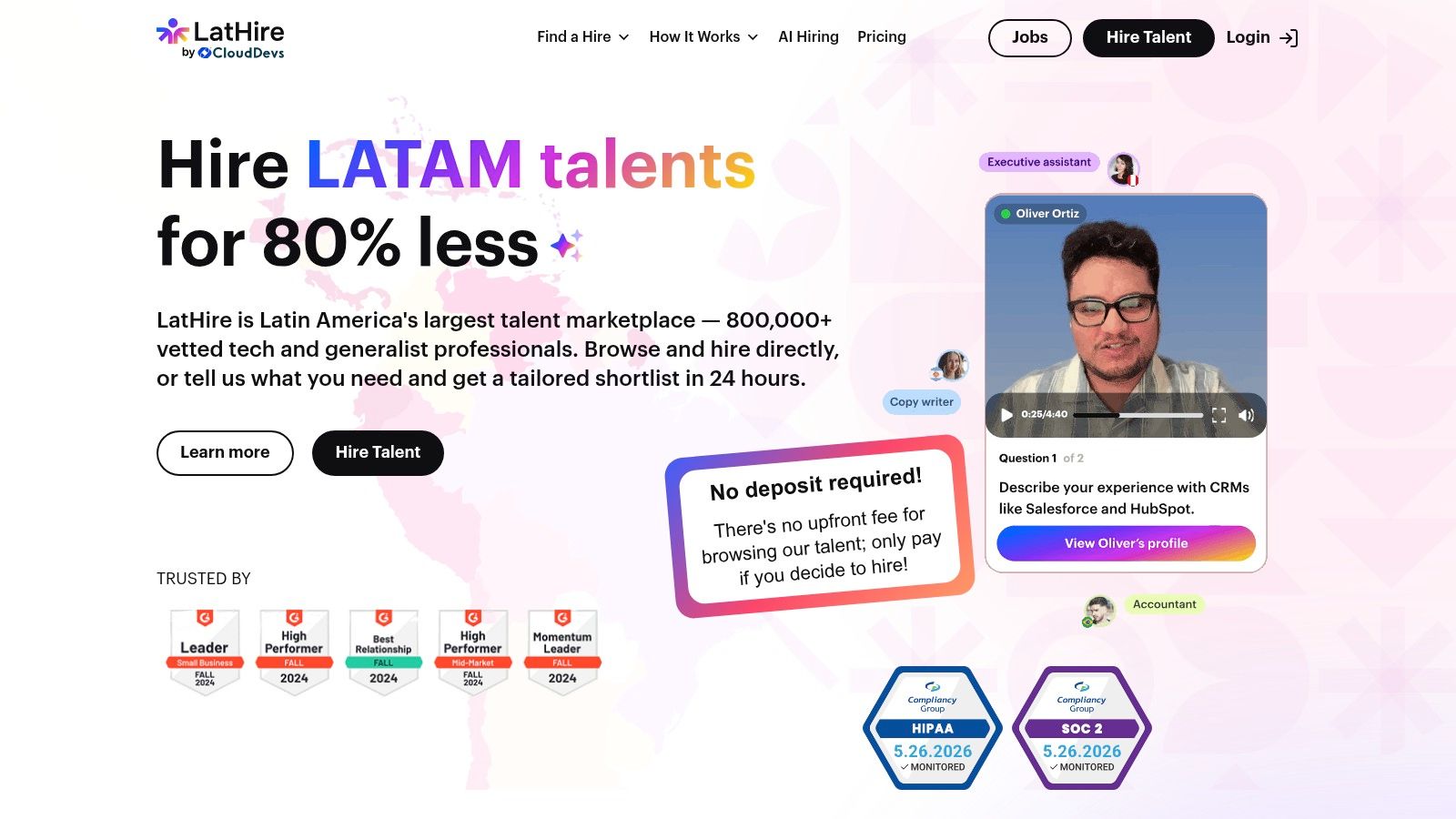
LatHire is an AI-powered hiring platform connecting U.S. and Canadian companies with pre-vetted Latin American professionals across technology, marketing, sales, and operations. Its model combines AI assessments, skills evaluations, and human-led background checks, then supports matching, HR administration, international payroll, benefits, and legal compliance.
That combination addresses the two problems buyers often underestimate: finding someone capable and structuring the engagement properly. LatHire says its talent pool includes more than 800,000 candidates, with matching available as quickly as 24 hours, but buyers should still validate the specific role, assessment method, and engagement terms before committing.
When the model fits
LatHire is most useful when a company wants regional talent but doesn't have local payroll, HR, or compliance infrastructure. It can also suit teams that need several roles, such as customer support, recruiting, administrative assistance, AI engineering, DevOps, or UX and UI design, rather than a single informal contractor.
The platform's profiles are designed to include validated skills, time-zone availability, and flexible engagement options. Its stated support includes international payroll, benefits, and compliance administration. The practical question is whether those services match your country, role, data environment, and preferred classification.
Companies comparing managed hiring options can review LatHire's approach to hire Latin American virtual assistants, then ask for written details on contract ownership, privacy responsibilities, intellectual-property assignment, termination handling, and replacement support.
Don't treat a managed platform as a substitute for internal controls. You still need a role scorecard, least-privilege access, documented approval limits, AI usage rules, and a manager responsible for outcomes.
Legal and Tax Considerations for Cross-Border Hiring
Cross-border hiring becomes risky when the company treats a label as a legal conclusion. Calling someone an “independent contractor” doesn't automatically make them one. If the business controls hours, tasks, supervision, exclusivity, and working methods in a way that resembles employment, the relationship may face challenge under local rules.
The classification decision should follow the actual working arrangement. An employee relationship generally involves stronger organizational control and corresponding payroll, benefits, leave, and termination obligations. A genuine contractor typically provides services with more independence, invoices for work, and controls how the service is delivered. The details vary by jurisdiction, so local legal advice remains necessary.
A practical classification test
Before hiring, write down:
- Control: Who sets working hours, procedures, priorities, and approval requirements?
- Integration: Is the person performing a core ongoing function inside the team?
- Independence: Can they serve other clients, choose their methods, and organize delivery?
- Payment: Is compensation tied to time, deliverables, milestones, or an ongoing salary-like cycle?
- Continuity: Is the engagement project-based, or does it have no defined endpoint?
- Equipment and access: Who supplies the tools, accounts, systems, and workspace?
No single answer decides classification. The pattern matters. A contractor label combined with fixed daily hours, exclusive service, direct supervision, internal titles, and indefinite continuity creates a materially different risk profile from a specialist hired for a defined deliverable.
Brazil's LGPD, Mexico's federal private-sector data-protection framework, and Argentina's privacy framework don't impose identical rules for consent, retention, or cross-border data handling. Mexico enacted a new federal private-sector data-protection law on March 20, 2025, requiring more detailed privacy notices, processing transparency, and procedures for ARCO rights, meaning access, rectification, cancellation, and opposition. The Latin America compliance guide from Howdy provides useful context, but it shouldn't replace country-specific counsel.

Privacy and AI are now connected
A virtual assistant may access customer records, inboxes, payment information, support tickets, and CRM data. If that assistant pastes information into an AI tool without approval, the company may lose control of where the data goes and how it is retained.
Use a written data-processing agreement where appropriate. Limit access by role, prohibit unapproved AI tools, define retention and deletion procedures, and record who can export customer data. Include confidentiality and intellectual-property terms that address prompts, templates, generated content, and workflow documentation.
Contract review itself can benefit from automation. A guide to AI contract review can help teams identify clauses that deserve attention, but no automated review should be treated as final legal advice.
A staffing partner, employer-of-record arrangement, or contractor-of-record service can reduce payroll and classification administration. It doesn't eliminate the buyer's responsibility for secure systems, lawful instructions, access management, or proper supervision.
The Impact of AI on Virtual Assistant Roles
AI is changing the value of assistant work, but the strongest outcome isn't necessarily replacement. Routine drafting, summarization, translation, categorization, and research can become faster. Judgment, local language nuance, exception handling, customer empathy, and quality control become more important.
Latin America's freelance-marketplace segment is estimated to expand at 7.5% annually, while newer AI-enabled marketplace models allow creators to train personal AI systems on their own work and sell AI-generated output, as described in marketplace research from Dataintelo. That trend changes the hiring question. Buyers need to decide which work belongs to a person, which work can be AI-assisted, and which work can be automated safely.
A task-level design method
Start with the workflow, not the tool.
- List the recurring tasks. Separate inbox triage, CRM updates, customer replies, research, reporting, translation, scheduling, and escalation handling.
- Mark the risk level. Identify tasks involving money, identity, regulated information, emotionally sensitive customers, or irreversible actions.
- Choose the operating mode. Use human-only handling for high-risk judgment, AI assistance for drafting and classification, and automation for low-risk repetitive actions.
- Define the review point. Every AI-assisted task needs a named reviewer or a clear confidence threshold for escalation.
- Measure the completed outcome. Track accuracy, exception handling, review time, resolution quality, and data exposure rather than raw activity.
An assistant might use an approved AI tool to draft a response from a verified knowledge base. The assistant still checks whether the answer fits the customer's country, language, account status, and emotional context. The system accelerates composition, but the human owns the decision.
Language quality needs real testing
Voice quality is especially important in the region. A Zendesk survey reported that 67% of Latino consumers considered voice easier than text for most customer-service tasks, while 64% were willing to delegate service tasks to AI personal assistants. The same source reported that 93% of agents emphasized human-supervised quality assurance. These findings are summarized in Athyna's discussion of Spanish and Portuguese expertise.
A benchmark of 1,000 real Brazilian Portuguese conversations scored 16 models between 43.3 and 88.6 out of 100, despite every model responding in Brazilian Portuguese. Language identification alone isn't quality assurance. Test regional vocabulary, intent classification, politeness, code-switching, speech recognition, grounded answers, and escalation behavior.
Use separate Brazilian Portuguese and Latin American Spanish test sets. For regulated or emotionally sensitive requests, require confidence-based handoff to a human.
Teams building an internal knowledge base in artificial intelligence should give the assistant approved source material, update ownership, and clear rules for what the AI may and may not answer.
Vetting and Onboarding Your Latin American Assistant
A strong hire starts with a role that can be tested. “Virtual assistant needed” is too vague for a marketplace, agency, or referral network to evaluate properly. Specify the recurring tasks, tools, live hours, languages, access level, decision rights, and escalation triggers.
The candidate should know what success looks like before the interview. The manager should know what evidence to collect.
Write the scorecard first
Use a short scorecard with categories such as:
- Communication: Can the person write concise updates and explain a problem clearly?
- Operational judgment: Can they prioritize competing requests without constant instruction?
- Tool fluency: Can they work confidently in the systems the role uses?
- Language performance: Can they handle written and spoken customer communication in the required language?
- Reliability: Can they maintain the agreed schedule and communicate blockers early?
- Security behavior: Do they understand least privilege, confidential data, and approved tools?
- AI judgment: Can they verify generated output instead of accepting fluent text as correct?
Build the assessment from real work. Give an administrative candidate an inbox and calendar conflict. Give a support candidate a policy question, an upset customer, and a request that requires escalation. Give a CRM candidate duplicate records and incomplete fields to resolve.
Don't use a generic personality test as the main filter. It may provide context, but it won't show whether the person can protect customer information, manage ambiguity, or follow an escalation rule.
Structure the interview around decisions
Ask the candidate to explain how they would handle a task, then introduce a change. For example, a customer requests an exception, the account record is incomplete, and the manager is unavailable. A good answer explains what the assistant can do independently, what they would verify, and when they would escalate.
Test writing and speech separately. A polished email doesn't prove the candidate can manage a live call, and conversational fluency doesn't prove they can document a CRM record accurately. If the role is bilingual, test both languages against realistic situations rather than asking whether the candidate considers themselves fluent.
Legal onboarding should happen before production access:
- Confirm the worker's identity and payment details.
- Finalize the contract or managed engagement structure.
- Document classification reasoning and local responsibilities.
- Sign confidentiality, intellectual-property, and data-processing terms where appropriate.
- Create role-based accounts with minimum necessary access.
- Define approved AI tools and prohibited data handling.
- Establish the live schedule, response expectations, and escalation path.
- Run a supervised workflow before granting broader permissions.
Make the first month operational
The first week should focus on context, tools, documentation, and boundaries. The assistant should observe how the team handles customer issues, calendar conflicts, approvals, and exceptions.
The next stage should move into controlled execution. Assign a small number of workflows, review completed work, and update the standard operating procedure when the same question appears repeatedly. Avoid measuring performance through online presence alone.
By the time the assistant owns a workflow, the manager should be able to answer:
- What starts the task?
- What does a correct output look like?
- Which decisions are allowed without approval?
- Which events require escalation?
- How is quality checked?
- What customer or company data is involved?
- What happens when an AI tool produces an uncertain answer?
Track completion accuracy, response quality, exception handling, review time, and handoff reliability. Those measures reveal whether the assistant is delivering value. Hours worked are only a useful proxy when the work itself is simple and tightly defined.
The best Latin American virtual assistant engagements combine fair commercial terms, lawful classification, strong language testing, careful access control, and task-level AI design. If you're evaluating providers, tools, or operating models, use The SaaS Hub to compare software and business technology options, then define your role scorecard and compliance requirements before you contact candidates.