
How to Hire Software Engineers in 2026
Learn how to hire software engineers in 2026 with a step-by-step playbook covering sourcing, interviews, offers, onboarding, and retention metrics.
By Yuvraj Kewate · 2026-09-17
You're probably hiring under pressure right now, with a role that looks important, a team that's already stretched, and a funnel that isn't moving the way it should. The hard part usually isn't finding resumes, it's getting the right engineers to respond, show up, and accept without burning weeks on interviews that never converged. In 2026, how to hire software engineers is less about posting a job and more about designing a conversion system that fits a market where senior talent is scarce, geography matters, and AI fluency has become its own signal.
Table of Contents
- What the 2026 Engineering Hiring Market Demands From You
- Sourcing Engineers Where They Actually Respond
- Running an Interview Loop That Produces Real Signal
- How TekRecruiter Can Help
- Building Offers Engineers Accept and Negotiation That Closes
- Onboarding and the First 90 Days as a Retention Engine
- Hiring Metrics That Tell You If the Engine Is Working
- Honest Answers to the Questions Hiring Teams Get Wrong
What the 2026 Engineering Hiring Market Demands From You
A 40-engineer org loses two staff engineers, posts a blended requisition, and then watches the search stall for months. That's a common failure mode because the role was described as if it were five jobs in one, and every candidate who mattered could tell.
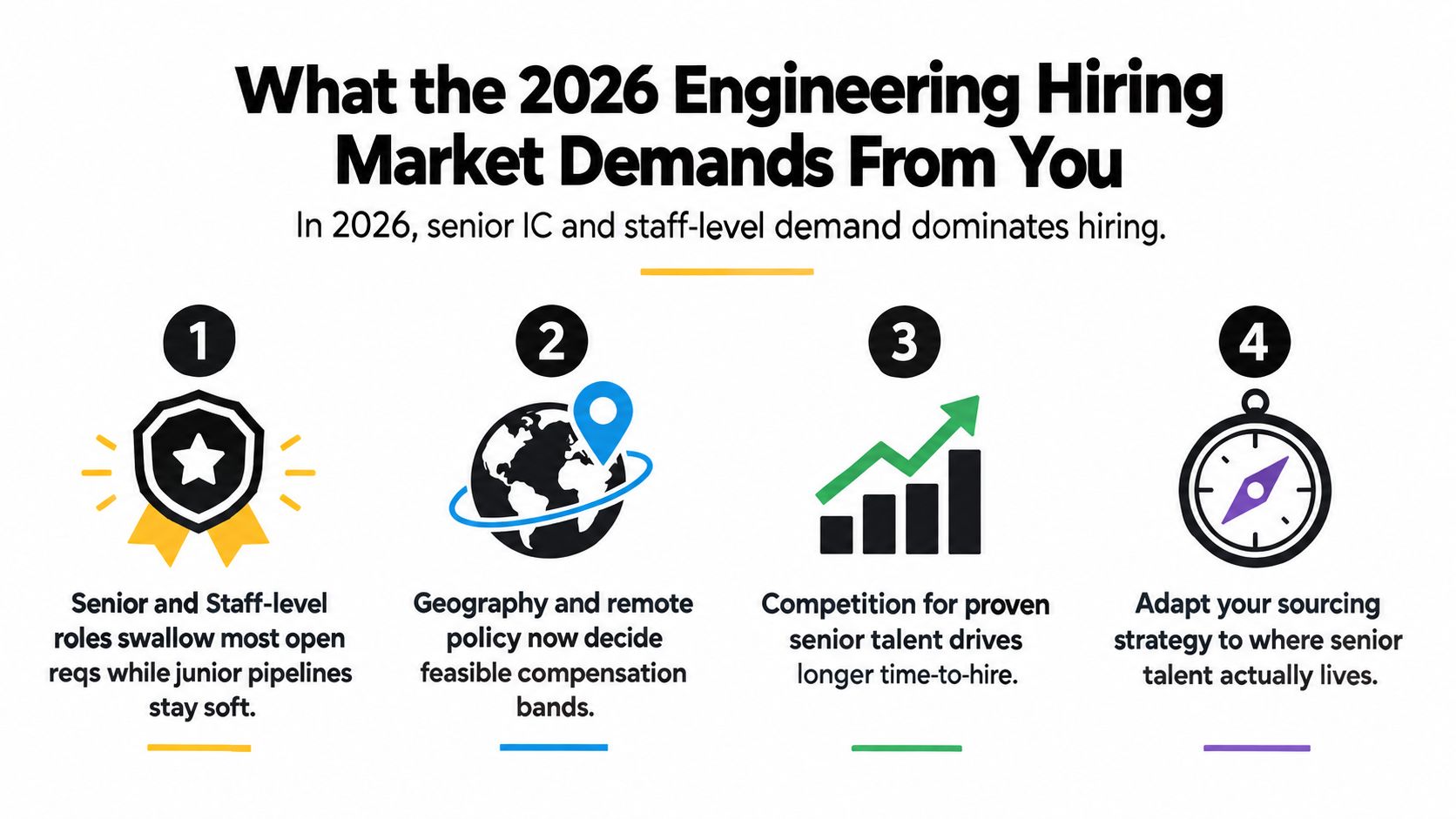
The market now rewards clarity more than volume. In 2026, software-engineering demand stayed strong, with one hiring analytics source reporting more than 67,000 open software engineering roles across 9,000 companies, about a 30% year-to-date increase, and the highest level in three years, while listings had roughly doubled since the mid-2023 trough (Recruits Lab report). At the same time, large-tech hiring data showed new-grad and entry-level hiring fell about 65% at the 12 Tech Majors compared with 2019, while early-stage startups reduced new-grad hiring by roughly 76% (Startup Fortune analysis). That mix means the market is no longer forgiving vague requirements or slow calibration.
Start by separating impact from implementation
The first job is to define the business outcome, not the stack. “Build the payments service” is not a hiring spec, and neither is “find a senior full-stack engineer.” The better version names the problem, the expected outcomes over the first 6 to 12 months, the stakeholders, and the operating constraints.
Practical rule: if two hiring managers can argue about the title, the seniority, or the must-have stack, the role isn't ready to source.
Then freeze the decision points. Decide what is required, what's merely preferred, and which trade-offs you'll accept. A good scorecard should make it obvious whether you want a senior IC, staff engineer, platform specialist, or a generalist who can flex across domains.
Lock comp philosophy before you source
Compensation is part of role design, not an afterthought. If your remote policy, hiring geography, and level assumptions aren't locked, the team will improvise a band after candidates have already seen the posting. That's how you create comp drift and internal disagreement.
Geography is now part of the strategy because vacancy patterns are uneven across markets. Recent 2026 coverage says vacancies are up in the U.S. and U.K. but flat or declining in Canada, Germany, and France, while top-paying tech companies show about 20% more open SWE roles year over year (Useronda market overview). In other words, the same job can play very differently depending on where you source, where you'll allow the person to work, and what you can pay without distorting your internal structure.
The role-definition artifacts should exist before outreach starts:
- Charter that states the business problem and expected impact.
- Scorecard that defines the competencies, scope, and evidence you'll accept.
- Comp range that matches the level and location strategy.
- Decision rubric that spells out what an accept, hold, or no-hire means.
Skip this step, and the rest of the funnel gets noisy fast. You'll spend more time debating fit, and less time hiring.
Sourcing Engineers Where They Actually Respond
Treat sourcing like a conversion problem, because that's what it is. A lead source isn't useful if it fills the top of the funnel but doesn't produce interviews, and a channel that produces lots of clicks but no replies is just expensive background noise.
A common mistake is using one sourcing motion for every role. A staff backend engineer, a junior frontend hire, and an AI infrastructure specialist do not respond to the same channels, the same message, or the same pitch. The source matters less than the match between segment and channel.
Match the channel to the segment
Senior engineers usually respond to targeted outreach that proves you've done the homework. That often means GitHub commit history, open-source activity, speaker lists from conferences like KubeCon, LambdaConf, and Strange Loop, or warm intros from former coworkers. Niche Slack and Discord communities also work when the role is precise and the outreach sounds like a peer wrote it.
Junior talent behaves differently. Universities, apprenticeship pipelines, and OSS contribution paths like GitHub Issues triage can produce better engagement when the role is entry-level. Broad outbound from a generic recruiter account usually underperforms here too, but the failure mode is different. Juniors need access and clarity, while seniors need relevance and speed.
| Channel | Senior US/EU | Junior US/EU | Senior LatAm/APAC |
|---|---|---|---|
| Targeted outbound to GitHub and open-source contributors | Higher | Lower | Higher |
| Conference attendee lists and speaker rosters | Higher | Lower | Higher |
| Niche Slack and Discord communities | Higher | Mixed | Higher |
| University partnerships and apprenticeship programs | Lower | Higher | Lower |
| Ex-employee warm intros | Higher | Lower | Higher |
| Selective agency support for hard-to-fill staff roles | Higher | Lower | Higher |
Layer geography onto the sourcing plan
Geography changes response patterns, expectations, and comp math. Remote-first messaging can widen the pool, but it doesn't automatically improve conversion. Some candidates want a hub, some want a true distributed setup, and some will only move if the package reflects the market they live in.
That's why regional strategy should be explicit. If you're hiring for U.S. and U.K. senior roles, the funnel will look different from one aimed at Canada, Germany, France, LatAm, or APAC. Comp expectations can shift materially across those regions, so the most useful question is not “Where can we post this?” It's “Which candidate segment are we competing for, and where do they respond?”
A disciplined weekly cadence helps:
- Refresh the shortlist from each active channel.
- Review reply quality, not just reply count.
- Kill channels under 2% reply if the role is senior and the outreach has already been tuned.
- Double down on the segment-specific source that produces actual screens, not just opens.
For teams that need a different kind of parallel hiring motion, this remote marketing jobs guide is a useful example of how geography and work model shape candidate behavior in adjacent talent markets.
The point isn't to chase every source. It's to build a channel mix that matches the role you've defined, the geography you can support, and the seniority you need.
Running an Interview Loop That Produces Real Signal
A good interview loop doesn't feel elegant, it feels disciplined. Every stage should test a different risk, and every interviewer should know exactly what evidence counts, what doesn't, and what would block a hire.
The biggest leak in engineering hiring is confusing conversation volume with signal quality. Data on software-engineer hiring funnels suggests teams should expect roughly 21 candidates per hire, with only about 3% of applicants reaching interview and around 27% of interviewed candidates receiving an offer (Rockstar Developer University). Another benchmark shows technical roles get about 3.6% of applications to interview, about 7.3% of interviewed candidates receive offers, and roughly 82% of offers are accepted (Candidate.fyi benchmark data). That means the loop has to protect interviewer time while still being fair to candidates.
Build the loop around evidence, not vibes
A useful pattern is:
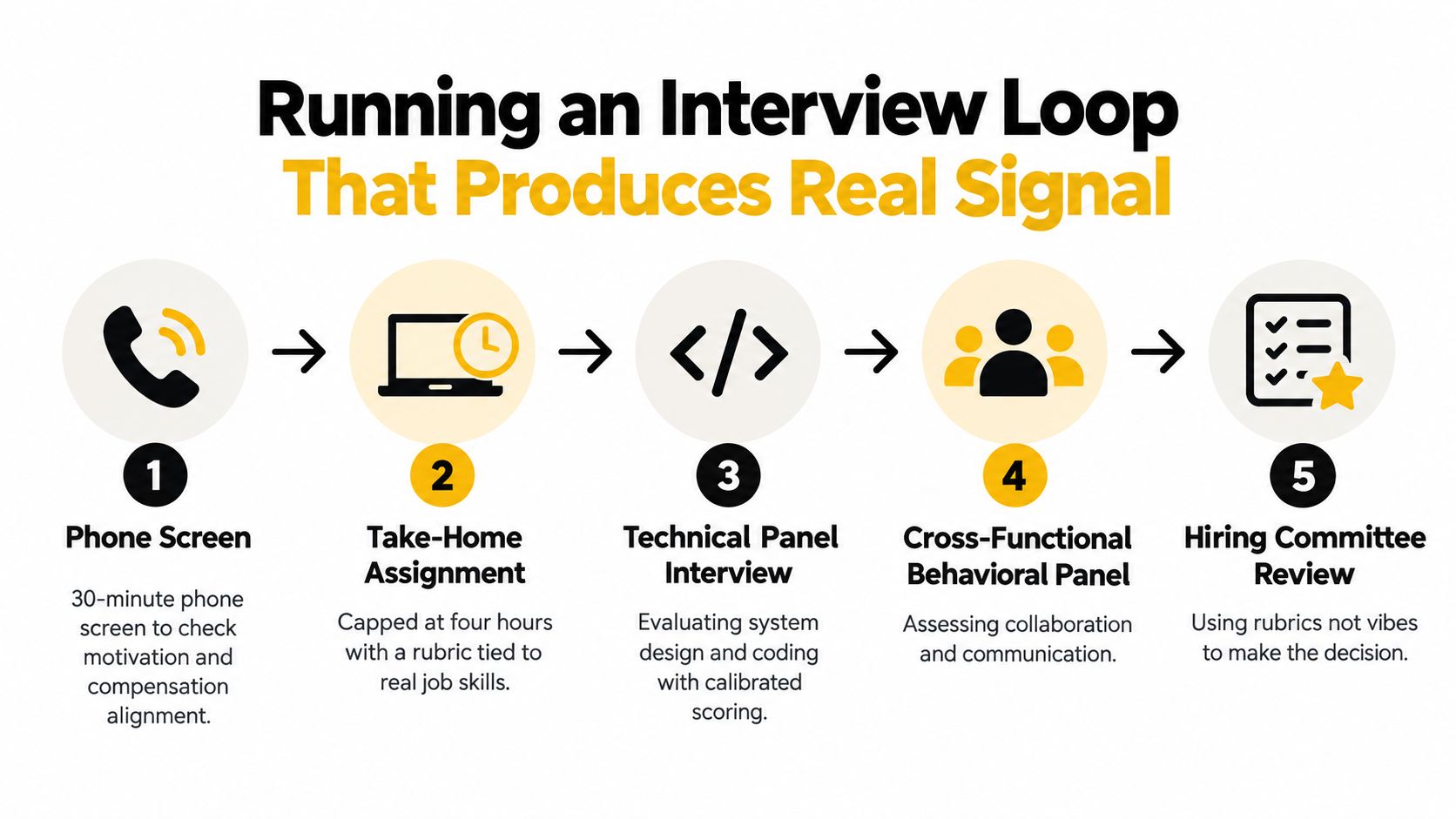
- 30-minute phone screen for motivation, role fit, and comp alignment.
- Take-home capped at four hours with a production-readiness rubric.
- Paired coding or system design on a real system the team owns.
- Debugging and code review to surface trade-offs and judgment.
- Cross-functional panel to test collaboration and async communication.
- Bar-raiser or final veto step that can stop a weak hire from sliding through.
The take-home should be short enough that serious candidates don't resent it. If a project drifts beyond four hours, you usually learn more about persistence than engineering skill. The same is true for endless multi-round loops. Once the process stretches too far, drop-off rises and interviewer memory gets worse.
Candidates don't fail because they're weak on every dimension. They fail because the loop doesn't isolate the risk you're trying to test.
Score with anchored rubrics
Use a 1-4 scale with definitions written in advance. A “1” means the candidate can't demonstrate the competency, a “2” means partial but risky evidence, a “3” means clear working competence, and a “4” means strong, repeatable, low-risk evidence. The rule should be simple, any 2-or-below blocks hire.
Include an AI fluency axis, but keep it separate from raw coding skill. You want to know whether the candidate can use copilots productively, review AI-generated diffs critically, and keep ownership of the codebase. You also want to know whether they can reason when the tool is wrong, because tool use is not the same thing as engineering judgment.
A calibration meeting should happen before debrief discussion. Each interviewer writes evidence first, then shares it. That reduces groupthink and keeps the conversation on observable behavior rather than charisma or pedigree.
Use these debrief questions:
- What evidence did we collect that maps to the scorecard?
- Where did the candidate show judgment under ambiguity?
- What risk would remain if we hired this person?
- Which concerns are factual, and which are just preferences?
Anti-bias guardrails matter here too. Keep interviews structured, ask the same core questions across candidates, and don't let a strong phone screen shortcut the technical round. The loop should move quickly, ideally to an offer call within six business days from screen to final decision, so serious candidates don't drift into other processes.
How TekRecruiter Can Help
When a search is unusually hard, the problem often isn't just sourcing volume. It's matching technical depth, speed, and candidate experience without wasting cycles on unqualified leads. That's where a specialized partner can help, especially for roles that demand senior judgment, niche systems experience, or a faster path to a credible shortlist.
TekRecruiter is a software-focused technology staffing and recruiting firm built around engineer-to-engineer conversations. The firm is headquartered in Miami, has deep relationships in New York, and says it was founded on engineering excellence and expertise. Its core pitch is simple, engineers recruit engineers, which matters because serious candidates usually respond better to a technical conversation than to a script-heavy screening process. You can review the firm directly on TekRecruiter's website.
Where that model fits best
For this topic, TekRecruiter makes the most sense when the hiring team needs a partner who can reduce waste in the early funnel and reach more specialized candidates without turning the process into a quiz. The firm covers software engineering, AI engineering, DevOps, SRE and platform engineering, cloud and systems engineering, data and analytics engineering, Salesforce engineering, ERP engineering, and cybersecurity engineering. That breadth helps when the job isn't a generic full-stack req and the internal team needs a recruiter who understands technical nuance.
It also offers multiple delivery models. Direct hire fits permanent team growth, staff augmentation fits short-term capacity gaps, on-demand gives access to a bench of 30,000+ pre-vetted engineers, and managed services suits teams that want an outsourced engineering group with delivery oversight. Those options are useful when the hiring question is broader than “who can fill a seat,” and instead becomes “which labor model fits the product and budget right now?”
For a closer look at its positioning in a single metro, the article on best software engineering staffing firm in Miami is a useful companion read.
The main reason to consider a firm like this is fit, not volume. If you need engineer-to-engineer screening, faster access to niche talent, or help deciding between direct hire and flexible capacity, a specialized recruiter can shorten the path from req to credible conversation.
Building Offers Engineers Accept and Negotiation That Closes
The offer stage exposes whether the earlier work was real. If comp was never aligned, leveling was fuzzy, or the candidate didn't believe the scope, the close will turn into a salvage operation.
A strong offer isn't just a number. It's a package that matches the role, the geography, and the company's stage. For senior engineers, the package often needs to answer a different question than it does for early-career candidates, because the candidate is evaluating risk, negotiating power, and upside all at once.
Choose the structure that fits the role
There are four realistic offer shapes in 2026. Base plus bonus is the cleanest when you want salary certainty and variable pay tied to measurable company or team goals. Base plus RSU works better for later-stage companies that want to tie the candidate to long-term value creation. Early-stage equity matters when the company can't win on cash alone and the candidate is willing to trade certainty for upside. Base plus sign-on is often the best answer when there's a geographic mismatch, a quick-close need, or a senior candidate taking a leap for a specific mandate.
Offer letters should be explicit, not implied. Include base, target bonus, equity grant size, vesting schedule, sign-on, relocation, level, title, manager, reporting line, start date, and at-will language. Candidates notice ambiguity here, and ambiguity usually feels like a negotiation tactic rather than clarity.
| Component | Base + Bonus | Base + RSU | Early-Stage Equity | Base + Sign-On |
|---|---|---|---|---|
| Cash certainty | High | High | Medium | High |
| Long-term upside | Low | Medium | High | Low |
| Best for | Stable senior hires | Later-stage retention | Founding or early growth roles | Fast close or location gaps |
| Negotiation leverage | Performance goals | Long-term alignment | Upside narrative | Immediate cash relief |
Negotiate without breaking trust
Anchor with the full package, not just salary. If the base is fixed, say so directly and move the conversation to the variable parts you can adjust. In practice, vacation, start date, title, and sign-on are often safer levers than base pay, especially when the market is tight and the candidate has options.
Avoid asking for competing offers you can't validate. That creates friction and turns a business conversation into a trust test. It also tends to punish the strongest candidates, because the people with real negotiating power don't always want to share the details of every other process they're running.
Practical rule: speed closes good candidates more reliably than clever negotiation does.
That means a verbal offer should go out within 48 hours, a written offer within 24 hours of the verbal, and the candidate should get a clear 7-day decision window with an expiry. If you wait longer, you're usually paying for indecision with lost momentum.
For teams that need legal or contract review discipline before the offer goes out, this AI contract review guide is a helpful adjacent reference. The underlying lesson is the same, remove ambiguity before the candidate starts comparing your process to the others in their pipeline.
Onboarding and the First 90 Days as a Retention Engine
The first 90 days are not paperwork. They're the period when a new engineer decides whether the company is organized, whether the manager is available, and whether the role matches the story they were sold.
Good onboarding reduces uncertainty. It also creates the earliest data you'll ever get on whether your hiring process was honest. If a new hire struggles to get access, can't find the right owner, or never gets a real first win, the problem usually started long before day one.
Make the first month unambiguous
Day 1 to week 1 should include laptop, access, buddy assignment, and a first manager 1:1 that explains context, priorities, and the decision-making style on the team. The first task should be deliberately small, such as a doc update or a safe code change, because early confidence matters.
Weeks 2 to 4 should shift the person into a clearly scoped first project with a named reviewer. They should see the full surface area of the service or product they're touching, and they should meet product, design, data, and operations partners early enough to understand how the team works. A 30-day external course or internal learning resource can help when the role has a steep tool or domain curve, and this continuing education resources guide is a relevant example of how structured learning can support ramp.
Turn the 60 and 90 day marks into feedback loops
Weeks 5 to 8 should include a retro on the first project, peer feedback, and a written growth plan that covers scope, skills, and the next layer of responsibility. The manager should not wait for the formal review to mention gaps. At that point, the engineer needs direction, not surprises.
Weeks 9 to 12 should end with a 90-day review against a clear rubric, a scope or promotion decision where appropriate, and a retention check-in on compensation, career path, and manager fit. If the person is struggling, you need to know whether it's role fit, expectation mismatch, or a coaching issue.
A few rituals move retention more than most managers think:
- Weekly 1:1s with a written agenda so priorities don't get lost.
- Monthly skip-levels to surface issues before they harden.
- A 30-day pulse survey with a closed loop on results, so feedback doesn't disappear into a dashboard.
Those checks turn onboarding into an actual retention system. They also tell you whether the hiring bar, the job description, and the manager experience are aligned.
Hiring Metrics That Tell You If the Engine Is Working
Most engineering hiring dashboards measure activity, not quality. Interview count is easy to track. So is application volume. Neither tells you whether the hiring engine is healthy.
The better view starts with the funnel, then moves to quality, then checks retention. That sequence matters because a fast funnel that produces weak hires is worse than a slower funnel with strong outcomes.
| Metric | Category | Target | Why It Matters |
|---|---|---|---|
| Applicants per requisition | Funnel | Contextual, not a target | Helps spot under-sourced roles without rewarding noise |
| Screen-to-onsite conversion | Funnel | Consistently high for qualified flows | Shows whether top-of-funnel screening is precise |
| Onsite-to-offer conversion | Funnel | Stable across interviewers | Indicates whether the loop is calibrated |
| Offer-to-accept rate | Funnel | 60% to 70% | Reveals whether comp, role, and process are competitive |
| Time-to-fill by level and source | Funnel | Track by segment | Exposes where the process slows down |
| 90-day manager rating | Quality | Positive and structured | Early signal on role fit and ramp |
| Interview score to performance correlation | Quality | Directionally positive | Tests whether interviews predict post-hire performance |
| 6-month and 12-month attrition by cohort | Retention | Low and stable | Shows whether early expectations matched reality |
| Regrettable first-year attrition | Retention | Under 15% | Signals whether the bar and onboarding are working |
| Internal mobility after 18 months | Retention | Track upward movement | Shows whether hires are growing inside the org |
The most useful operating rhythm is a weekly hiring review and a quarterly retrospective. Weekly meetings should look at source quality, stage conversion, and blocker removal. Quarterly reviews should ask whether the scorecard, comp band, and interview rubric still match the market.
If the funnel looks busy but the hires don't stick, the problem is usually upstream, not in onboarding.
A contrarian but important question belongs here too. In the AI-assisted hiring era, a candidate who uses copilots well isn't automatically strong. What matters is whether they can explain trade-offs, catch bad generated code, and keep ownership when the tool gets clever in the wrong direction. That's why AI fluency should live alongside, not instead of, fundamentals like debugging, architecture, communication, and judgment.
Honest Answers to the Questions Hiring Teams Get Wrong
The same mistakes keep showing up in engineering hiring because they feel efficient at first. They're not. They just move the pain downstream into candidate drop-off, weak offers, or poor first-year retention.
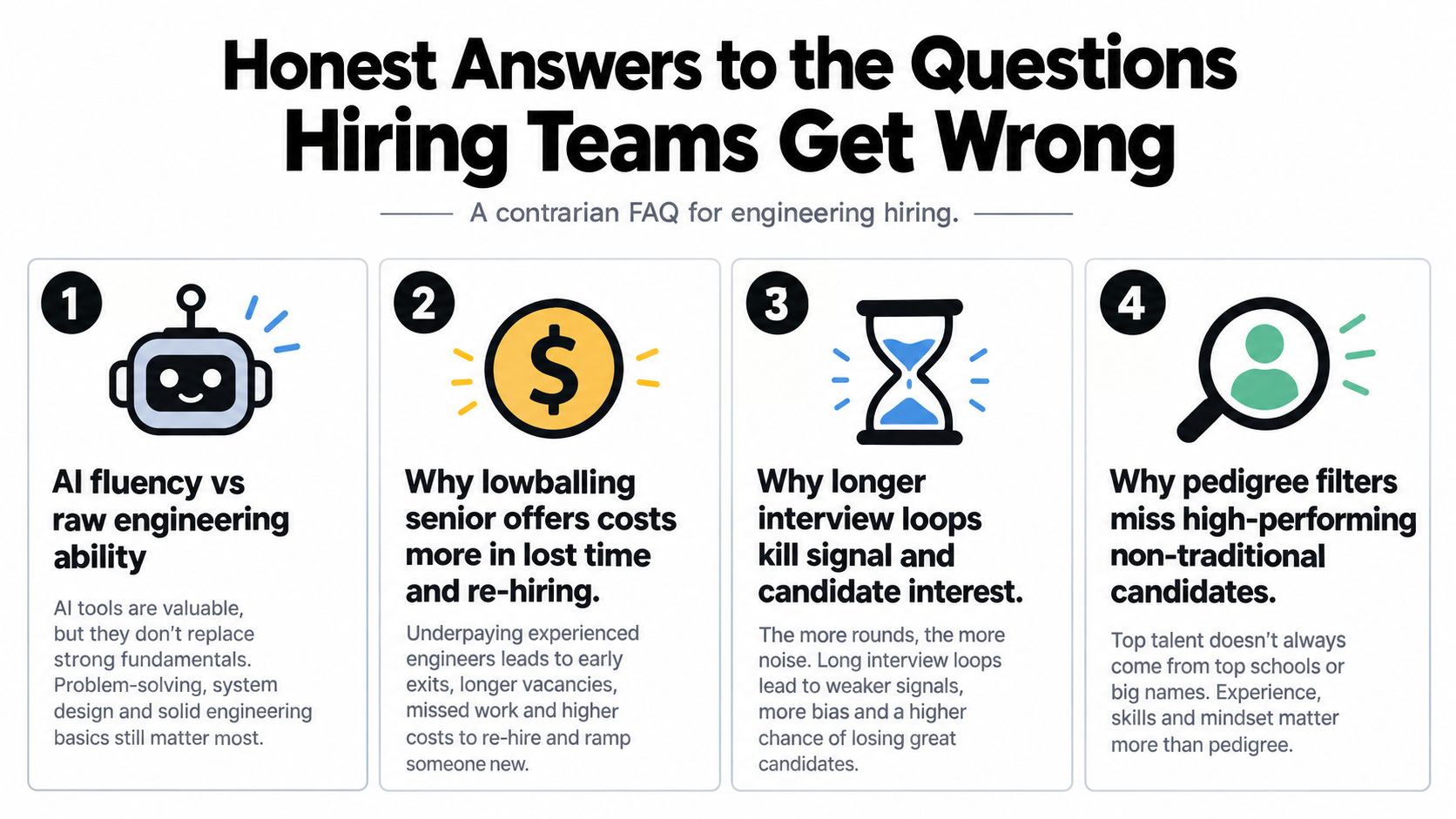
The first misconception is that AI fluency can replace engineering depth. It can't. A developer who can prompt an LLM quickly is useful, but that skill alone doesn't prove they can reason about systems, review code critically, or own production outcomes. The right way to score AI-assisted work is to ask what the candidate did, what the tool did, and where human judgment changed the result.
The second mistake is assuming geography is just an HR setting. It isn't. Fully remote-first posts can underdeliver for senior roles when the role, manager style, or compensation band doesn't match the candidate's preferred work model. A hub-and-spoke setup or a clearer regional strategy often converts better because it gives senior candidates a more believable day-to-day picture.
Generalist or specialist depends on the problem
Hire generalists when the product surface is still shifting and the team needs people who can move across boundaries. Hire specialists when the work is constrained, technically deep, or operationally risky. Most search failures happen when teams write one requisition but secretly want the other.
Take-home tests also need discipline. Anything above four hours tends to shrink the pool, especially for strong candidates who are already interviewing elsewhere. You don't want to screen for patience at the cost of signal.
Counteroffers deserve a sober read, too. They often mean the candidate is valuable, but they don't always mean they're committed. Treat the counteroffer as one data point in a broader decision, not as a reason to rewrite the role or the comp philosophy on the fly.
The best teams update their playbook quarterly. They review funnel conversion, offer acceptance, first-year retention, and interview-to-performance signals, then adjust scorecards, bands, and role definitions before the market forces a correction. That's how you keep how to hire software engineers aligned with 2026 conditions instead of last year's assumptions.
If you're hiring now, use the market realities above to tighten your role definition, cut interview waste, and make your offers easier to accept. The fastest path to better engineering hires is usually a sharper scorecard, a shorter loop, and a comp strategy that fits the market you're in, so start there before you add another sourcing channel.